
Arkansas
Arkansas Recording Laws (2026): One-Party Consent Rules
Independently fact-checked against primary sources (last audited August 15, 2026). · Reviewed by the RecordingLaw editorial team. · Law checked current as of August 8, 2026. · 11 primary sources cited on this page. How we verify our legal content
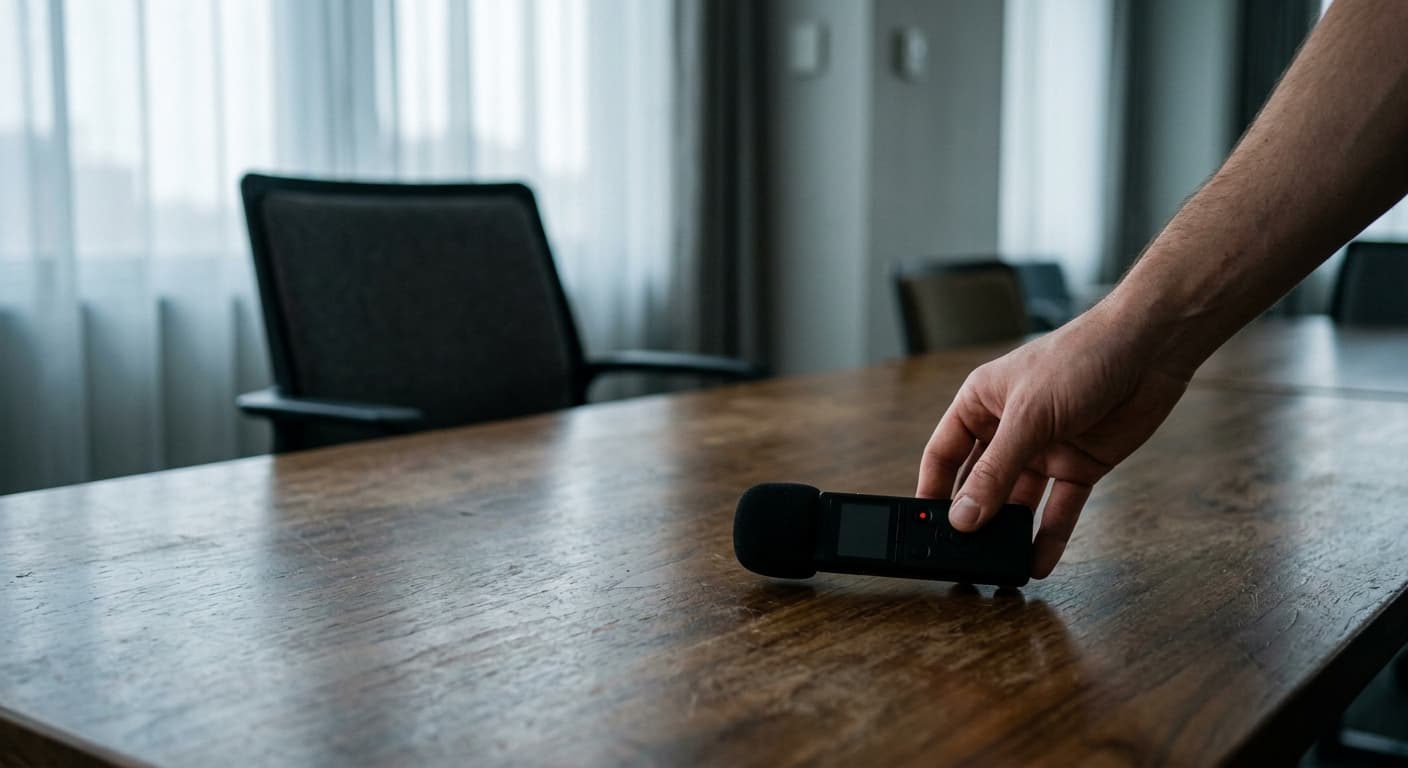
Arkansas is a one-party consent state. Under Ark. Code Ann. § 5-60-120(a), any participant in a wire, landline, oral, telephonic, or wireless communication may record it without telling the other party. Recording a conversation without being a participant and without any party's consent is a Class A misdemeanor under § 5-60-120(b), punishable by up to one year in jail and a $2,500 fine, plus potential federal civil liability.
Arkansas recording law at a glance
| Question | Answer |
|---|---|
| Consent rule | One-party consent |
| Main statute | Ark. Code Ann. § 5-60-120 |
| When recording is illegal | Non-participant records without any party's prior consent |
| Criminal penalty | Class A misdemeanor: up to 1 year jail, fine up to $2,500 |
| Civil penalty | No state statutory remedy; federal ECPA: $100/day or $10,000 min, plus punitives + attorney fees |
| Hidden cameras | Class D felony (1st/2nd offense), Class C felony (3rd+ offense, or any offense where the victim is under 14) under § 5-16-101 |
| Recording police | Permitted in principle; 8th Circuit has NOT clearly established the First Amendment right (Molina, 2023) |
For statutes, penalties, and court decisions in depth, see the Arkansas recording laws in-depth section below.
Recording in-person conversations in Arkansas
Arkansas's consent rule for face-to-face conversations runs through the "oral communication" category of Ark. Code Ann. § 5-60-120(a). An oral communication is a spoken conversation in which the speakers reasonably expect that no one outside the conversation will overhear.
If you are part of the conversation, you can record it without informing anyone else. If you are not, you need at least one participant's prior consent. Planting a hidden audio device to capture a conversation between people who did not consent is the textbook § 5-60-120 violation. An employee recording a one-on-one meeting with a manager is lawful; a neighbor planting a microphone next door is a Class A misdemeanor.
Note that § 5-60-120 is an audio statute. Silent video recording in a public space with no reasonable expectation of privacy is not governed by this section. Video recording in private spaces that captures intimate areas falls under the separate voyeurism statute at § 5-16-101, discussed below.

Recording phone calls in Arkansas
Section 5-60-120 covers landline, telephonic (including VoIP), and wireless calls. As a participant, you can record any call you are part of without disclosing it. The rule covers landline, cell, VoIP (Zoom, Teams, Google Meet, FaceTime), conference calls, and push-to-talk messages when you are the sender or recipient.
For more detail on call-specific rules, see Arkansas Phone Call Recording Laws.
Interstate calls: use the stricter state's rule
Federal ECPA at 18 U.S.C. § 2511(2)(d) is a floor, not a ceiling. When an Arkansas caller is on the line with someone in an all-party consent state, the more protective state's rule can apply from that end of the call.
States that require all-party consent for at least some recording contexts include California, Connecticut, Delaware, Florida, Illinois, Maryland, Massachusetts, Montana, Nevada, New Hampshire, Oregon, Pennsylvania, and Washington. When calling someone in those states, disclose at the start and get consent from every party. A brief "this call may be recorded" announcement avoids civil and criminal exposure in the other state.

Hidden cameras, doorbells, and nanny cams
Ark. Code Ann. § 5-16-101 (video voyeurism) prohibits secretly observing, photographing, filming, or videotaping a person in a residence, school, place of business, or other structure when (1) the person is in a private area out of public view, (2) the person has a reasonable expectation of privacy, and (3) the person has not consented. All three elements must be present.
Bathrooms, locker rooms, fitting rooms, exam rooms, and guest bedrooms are the clearest cases. A common open workspace, a public lobby, or a store's retail floor typically does not satisfy the "private area out of public view" element.
A first or second offense under § 5-16-101(a) is a Class D felony: up to 6 years in prison and a fine up to $10,000. A third or subsequent offense is a Class C felony: 3 to 10 years. Separately, § 5-16-101(c)(1)(C) makes a subsection (a) violation a Class C felony whenever the victim is under fourteen years of age, no matter whether it is a first offense. These grades are far harsher than the audio-only Class A misdemeanor under § 5-60-120.
Ring doorbells and exterior cameras pointed at a sidewalk, driveway, or porch are generally lawful because the targeted area is not a "private area out of public view." Audio capture from the same device is still governed by § 5-60-120: recording conversations of guests or service workers without any party's consent can be a § 5-60-120 violation.
For camera-specific rules, see Arkansas Security Camera Laws and Arkansas Voyeurism Laws.

Penalties for illegal recording in Arkansas
Arkansas's recording-law penalties split across several statutes depending on what was recorded and how.
| Statute | Offense | Class | Prison | Fine |
|---|---|---|---|---|
| § 5-60-120(b) | Audio interception without consent | Class A misdemeanor | Up to 1 year | Up to $2,500 |
| § 5-16-101 (1st or 2nd) | Video voyeurism | Class D felony | Up to 6 years | Up to $10,000 |
| § 5-16-101 (3rd+) | Video voyeurism | Class C felony | 3 to 10 years | Up to $10,000 |
| § 5-16-101(c)(1)(C) | Video voyeurism, victim under 14 (any offense number) | Class C felony | 3 to 10 years | Up to $10,000 |
| § 5-16-101(b) | Secret recording of a person's body (concealed equipment) | Class B misdemeanor (Class A if distributed or repeat offense) | Up to 90 days (up to 1 year if escalated) | Up to $1,000 (§ 5-4-201(b)(2)); up to $2,500 if escalated to Class A |
| § 5-26-314(d)(3) | Unlawful distribution of an intimate image, baseline | Class A misdemeanor | Up to 1 year | Up to $2,500 |
| § 5-26-314(d)(2) | Same, where the actor had a purpose to cause physical, mental, economic, or reputational harm, or received anything of value | Class D felony | Up to 6 years | Up to $10,000 |
| § 5-26-314(d)(1) | Same, on the specified repeat offenses | Class C felony | 3 to 10 years | Up to $10,000 |
| § 5-14-139 (1st) | Deepfake visual material (creation or distribution) | Class A misdemeanor | Up to 1 year | Up to $2,500 |
| § 5-14-139 (2nd+) | Deepfake visual material (creation or distribution) | Class D felony | Up to 6 years | Up to $10,000 |
| § 5-71-208 | Harassment (catch-all for non-sexual surreptitious/repeated recording) | Class A misdemeanor | Up to 1 year | Up to $2,500 |
Sentencing anchors: Class A misdemeanor penalties are set by Ark. Code Ann. § 5-4-401(b)(1) (up to 1 year) and § 5-4-201(b)(1) (fine up to $2,500). Class D felony is set by § 5-4-401(a)(5) (up to 6 years) and § 5-4-201(a)(2) (fine up to $10,000). Class C felony is set by § 5-4-401(a)(4) (3 to 10 years).
The Harassment Backstop
Ark. Code Ann. § 5-71-208 (harassment) serves as a catch-all for non-sexual surreptitious or repeated video surveillance that does not fit the voyeurism statute. Section 5-60-120(b) reaches audio only. Section 5-16-101 reaches video only where nudity or a private body area is captured in a place with a reasonable expectation of privacy. Non-sexual surreptitious video in a private setting (a hidden camera in a hallway or office, for example) does not always fit either statute. Section 5-71-208 fills that gap when the recording is repeated, unwanted, serves no legitimate purpose, and is intended to harass, annoy, or alarm. The offense is a Class A misdemeanor, matching the audio penalty tier. Together with common-law intrusion upon seclusion under Dunlap v. McCarty, § 5-71-208 covers the non-sexual surreptitious-video gap when the conduct is targeted and repeated.
Civil liability
Arkansas's eavesdropping chapter (Chapter 60) contains no civil damages provision. Section 5-60-120 is criminal-only: no statutory damages floor, no attorney-fee provision, and no private right of action at the state level.
Plaintiffs harmed by illegal recording have three routes. First, federal ECPA at 18 U.S.C. § 2520 provides statutory damages of $100 per day or $10,000, whichever is greater, plus actual damages, punitive damages, and attorney fees. Second, Arkansas common-law invasion of privacy under Dunlap v. McCarty, 284 Ark. 5, 678 S.W.2d 361 (1984) provides an intrusion-upon-seclusion claim. Third, the new Ark. Code Ann. § 16-118-119 (Act 827 of 2025) provides a civil cause of action for synthetic intimate imagery, with actual, compensatory, and punitive damages plus injunctive relief and attorney fees.
Recording the police in Arkansas
Arkansas sits in the Eighth Circuit, which covers Arkansas, Iowa, Minnesota, Missouri, Nebraska, North Dakota, and South Dakota. The 8th Circuit's posture on civilian recording of on-duty police is more restrictive than most other federal circuits.
In Molina v. City of St. Louis, 59 F.4th 334 (8th Cir. 2023), reh'g en banc denied, 65 F.4th 994 (8th Cir. 2023), cert. denied sub nom. Molina v. Book, 144 S. Ct. 558 (2024), the court held that observing and recording police was not clearly established as a First Amendment right in the circuit, and granted officers qualified immunity. That is a stronger negative position than circuits that simply have not addressed the question.
Earlier, Chestnut v. Wallace, 947 F.3d 1085 (8th Cir. 2020), recognized a clearly established right to observe police-citizen interactions at a distance, a narrower proposition than a stand-alone right to record. Robbins v. City of Des Moines, 984 F.3d 673 (8th Cir. 2021), granted qualified immunity on First Amendment claims while reversing it on Fourth Amendment seizure grounds.
Practical guidance: stand at a reasonable distance, do not interfere with an active scene, comply with lawful step-back orders, avoid trespass, and pair any First Amendment claim with a Fourth Amendment claim where the facts support it. The Fourth Amendment lane (unlawful seizure of equipment, false arrest) has fared better in 8th Circuit cases.
For a deeper treatment, see Arkansas Laws on Recording Police.
Special topics in Arkansas
Public meetings and the Arkansas FOIA
Arkansas expressly codifies the right to record open public meetings. Ark. Code Ann. § 25-19-106 (the Sunshine Law) requires meetings of municipalities, counties, school districts, and state boards supported wholly or partly by public funds to be open, and Act 310 of 2021 (SB 194) amended the FOIA "copy" definition to include image capture, still and moving photography, and video and digital recording. Public bodies must retain a recording of each open meeting for at least one year under § 25-19-106(d)(2). Ark. Code Ann. § 25-19-107 supplies the civil enforcement route: an immediate appeal to circuit court, a hearing set within seven days, contempt for refusing to comply with the court's order, and fee-shifting. The criminal penalty sits in a different section. Ark. Code Ann. § 25-19-104 ("Penalty") makes any person who negligently violates the chapter guilty of a Class C misdemeanor, which carries up to 30 days under § 5-4-401(b)(3) and a fine up to $500 under § 5-4-201(b)(3).
Workplace recording and NLRA
Arkansas is one-party consent for workplace audio: an employee can record any conversation they participate in, including one-on-ones with managers, HR meetings, performance reviews, and disciplinary interviews. Private-sector employers covered by the National Labor Relations Act must evaluate no-recording handbook rules under Stericycle, Inc., 372 NLRB No. 113 (Aug. 2, 2023), where a blanket no-recording rule is presumptively unlawful under Section 8(a)(1) unless the employer shows a substantial business interest achievable by no narrower rule. NLRB GC 25-05 (Feb. 14, 2025) rescinded certain General Counsel memoranda but did not overrule Stericycle, and NLRB GC 25-07 (June 25, 2025) added a narrow per se bar on surreptitious recording of collective-bargaining sessions. See Arkansas Workplace Recording Laws for the full analysis.
Deepfake and synthetic intimate imagery
Act 827 of 2025 (signed April 17, 2025) created two linked statutes. Ark. Code Ann. § 5-14-139 criminalizes unlawful creation or distribution of deepfake visual material of a sexual nature without the depicted person's consent (Class A misdemeanor first offense, Class D felony second or subsequent), and Ark. Code Ann. § 16-118-119 establishes a civil cause of action for actual, compensatory, and punitive damages plus injunctive relief and attorney fees. The separate Ark. Code Ann. § 5-26-314, now titled "Unlawful distribution of an intimate image," covers non-consensual distribution of real intimate images. Act 981 of 2025 rewrote the offense and removed the two elements that used to narrow it: a person eighteen or older now commits it by purposely distributing an intimate image of an identifiable person without that person's consent, with no harassment purpose required and no family, household, or dating relationship required between actor and victim. It still reaches only real imagery, so AI-generated synthetic material remains § 5-14-139's territory.
Federal overlays
18 U.S.C. § 2511(2)(d) sets a one-party consent floor that Arkansas's § 5-60-120 matches. The TAKE IT DOWN Act (Pub. L. No. 119-12, signed May 19, 2025) criminalizes knowing publication of non-consensual intimate imagery including AI deepfakes and requires covered platforms to remove flagged content within 48 hours (compliance deadline May 19, 2026). Body-worn camera footage is governed by the Arkansas FOIA, § 25-19-101 et seq., and is presumptively a public record subject to that chapter's exemptions. Ark. Code Ann. § 12-6-701 is one of those narrow exemptions rather than a general body-camera statute: titled "Confidentiality of certain law enforcement records," it makes a record depicting or recording the death of a law enforcement officer confidential and exempt from FOIA disclosure, with limited family access and a circuit-court petition route for everyone else. Arkansas has no statewide body-cam mandate (HB 1219 of the 2025 session was withdrawn by the author February 6, 2025).
Recent legal developments
- April 17, 2025: Governor Sanders signed HB 1529 / Act 827 of 2025, creating the deepfake criminal offense at Ark. Code Ann. § 5-14-139 and the civil cause of action at § 16-118-119. Effective on the general 90-day-after-sine-die schedule.
- May 19, 2025: President Trump signed the federal TAKE IT DOWN Act (Pub. L. No. 119-12), adding a federal criminal hook and 48-hour platform-takedown duty. Platform-compliance deadline: May 19, 2026.
- January 24, 2025: The Eleventh Circuit, in Insurance Marketing Coalition Ltd. v. FCC, 127 F.4th 303 (11th Cir. 2025), vacated Part III.D of the FCC's 2023 Order (38 FCC Rcd. 12247), which had amended 47 C.F.R. § 64.1200(f)(9) to impose both the one-to-one-consent restriction and the "logically and topically associated" restriction.
- January 15, 2024: U.S. Supreme Court denied certiorari in Molina v. Book, 144 S. Ct. 558 (2024), leaving the 8th Circuit's "not clearly established" ruling on recording police as final binding precedent.
- February 6, 2025: HB 1219 (statewide body-worn camera mandate) was withdrawn by the author and did not become law. Body-cam adoption in Arkansas remains agency-by-agency.
Arkansas recording laws in depth
The pages below each cover a specific recording context in greater depth than this hub can.
By type of recording
- Arkansas Audio Recording Laws: One-Party Consent Rules and Penalties (2026)
- Arkansas Video Recording Laws: Public Filming, Private Property, and Consent (2026)
- Arkansas Phone Call Recording Laws: Landline, Cell, and VoIP Rules (2026)
- Arkansas Voyeurism Laws: Hidden Cameras, Penalties, and Defenses (2026)
- Arkansas Dashcam Laws: Mounting, Audio, and Legal Uses (2026)
By place or relationship
- Arkansas Laws on Recording Police: Your Rights and Limits (2026)
- Arkansas Workplace Recording Laws: Employee and Employer Rights (2026)
- Arkansas Laws on Recording in Public: Your Complete Guide (2026)
- Arkansas Security Camera Laws: Home, Business, and HOA Rules (2026)
- Arkansas Landlord-Tenant Recording Laws: Cameras, Audio, and Privacy Rights (2026)
- Arkansas Medical Recording Laws: Patient Rights, HIPAA, and One-Party Consent (2026)
- Arkansas School Recording Laws: Student Privacy, FERPA, and Classroom Rules (2026)
More Arkansas laws
- Arkansas Alimony Laws
- Arkansas At-Will Employment Laws
- Arkansas Data Privacy Laws
- Arkansas Divorce Laws
- Arkansas Expungement Laws
This article is general legal information, not legal advice. Recording laws change and apply differently to each situation. For advice about your situation, consult a licensed Arkansas attorney.
More Arkansas Laws
- Arkansas AI Meeting Recording Laws
- Arkansas Dashcam Laws
- Arkansas Data Privacy Laws
- Arkansas Deepfake Laws
- Arkansas Employee Monitoring Laws
- Arkansas GPS Tracking Laws
- Arkansas Police Bodycam Laws
- Arkansas Smart Glasses Recording Laws
Frequently Asked Questions
Is Arkansas a one-party or two-party consent state?
Arkansas is a one-party consent state under Ark. Code Ann. § 5-60-120(a). A participant in any wire, landline, oral, telephonic, or wireless communication may record it without telling the other party. Arkansas is not a two-party or all-party consent state for audio recording.
Can I record a phone call in Arkansas without telling the other person?
Yes, if you are a participant in the call. The one-party rule covers landline calls, cell phone calls, VoIP calls, and conference calls. If the other party is in California, Florida, Illinois, Massachusetts, Pennsylvania, Washington, or another all-party state, the safer practice is to disclose at the start of the call and get everyone's consent.
What is the penalty for illegally recording someone in Arkansas?
Illegal audio interception under Ark. Code Ann. § 5-60-120 is a Class A misdemeanor: up to 1 year in jail and a fine up to $2,500. Hidden-camera video voyeurism under § 5-16-101(a) is a Class D felony for a first or second offense (up to 6 years) and a Class C felony on a third or subsequent offense (3 to 10 years), and § 5-16-101(c)(1)(C) makes it a Class C felony on any offense where the victim is under fourteen.
Can I sue someone for illegally recording me in Arkansas?
Yes, but Arkansas has no state statutory civil cause of action for illegal recording. Section 5-60-120 is criminal-only. Arkansas plaintiffs typically file under federal ECPA at 18 U.S.C. § 2520, which provides statutory damages of $100 per day or $10,000 (whichever is greater), plus actual damages, punitive damages, and attorney fees. A common-law intrusion-upon-seclusion claim under Dunlap v. McCarty, 284 Ark. 5 (1984), is the companion state-law theory.
Are Ring doorbells and nanny cams legal in Arkansas?
Outdoor cameras pointed at a sidewalk, driveway, or porch are generally lawful because that area is not a 'private area out of public view' under § 5-16-101. Audio capture from the same device is governed by § 5-60-120: if the device records conversations of guests or service workers without any party's consent, that can be a violation. Cameras in bathrooms, locker rooms, or other private spaces are Class D felony video voyeurism.
Can I record at a city council or school board meeting in Arkansas?
Yes. Ark. Code Ann. § 25-19-106 (the Sunshine Law provision) and Act 310 of 2021 together give you an express statutory right to photograph, video-record, and audio-record open public meetings. Public bodies must retain a meeting recording for at least one year under § 25-19-106(d)(2). A public body that bars recording faces mandamus in circuit court and potential fee-shifting under § 25-19-107.
Can I record on-duty police in Arkansas?
You can in principle, but the Eighth Circuit has not clearly established a First Amendment right to record police on a public sidewalk. In Molina v. City of St. Louis, 59 F.4th 334 (8th Cir. 2023), cert. denied sub nom. Molina v. Book, 144 S. Ct. 558 (2024), the court granted qualified immunity on First Amendment retaliation claims. Stand at a reasonable distance, do not interfere, comply with lawful step-back orders, and pair any First Amendment claim with a Fourth Amendment claim where the facts support it.
Can my employer record me in Arkansas?
An Arkansas employer can record audio in common workspaces under one-party consent if the employer is party to the conversation or a participating employee has consented. Cameras in bathrooms, locker rooms, or changing areas are Class D felony video voyeurism under § 5-16-101. Federal labor law adds a separate layer: under Stericycle, Inc., 372 NLRB No. 113 (2023), a blanket no-recording handbook rule is presumptively unlawful under NLRA Section 8(a)(1) unless the employer can show a narrowly tailored business justification.
Updates
Corrected the description of Insurance Marketing Coalition v. FCC to what the Eleventh Circuit vacated: Part III.D of the FCC's 2023 Order, which amended 47 C.F.R. § 64.1200(f)(9) with the one-to-one-consent and "logically and topically associated" restrictions.
Corrected the Arkansas FOIA criminal-penalty citation (the Class C misdemeanor for a negligent violation is Ark. Code Ann. § 25-19-104, not § 25-19-107), updated the § 5-26-314 discussion and penalty rows to the current "unlawful distribution of an intimate image" offense as rewritten by Act 981 of 2025 (no harassment purpose and no relationship element, with Class D and Class C felony tiers), corrected the Class B misdemeanor fine to $1,000, clarified that § 12-6-701 is a narrow officer-death confidentiality exemption rather than the general body-camera rule, and added the § 5-16-101(c)(1)(C) Class C felony tier that applies whenever the victim is under fourteen.
Corrected two pinpoint statute citations (the harassment backstop is Ark. Code Ann. section 5-71-208, not 5-71-209; the FOIA meeting-recording retention rule is section 25-19-106(d)(2), not (c)(2)), tightened several inline statute links to section-specific sources, and added the lower Class B/Class A misdemeanor tier that applies to secretly recording a person's body under section 5-16-101(b) (as distinct from the felony tier for section 5-16-101(a)). The page's existing deepfake-statute citation (section 5-14-139) was independently re-verified against the enacted Act text and confirmed correct as written.
Independently fact-checked against the cited primary sources
Governing law re-checked for recent changes
Reviewed and approved by an editor
Restructure: Rewrote the page to the standard hub format (AEO lede, KeyTakeaways, at-a-glance table, dedicated H2s, consolidated penalty table, Special Topics subsections, and an in-depth index linking all 12 sub-pages). Re-verified load-bearing facts against primary sources: § 5-60-120 one-party consent and Class A misdemeanor; § 5-16-101 Class D (1st/2nd) and Class C (3rd+) felony grading; Act 827/2025 deepfake statutes; sentencing anchors §§ 5-4-401 and 5-4-201. No fact corrections required; all statutes and case citations match verification.
Refresh: Anchored Arkansas's Class A misdemeanor under Ark. Code Ann. § 5-60-120 (up to 1 year and a $2,500 fine, sentencing anchors at § 5-4-401(b)(1) and § 5-4-201(b)(1)) and the separate Class D / Class C felony grading for video voyeurism under § 5-16-101. Documented that Arkansas has NO statutory civil cause of action under its eavesdropping chapter (Chapter 60 is criminal-only) and routed plaintiffs to (a) federal ECPA at 18 U.S.C. § 2520 with $100 per day or $10,000 statutory damages floor plus actual, punitive, attorney fees, and equitable relief, (b) Arkansas common-law invasion of privacy under Dunlap v. McCarty, 284 Ark. 5, 678 S.W.2d 361 (1984), (c) the new § 5-41-211 deepfake civil cause of action for synthetic intimate imagery, and (d) § 25-19-107 FOIA enforcement against public bodies that deny meeting-recording rights. Arkansas joins Kentucky, Alabama, and Oklahoma as one-party states with no parallel state civil remedy. Added the unique Arkansas FOIA recording-rights H2: Ark. Code Ann. § 25-19-106 (Sunshine Law open-meetings rule), Act 310 of 2021 (SB 194) image-capture amendment to the FOIA's 'copy' definition at § 25-19-101, the § 25-19-106(c)(2) one-year retention requirement on public bodies, and § 25-19-107 enforcement (mandamus / injunction / Class C misdemeanor for negligent violation / fee-shifting). No competitor leads with this codified citizen recording right. Added Arkansas's new comprehensive deepfake offense at Ark. Code Ann. § 5-41-211 (HB 1529 / Act 827 of 2025, signed Governor Sarah Huckabee Sanders April 17, 2025; Class A misdemeanor first offense, Class D felony for any subsequent offense, plus a private right of action with actual damages and reasonable attorney fees; effective on the general 90-day-after-sine-die schedule per Arkansas Constitution amend. 7). Dropped the unverified 'Act 372 of 2023' deepfake-expansion claim and the 'Stilley v. State' fabrication; neither survives primary-law verification (Vita lesson invoked). Corrected the NCII citation to Ark. Code Ann. § 5-26-314 (the prior baseline cited § 5-26-313, which is Domestic battering in the third degree); surfaced the harassment-purpose plus relationship narrowing elements and noted that § 5-26-314 does not on its face reach AI deepfake intimate content. Corrected Arkansas's body-camera framing to § 12-6-701 (the prior baseline cited § 12-6-602, which is unrelated sentencing administration); documented HB 1219 of the 2025 Regular Session withdrawn by author February 6, 2025 (no Arkansas statewide body-worn camera mandate; adoption is agency-by-agency). Added 8th Circuit divergence framing with Molina v. City of St. Louis, 59 F.4th 334 (8th Cir. 2023), reh'g en banc denied 65 F.4th 994, cert. denied sub nom. Molina v. Book, 144 S. Ct. 558 (2024) (right to observe and record police NOT clearly established), Robbins v. City of Des Moines, 984 F.3d 673 (8th Cir. 2021) (qualified immunity granted on First Amendment claims, reversed on Fourth Amendment), and Chestnut v. Wallace, 947 F.3d 1085 (8th Cir. 2020) (right to OBSERVE at a distance, NOT a stand-alone right to record). The 8th Circuit's affirmative rejection of the clearly-established framing is a stronger negative posture than circuits that have merely declined to address the question. Reframed NLRB GC 25-05 (Feb. 14, 2025) as a housekeeping rescission of prior General Counsel memoranda rather than a Boeing-era reinstatement; Stericycle, Inc., 372 NLRB No. 113 (Aug. 2, 2023) remains binding Board precedent. Updated FCC 24-24 (one-to-one consent rule) status to vacated by 11th Cir. Insurance Marketing Coalition Ltd. v. FCC, 127 F.4th 303 (11th Cir. 2025) (mandate April 30, 2025); removed reliance on stale 47 C.F.R. § 64.501 (deleted effective November 20, 2017 per the FCC 2017 Biennial Review at 82 Fed. Reg. 48439). Added the federal TAKE IT DOWN Act (Pub. L. No. 119-12, signed May 19, 2025; criminalizes knowing publication of NCII including AI deepfakes; 48-hour notice-and-takedown duty for covered platforms effective May 19, 2026, just over a week from this article's update date). Replaced commercial-codifier URLs with primary-source links at arkleg.state.ar.us, courts.arkansas.gov, ecf.ca8.uscourts.gov, dps.arkansas.gov, and uscode.house.gov.
Refresh: Anchored the Class A misdemeanor under § 5-60-120 (up to 1 year, $2,500 fine; anchors § 5-4-401(b)(1) and § 5-4-201(b)(1)) and the Class D / Class C felony grading for video voyeurism under § 5-16-101. Documented that Arkansas has NO statutory civil cause of action (Chapter 60 is criminal-only) and routed plaintiffs to (a) federal ECPA at 18 U.S.C. § 2520 ($100/day or $10,000 floor plus actual, punitive, attorney fees, equitable relief), (b) common-law invasion of privacy under Dunlap v. McCarty, 284 Ark. 5, 678 S.W.2d 361 (1984), (c) the new §§ 5-14-139/16-118-119 deepfake causes of action, and (d) § 25-19-107 FOIA enforcement. Added the Arkansas FOIA recording-rights section: § 25-19-106 (Sunshine Law), Act 310 of 2021 (SB 194) image-capture amendment to the 'copy' definition at § 25-19-101, § 25-19-106(d)(2) one-year retention, and § 25-19-107 enforcement. Added §§ 5-14-139 and 16-118-119 (HB 1529 / Act 827 of 2025, signed April 17, 2025). Corrected NCII citation to § 5-26-314 (not § 5-26-313) and body-camera citation to § 12-6-701 (not § 12-6-602). Documented HB 1219 withdrawal (February 6, 2025). Added 8th Circuit analysis: Molina v. City of St. Louis (2023), Robbins v. City of Des Moines (2021), Chestnut v. Wallace (2020).
Added wearable recording device guidance covering AI voice recorders (Plaud) and smart glasses (Meta Ray-Bans) under Arkansas one-party consent law.
The Law Behind This Article
This article rests on the statutory provisions below, held in our own legal record and retrieved from the official source. Tap a section to read the operative text.
Arkansas Code of 1987 Annotated
§ 5-60-120Interception and recording.In forcecited in 18 of our articles
(a) It is unlawful for a person to intercept a wire, landline, oral, telephonic communication, or wireless communication, and to record or possess a recording of the communication unless the person is a party to the communication or one (1) of the parties to the communication has given prior…
Official text (excerpt) · last checked 2026-09-23 · Read the full text in our law library · Verify at arkleg.state.ar.us
Cited in 10 court opinions in our collectionLatest citing opinion in our collection: 2022
In the courts (editorial summary, independently checked):Lewis v. State (1999) applied Section 5-60-120(a) to a man who taped his ex-wife's calls without being a party or having consent, affirming revocation. Elliott v. State (1998) held that while such recording by a private citizen is unlawful, the statute does not bar the tape from evidence.
Opinions citing this section in our collection:
- Lewis v. State (Supreme Court of Arkansas 1999, 336 Ark. 469)✓A man on probation admitted attaching a recorder to the telephone box outside his ex-wife's house and taping her calls; the court found that violated Section 5-60-120(a) because he was not a party and no party consented, and affirmed the revocation.
- Opinion No. (Arkansas Attorney General Reports 1998)“…consented to the recording. This provision is set forth in A.C.A. § 5-60-120 , as follows: 5-60-120 . Interceptio…”
- King v. State (Supreme Court of Arkansas 2019, 571 S.W.3d 476)✓A friend's phone app secretly recorded a murder suspect's call with a detective; the court held that although Section 5-60-120 makes such a recording by a non-party unlawful, it does not bar admissibility, and affirmed the refusal to exclude the tape.
Identified automatically from the court opinions citing this section — not a ranking of which case controls.
Also relied on in: Arkansas Audio Recording Laws: One-Party Consent Rules and Penalties (2026), Arkansas Dashcam Laws: Mounting, Audio, and Legal Uses (2026), Arkansas Laws on Recording Police: Your Rights and Limits (2026)
§ 5-16-101Crime of video voyeurism.In forcecited in 15 of our articles
(a) It is unlawful for a person to use a camera, videotape, photo- optical, photoelectric, or other image recording device for the purpose of secretly observing, viewing, photographing, filming, or videotaping another person who is present in a residence, place of business, school, or other structu
Official text (excerpt) · last checked 2026-08-31 · Read the full text in our law library · Verify at arkleg.state.ar.us
Cited in 5 court opinions in our collectionLatest citing opinion in our collection: 2023
In the courts (editorial summary, independently checked):Courts have applied the video voyeurism statute in Devries (2019), where children had a reasonable expectation of privacy behind closed bedroom and bathroom doors in a parent's home, and in Powell (2020), holding the crime is complete on using a camera for the prohibited purpose even if the images are never viewed.
Opinions citing this section in our collection:
- Opinion No. (Arkansas Attorney General Reports 2001)“…tice of the surveillance would also negate any violation of A.C.A. § 5-16-101 , which criminalizes "video voyeurism."…”
- Bruce Wayne Devries v. State of Arkansas (Court of Appeals of Arkansas 2019, 2019 Ark. App. 478)✓One adopted daughter testified she caught Devries watching her through the bathroom window and found a baby monitor in her bathroom and bedroom; another caught him filming under her door. The court affirmed the video voyeurism convictions, rejecting his no-privacy-at-home claim.
- Robert Powell v. State of Arkansas (Court of Appeals of Arkansas 2020, 605 S.W.3d 532)✓Powell hid a camera in a fake outlet in a cabin he rented to a family and argued he could not be guilty because police took the SD card before he viewed the footage; the court held the statute punishes using a camera for that secret purpose, so never watching is no defense.
Identified automatically from the court opinions citing this section — not a ranking of which case controls.
Also relied on in: Arkansas Landlord-Tenant Recording Laws: Cameras, Audio, and Privacy Rights (2026), Arkansas Workplace Recording Laws: Employee and Employer Rights (2026), Arkansas Video Recording Laws: Public Filming, Private Property, and Consent (2026)
§ 5-71-208Harassment.In forcecited in 5 of our articles
(a) A person commits the offense of harassment if : (1) With purpose to harass, annoy, or alarm another person, without good cause, he or she: (A) Strikes, shoves, kicks, or otherwise touches a person, subjects that person to offensive physical contact or attempts or threatens to do so; (B)
Official text (excerpt) · last checked 2026-08-26 · Read the full text in our law library · Verify at arkleg.state.ar.us
Cited in 13 court opinions in our collectionLatest citing opinion in our collection: 2026
In the courts (editorial summary, independently checked):Arkansas courts have construed section 5-71-208 in both directions. Rose v. State (2018) affirmed a harassment conviction for offensive touching, inferring purpose to harass from the circumstances, and Hunt v. State (2005) reversed an adjudication because obscene remarks were not shown likely to provoke a violent or disorderly response.
Opinions citing this section in our collection:
- Bates v. Bates (Supreme Court of Arkansas 1990, 303 Ark. 89)“…ault, Ark.Code Ann. §§ 5-13-204 to -207 (1987); harassment, Ark.Code Ann. § 5-71-208 (1987); harassing communications, Ark.C…”
- Potter v. State (Supreme Court of Arkansas 2000, 342 Ark. 621)✓A woman reported that a man had followed her for weeks and was parked near her in a park; the court treated reasonable suspicion of stalking or of harassment carrying danger of forcible injury as enough to justify the stop and frisk, but did not construe the harassment section.
- Rose v. State (Court of Appeals of Arkansas 2018, 558 S.W.3d 415)✓A man grabbed a woman's breast in a convenience store and pulled out a realistic BB gun when she objected; the court affirmed his harassment conviction under section 5-71-208(a)(1) and (4), holding the jury could infer his purpose to harass or alarm from the circumstances.
Identified automatically from the court opinions citing this section — not a ranking of which case controls.
Also relied on in: Arkansas Employee Monitoring Laws: Workplace Privacy Rules (2026)
§ 5-14-139Unlawful creation or distribution of deepfake visual material.In forcecited in 6 of our articles
(a) As used in this section: (1) "Deepfake visual material" means a photograph, image, video, or other visual depiction that: (A) Appears to an ordinary person to be an authentic depiction of an identifiable person; and (B) Is generated, modified, or adapted using technology to falsely depict
Official text (excerpt) · last checked 2026-08-30 · Read the full text in our law library · Verify at arkleg.state.ar.us
Also relied on in: Arkansas Deepfake Laws: AI Images, Voice Cloning & Penalties (2026), Arkansas Voyeurism Laws: Hidden Cameras, Penalties, and Defenses (2026)
§ 25-19-106Open public meetings. [Effective when emergency ends or on December 31, 2020.]In forcecited in 5 of our articles
(a) Except as otherwise specifically provided by law, all meetings, formal or informal, special or regular, of the governing bodies of all municipalities, counties, townships, and school districts and all boards, bureaus, commissions, or organizations of the State of Arkansas, except grand juries,…
Official text (excerpt) · last checked 2020-11-06 · Read the full text in our law library
Cited in 112 court opinions in our collectionLatest citing opinion in our collection: 2025
Opinions citing this section in our collection:
- Bryant v. Weiss (Supreme Court of Arkansas 1998, 335 Ark. 534)“…all be furnished to anyone who requests the information." Ark.Code Ann. § 25-19-106(b)(1)(Repl.1996)(emphasis added). That…”
- City of Fort Smith v. Wade (Supreme Court of Arkansas 2019, 578 S.W.3d 276)“…ning bodies of municipalities, are required to be public. Ark. Code Ann. § 25-19-106 (a) (Repl. 2014). We have held that FO…”
- City of Greenwood v. Shadow Lake Ass'n (Supreme Court of Arkansas 2015, 459 S.W.3d 291)“…tings provision of the Arkansas Freedom of Information Act (A.C.A. § 25-19-106) and whether or not there was a violati…”
Identified automatically from the court opinions citing this section — not a ranking of which case controls.
Also relied on in: Arkansas Laws on Recording in Public: Your Complete Guide (2026), Arkansas School Recording Laws: Student Privacy, FERPA, and Classroom Rules (2026)
§ 25-19-107Appeal from denial of rights — Attorney's fees.In forcecited in 3 of our articles
(a) Any citizen denied the rights granted to him or her by this chapter may appeal immediately from the denial to the Pulaski County Circuit Court or to the circuit court of the residence of the aggrieved party, if the State of Arkansas or a department, agency, or institution of the state is involve
Official text (excerpt) · last checked 2026-08-06 · Read the full text in our law library · Verify at arkleg.state.ar.us
Cited in 53 court opinions in our collectionLatest citing opinion in our collection: 2026
Opinions citing this section in our collection:
- Harris v. City of Fort Smith (Supreme Court of Arkansas 2006, 366 Ark. 277)“…es under the Freedom of Information Act (FOIA) set forth in Ark.Code Ann. § 25-19-107 (Repl.2002). We affirm the circuit cour…”
- Orsini v. State (Supreme Court of Arkansas 2000, 340 Ark. 665)“…ring within seven days of her FOIA request, as required by Ark. Code Ann. § 25-19-107 (b) (Repl. 1996). We agree that Orsini…”
- Depoyster v. Cole (Supreme Court of Arkansas 1989, 298 Ark. 203)“…at he is entitled to an award of attorney's fees and costs. Ark.Code Ann. § 25-19-107(d) (Supp.1987) provides that in any act…”
Identified automatically from the court opinions citing this section — not a ranking of which case controls.
Also relied on in: Arkansas Freedom of Information Act: Deadlines, Fees, and Appeals
§ 12-6-701Confidentiality of certain law enforcement records — Definitions.In forcecited in 4 of our articles
(a) As used in this section: (1) “Access a record” means to view a photograph or video recording or to listen to an audio recording; (2) “Custodian of the record” means a person identified by the governmental entity that possesses the record and is responsible for safeguarding and providing…
Official text (excerpt) · last checked 2020-11-06 · Read the full text in our law library
Also relied on in: Arkansas Police Body Camera Laws: Public Records Access, How to Get a Police Report in Arkansas (2026): Crash & Incident Reports, How to Request Body Cam Footage: State Laws and the Request Process
§ 5-26-314Unlawful distribution of an intimate image.In forcecited in 5 of our articles
(a) As used in this section: (1) "Identifiable" means recognizable as a specific person by: (A) The person's face, likeness, or other distinguishing characteristic; or (B) Any additional information that states the identity or purported identity of the person; and (2) "Intimate image" means
Official text (excerpt) · last checked 2026-08-06 · Read the full text in our law library · Verify at arkleg.state.ar.us
Also relied on in: Arkansas Sexting Laws: Legal Consequences and Penalties, Arkansas Pornography Laws (2026): Legal Status, Age Verification, and Penalties
§ 25-19-104Penalty.In forcecited in 3 of our articles
Any person who negligently violates any of the provisions of this chapter shall be guilty of a Class C misdemeanor.
Official text (excerpt) · last checked 2020-11-06 · Read the full text in our law library
Cited in 18 court opinions in our collectionLatest citing opinion in our collection: 2012
Opinions citing this section in our collection:
- Opinion No. (Arkansas Attorney General Reports 2006)“…h regard to the criminal penalty for violation of the FOIA, A.C.A. § 25-19-104 (Supp. 2005), provides: Any perso…”
- Daugherty v. Jacksonville Police Department (Supreme Court of Arkansas 2012, 411 S.W.3d 196)“…violation, if done negligently, constitutes a misdemeanor. A.C.A. § 25-19-104.) Moreover, a citizen who has been aggr…”
Identified automatically from the court opinions citing this section — not a ranking of which case controls.
§ 5-4-201Fines — Limitations on amount.In forcecited in 13 of our articles
(a) A defendant convicted of a felony may be sentenced to pay a fine: (1) Not exceeding fifteen thousand dollars ($15,000) if the conviction is of a Class A felony or Class B felony; (2) Not exceeding ten thousand dollars ($10,000) if the conviction is of a Class C felony or Class D felony;…
Official text (excerpt) · last checked 2020-11-06 · Read the full text in our law library
Cited in 42 court opinions in our collectionLatest citing opinion in our collection: 2026
Opinions citing this section in our collection:
- Jim Ray, Inc. v. Williams (Court of Appeals of Arkansas 2007, 99 Ark. App. 315)“…Trade Practices Act. Ark.Code Ann. § 4-88-103 (Repl. 2001); Ark.Code Ann. § 5-4-201(b)(1) (Repl.2006). The Act also provide…”
- Wooten v. State (Court of Appeals of Arkansas 2005, 93 Ark. App. 178)“…a $1000 fine and a jail term not to exceed one year. See Ark. Code Ann. §§ 5-4-201 (b)(1) and 5-4-401(b)(1) (Repl. 1997).…”
- Morris v. State (Supreme Court of Arkansas 2017, 518 S.W.3d 70)“…fine for a Class C misdemeanor is not to exceed $500. See Ark. Code Ann. § 5-4-201(b)(3) (Repl. 2013). The Arkans…”
Identified automatically from the court opinions citing this section — not a ranking of which case controls.
Also relied on in: Arkansas Surveillance Camera Laws (2026 Guide), Arkansas AI Meeting Recording Laws (2026), Arkansas Age of Consent Laws: Statutes, Penalties and Reporting
§ 5-4-401Sentence.In forcecited in 17 of our articles
(a) A defendant convicted of a felony shall receive a determinate sentence according to the following limitations: (1) For a Class Y felony, the sentence shall be not less than ten (10) years and not more than forty (40) years, or life; (2) For a Class A felony, the sentence shall be not less…
Official text (excerpt) · last checked 2020-11-06 · Read the full text in our law library
Cited in 248 court opinions in our collectionLatest citing opinion in our collection: 2026
Opinions citing this section in our collection:
- Radford v. State (Court of Appeals of Arkansas 2018, 538 S.W.3d 894)“…r a Class B felony is five to twenty years' imprisonment. Ark. Code Ann. § 5-4-401 (a)(3). The final sentencing order tha…”
- Romario Waller v. State of Arkansas (Supreme Court of Arkansas 2020, 2020 Ark. 381)“…onment for first-degree murder is not illegal on its face. Ark. Code Ann. § 5-4-401(a)(1) (Repl. 1993). Moreover, this cour…”
- James Sherwood Edwards v. State of Arkansas (Court of Appeals of Arkansas 2024, 2024 Ark. App. 431)“…nge for Class D felony at not more than fifteen years) with Ark. Code Ann. § 5-4-401(a)(2) (Repl. 2013) (setting sentencing…”
Identified automatically from the court opinions citing this section — not a ranking of which case controls.
Also relied on in: Arkansas Security Camera Laws: Home, Business, and HOA Rules (2026), Arkansas Ring Doorbell Laws: What You Need to Know in 2026, How Many Years for First Degree Murder?
United States Code Title 18
§ 2511Interception and disclosure of wire, oral, or electronic communications prohibitedIn forcecited in 441 of our articles
Except as otherwise specifically provided in this chapter any person who— intentionally intercepts, endeavors to intercept, or procures any other person to intercept or endeavor to intercept, any wire, oral, or electronic communication; intentionally uses, endeavors to use, or procures any other person to use or endeavor to use any electronic, mechanical, or other device to intercept any oral communication when— such device is affixed to, or otherwise transmits a signal through, a wire, cable, or other like connection used in wire communication; or such device transmits communications by radio, or interferes with the transmission of such communication; or such person knows, or has reason to know, that such device or any component thereof has been sent through the mail or transported in interstate or foreign commerce; or such use or endeavor to use (A) takes place on the premises of any business or other commercial establishment the operations of which affect interstate or foreign commerce; or (B) obtains or is for the purpose of obtaining information relating to the operations of any business or other commercial establishment the operations of which affect interstate or foreign…
Official text (excerpt) · last checked 2026-09-17 · Read the full text in our law library · Verify at uscode.house.gov
Cited in 2,045 court opinions in our collectionLatest citing opinion in our collection: 2026
In the courts (editorial summary, independently checked):Griggs-Ryan v. Smith (1990) applied the Section 2511(2)(d) prior-consent exception, treating a tenant repeatedly told that all incoming calls were taped as having impliedly consented. United States v. United States District Court (1972) read the then-current Section 2511(3) as conferring no presidential surveillance power.
Opinions citing this section in our collection:
- Mitchell v. Forsyth (Supreme Court of the United States 1985, 472 U.S. 511)✓The Attorney General authorized a warrantless 1970 national security wiretap that caught the plaintiff's calls; the Court held the since-repealed Section 2511(3) disclaimer left the tap lawful under Title III, and that Mitchell had qualified immunity.
- United States v. United States District Court for the Eastern District of Michigan (Supreme Court of the United States 1972, 407 U.S. 297)✓The Attorney General approved warrantless wiretaps on members of a domestic group accused of bombing a CIA office; the Court read Section 2511(3) as a congressional disclaimer conferring no surveillance power, then held the Fourth Amendment required prior judicial approval.
- Forsyth v. Barr (Court of Appeals for the Fifth Circuit 1994, 19 F.3d 1527)✓Dallas police used, in an internal affairs probe of an officer, calls private parties allegedly intercepted illegally; assuming that was unlawful, the Fifth Circuit held Section 2517(1) and (2) allowed the disclosure and use, defeating the Section 2511(1)(c) and (d) claims.
Identified automatically from the court opinions citing this section — not a ranking of which case controls.
Also relied on in: Connecticut Recording Laws (2026): Hybrid Consent Rules Explained, Oregon Recording Laws (2026): Hybrid One-Party and All-Party Rules, US Recording Laws by State (2026): All 50 States Explained
§ 2520Recovery of civil damages authorizedIn forcecited in 130 of our articles
Except as provided in section 2511(2)(a)(ii), any person whose wire, oral, or electronic communication is intercepted, disclosed, or intentionally used in violation of this chapter may in a civil action recover from the person or entity, other than the United States, which engaged in that violation such relief as may be appropriate. In an action under this section, appropriate relief includes— such preliminary and other equitable or declaratory relief as may be appropriate; damages under subsection (c) and punitive damages in appropriate cases; and a reasonable attorney’s fee and other litigation costs reasonably incurred.
Official text (excerpt) · last checked 2026-07-28 · Read the full text in our law library · Verify at uscode.house.gov
Cited in 860 court opinions in our collectionLatest citing opinion in our collection: 2026
In the courts (editorial summary, independently checked):Walker v. Darby (1990) held a 2520 plaintiff need not prove the contents of intercepted conversations, only interception and a justified expectation against it. Bartnicki v. Vopper (2001) barred 2520 damages against defendants who took no part in the interception, obtained the tape lawfully, and disclosed a matter of public concern.
Opinions citing this section in our collection:
- Jessie Walker v. Thomas E. Darby, Hugh L. Robinson, Jr., and Kenneth Day (Court of Appeals for the Eleventh Circuit 1990, 911 F.2d 1573)✓A postal letter carrier said three supervisors wired an intercom near his workstation to listen in. Reversing summary judgment, the Eleventh Circuit held a section 2520 plaintiff can show interception without proving the contents of specific conversations.
- Gelbard v. United States (Supreme Court of the United States 1972, 408 U.S. 41)“…disclosure, or use is entitled to recover civil damages, 18 U. S. C. § 2520 . Title III also bars the use as eviden…”
- DirecTV, Inc. v. Hoa Huynh (Court of Appeals for the Ninth Circuit 2007, 503 F.3d 847)“…7 U.S.C. § 605 (e)(4), or alternatively, for violations of 18 U.S.C. § 2520 (a), or alternatively, for violations o…”
Identified automatically from the court opinions citing this section — not a ranking of which case controls.
Also relied on in: Alabama Audio Recording Laws: Consent Rules and Penalties, Alabama Phone Call Recording Laws: What You Need to Know, Alaska Phone Call Recording Laws: Rules for Landline, Cell, and VoIP (2026)
Code of Federal Regulations Title 47
§ 64.1200Delivery restrictions.In forcecited in 14 of our articles
(a) No person or entity may: (1) Except as provided in paragraph (a)(2) of this section, initiate any telephone call (other than a call made for emergency purposes or is made with the prior express consent of the called party) using an automatic telephone dialing system or an artificial or prerecorded voice; (i) To any emergency telephone line, including any 911 line and any emergency line of a hospital, medical physician or service office, health care facility, poison control center, or fire protection or law enforcement agency; (ii) To the telephone line of any guest room or patient room of a hospital, health care facility, elderly home, or similar establishment; or (iii) To any telephone number assigned to a paging service, cellular telephone service, specialized mobile radio service, or other radio common carrier service, or any service for which the called party is charged for the call.
Official text (excerpt) · last checked 2026-07-28 · Read the full text in our law library · Verify at ecfr.gov
Cited in 840 court opinions in our collectionLatest citing opinion in our collection: 2026
Opinions citing this section in our collection:
- Samuel Zean v. Fairview Health Services (Court of Appeals for the Eighth Circuit 2017, 858 F.3d 520)“…with . . . the prior express consent of the called party.” 47 C.F.R. § 64.1200(a)(2). Under the Hobbs Act, 28 U.S.C. §…”
- Krakauer v. Dish Network, L. L.C. (Court of Appeals for the Fourth Circuit 2019, 925 F.3d 643)“…ing regulations was the national Do-Not-Call registry. See 47 C.F.R. § 64.1200(c)(2). Within the federal government’s…”
- ACA Int'l v. Fed. Commc'ns Comm'n (Court of Appeals for the D.C. Circuit 2018, 885 F.3d 687)“…C. Compare 16 C.F.R. §§ 310.4(b)(1)(iii)(B), 310.4(c), with 47 C.F.R. § 64.1200(c). But the agencies’ initiatives also…”
Identified automatically from the court opinions citing this section — not a ranking of which case controls.
Also relied on in: Michigan Recording Laws (2026): Consent Rules and Participant Exception, TCPA Explained: Robocall, Text, and Telemarketing Law (2026), TCPA Damages and Lawsuits: Penalties, Settlements (2026)
Search our full record of US law — 2.1 million sections, every state + federal →
Sources and References
- arkleg.state.ar.us.gov
- arkleg.state.ar.us.gov
- arkleg.state.ar.us.gov
- courts.arkansas.gov.gov
- ecf.ca8.uscourts.gov.gov
- ecf.ca8.uscourts.gov.gov
- ecf.ca8.uscourts.gov.gov
- uscode.house.gov.gov
- congress.gov.gov
- nlrb.gov.gov
- ftc.gov.gov
- Act 981 of 2025 (HB 1967), amending Ark. Code Ann. Sec. 5-26-314, Unlawful distribution of an intimate image(arkleg.state.ar.us)
- Act 597 of 2021 (HB 1732), amending Ark. Code Ann. Sec. 5-16-101(c), video voyeurism penalties(arkleg.state.ar.us)
- Act 1994 of 2005, Sec. 413, amending Ark. Code Ann. Sec. 25-19-104 (FOIA Penalty: Class C misdemeanor for negligent violation)(arkleg.state.ar.us)
- Act 209 of 2009 (HB 1382), amending Ark. Code Ann. Sec. 5-4-201(b), misdemeanor fine limits(arkleg.state.ar.us)
- Act 531 of 2017 (HB 1236), enacting Ark. Code Ann. Sec. 12-6-701, confidentiality of records depicting a law enforcement officer's death(arkleg.state.ar.us)
- Act 1028 of 2019 (HB 1928), adding Ark. Code Ann. Sec. 25-19-106(d), open-meeting recording and one-year retention(arkleg.state.ar.us)