
Nevada
Nevada Recording Laws (2026): All-Party for Calls, One-Party in Person
Independently fact-checked against primary sources (last audited August 15, 2026). · Reviewed by the RecordingLaw editorial team. · Law checked current as of August 15, 2026. · 21 primary sources cited on this page. How we verify our legal content
Nevada is a hybrid recording state, counted among the 13 all-party consent states because of its phone-call rule: in-person conversations require only one-party consent under NRS 200.650, but telephone calls require all-party consent under NRS 200.620 as construed by the Nevada Supreme Court in Lane v. Allstate Ins. Co., 114 Nev. 1176, 969 P.2d 938 (1998), a rule that also applies to cellphone calls and text messages on the statutory definition of wire communication. Recording a phone call without every participant's consent is a Category D felony, punishable by 1 to 4 years in state prison and a fine of up to $5,000.
Nevada recording law at a glance
| Question | Answer |
|---|---|
| Consent rule for in-person conversations | One-party (NRS 200.650) |
| Consent rule for telephone calls (landline and cellular) | All-party (NRS 200.620 per Lane v. Allstate 1998) |
| Consent rule for text messages | All-party on the text of NRS 200.610(2), which defines wire communication to include writing sent by wire or cable; no Nevada decision on point |
| Consent rule for VoIP and video calls (Zoom, Teams, FaceTime, Meet) | Undecided in Nevada; treat as all-party and announce the recording |
| Criminal penalty | Category D felony: 1-4 years, up to $5,000 fine (NRS 200.690, NRS 193.130) |
| Civil damages | $100/day or $1,000 minimum (whichever is greater), plus actual, punitive, and attorney fees (NRS 200.690) |
| Hidden cameras / voyeurism | NRS 200.604: gross misdemeanor (1st offense), Category E felony (2nd+) |
| Recording police in public | Protected by NRS 171.1233 and Ninth Circuit First Amendment precedent |
For in-depth treatment by medium and context, see the Nevada recording laws in depth section below.
Recording in-person conversations in Nevada
NRS 200.650 prohibits surreptitious listening to, monitoring, or recording of a private conversation by an outside person unless authorized by one of the persons engaging in the conversation. The one-party authorization carve-out is what makes Nevada a one-party state for face-to-face exchanges: a participant's own consent satisfies the statute.
The statute reaches only "private conversations." A loud exchange in a public lobby where others can clearly overhear lacks the reasonable expectation of privacy that the statute protects. Courts look at location, whether doors were closed, and the steps speakers took to keep the conversation private.
The statute's outside-person framing is the other key feature. A participant is never an "outside person," so a Nevada resident may lawfully record a workplace meeting, a family discussion, or an HR performance review they are part of, without telling anyone else. A non-participant who plants a recording device and leaves the room is squarely within NRS 200.650 and faces the same Category D felony penalty.

Recording phone calls in Nevada
Telephone recording is governed by NRS 200.620, which makes it unlawful to intercept a "wire communication" except in narrow circumstances. NRS 200.610(2) defines a wire communication as the transmission of writing, signs, signals, pictures and sounds of all kinds by wire, cable, or other similar connection between the points of origin and reception. The statute's text reads like a one-party rule, but the Nevada Supreme Court construed it differently in Lane v. Allstate Ins. Co., 114 Nev. 1176, 969 P.2d 938 (1998).
Lane was a fractured decision producing four separate opinions, on direct appeal from a Nevada state district court, not (as sometimes assumed) a certified federal question. The majority held that NRS 200.620 requires every party's consent before a telephone call may be recorded. The reasoning was structural: because the Legislature wrote an explicit one-party authorization into NRS 200.650 for in-person conversations, the absence of that language in NRS 200.620 showed the Legislature intended a stricter rule for phone calls. Lane has not been overruled, and NRS 200.620 has not been amended to disturb that construction.
How far that rule reaches beyond a landline call is a question no Nevada appellate court has answered. Lane itself involved recorded telephone conversations. Applying it to cellphone calls and text messages rests on the wording of NRS 200.610(2), which expressly covers the transmission of "writing" by wire, cable, or other similar connection, and that is the reading a Nevada court is most likely to adopt. Internet-carried services such as VoIP audio and video-conference calls (Zoom, Teams, FaceTime, Google Meet) are a further step no Nevada court has taken and no Nevada statute addresses. Because a violation is a Category D felony, the prudent course is to treat all of them as all-party.
The practical upshot turns on where the recording itself takes place, not merely where the Nevada participant is located. In Ditech Financial LLC v. Buckles, 133 Nev. 493, 401 P.3d 215 (2017), answering a certified question from the U.S. District Court for the District of Nevada, the Nevada Supreme Court held that NRS 200.620 does not apply extraterritorially because "interceptions and recordings occur where made." A Nevada resident who records a call on equipment located in Nevada needs every party's consent, even if the other party is calling from a one-party state. A caller located outside Nevada who records on out-of-state equipment is governed by that state's law instead, even when the person on the other end is in Nevada. The safest approach for anyone recording from inside Nevada is to announce the recording at call open before substantive discussion begins.
Nevada is one of the stricter states for telephone recording. For full details on interstate call rules and employer compliance, see the Nevada Phone Call Recording Laws sub-page.
Because Nevada treats phone calls and in-person conversations differently, our recording consent checker lets you choose the medium and the other party's state.
Hidden cameras, doorbells, and nanny cams
NRS 200.604 prohibits the knowing and intentional capture of an image of a person's private area without consent in circumstances where the depicted person has a reasonable expectation of privacy. A first offense is a gross misdemeanor under NRS 193.140 (up to 364 days in jail, up to $2,000 fine). A second or subsequent offense is a Category E felony under NRS 193.130.
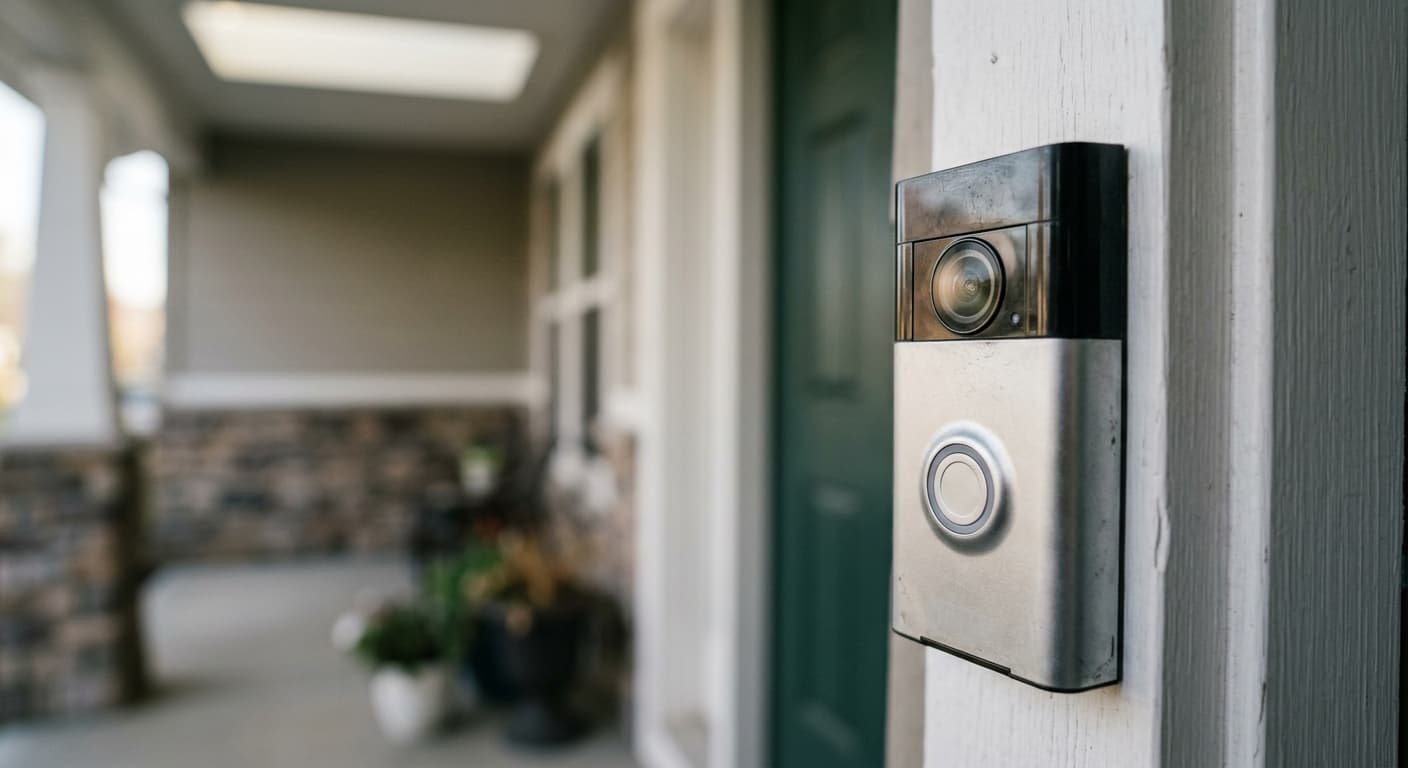
Video recording in places where no reasonable expectation of privacy exists, such as a public-facing porch or driveway, falls outside NRS 200.604 as long as no private area is captured. A Ring or Nest doorbell camera pointed at the front walkway is generally lawful for its video track. The audio track is a separate matter: if the microphone captures a phone call by an approaching visitor, that is interception of a wire communication under NRS 200.620 (all-party consent, per Lane), not a simple video-capture issue. Disabling audio on outdoor cameras or posting clear notice of audio recording is the straightforward compliance fix.
A nanny cam in a living room or nursery is generally lawful. Placing a camera in a bathroom, guest bedroom, or any space where a nanny or domestic worker has a reasonable expectation of privacy and capturing their private area is a gross misdemeanor under NRS 200.604 on the first offense.
For full coverage of voyeurism, security-camera rules, and video recording, see the Nevada Voyeurism and Hidden Camera Laws and Nevada Security Camera Laws sub-pages.
Penalties for illegal recording in Nevada
NRS 200.690 is the single penalty provision covering the entire wire, oral, and listening-device interception cluster (NRS 200.620 through NRS 200.650).
Criminal penalty:
| Element | Amount |
|---|---|
| Classification | Category D felony (NRS 193.130) |
| Imprisonment | 1 to 4 years in Nevada State Prison |
| Fine | Up to $5,000 |
| Mens rea | Willful and knowing |
Civil remedies (NRS 200.690):
| Remedy | Amount |
|---|---|
| Liquidated damages | $100 per day of violation or $1,000 minimum, whichever is greater |
| Actual damages | Whatever losses the plaintiff can prove |
| Punitive damages | Available on clear-and-convincing showing of oppression, fraud, or malice |
| Attorney fees and costs | Reasonable fees and court costs |
A plaintiff pleads the greater of actual or liquidated damages. The federal ECPA civil cause under 18 U.S.C. section 2520 layers on top with statutory damages of $100 per day or $10,000 (whichever is greater), plus punitive damages and attorney fees. A Nevada plaintiff may plead both causes simultaneously.
The common-law intrusion upon seclusion tort, anchored in PETA v. Bobby Berosini, Ltd., 111 Nev. 615, 895 P.2d 1269 (1995), operates alongside the statutory cause. NRS 42.005 supplies punitive damages on a clear-and-convincing showing of oppression, fraud, or malice.
The limitations period is three years for liabilities created by statute under NRS 11.190(3) and two years for personal injury under NRS 11.190(4)(e). Plaintiffs should plead within the shorter window when authority is unclear.

Recording the police in Nevada
Nevada residents have an express statutory right and a controlling federal First Amendment right to record law enforcement in public.
NRS 171.1233, enacted in 2017, provides that any person not under arrest or in police custody may record law enforcement activity and maintain custody and control of the recording and the equipment used. A person under arrest does not, by that status alone, forfeit the right to have recordings and equipment maintained and returned. The statute does not protect interference with or obstruction of law enforcement activity.
Nevada is in the Ninth Circuit. In Fordyce v. City of Seattle, 55 F.3d 436 (9th Cir. 1995), a man videotaping a public protest march, including the police officers working it, sued after an officer allegedly smashed his camera into his face; the Ninth Circuit held that a genuine issue of material fact existed as to whether the officer tried to prevent or dissuade him from exercising his "First Amendment right to film matters of public interest," and sent that claim to trial. In Askins v. U.S. Department of Homeland Security, 899 F.3d 1035 (9th Cir. 2018), the Ninth Circuit cited Fordyce for the rule that the First Amendment right to photograph and record matters of public interest "includes the right to record law enforcement officers engaged in the exercise of their official duties in public places."
A bystander who films from a safe distance without obstructing the encounter is protected by both NRS 171.1233 and the Fordyce/Askins First Amendment line. NRS 171.1233 is a record-the-police statute only; Nevada courtroom recording is governed separately by Nevada Supreme Court Rules and requires advance permission from the presiding judge.
For full analysis, see Nevada Laws on Recording Police.
Special topics in Nevada
Body-worn cameras (NRS 289.830)
NRS 289.830 requires Nevada law enforcement agencies employing uniformed officers in regular public contact to require officers to wear a portable event recording device on duty. Officers must activate the device at the initiation of any law-enforcement or investigative encounter and on calls for service, and may not deactivate until the encounter concludes. Records are public records subject to NRS Chapter 239 disclosure and redaction rules. This statute imposes obligations on agencies and officers, not on citizens.
Workplace recording and NLRB overlay
In-person workplace conversations follow NRS 200.650 (one-party). Workplace phone calls follow NRS 200.620 (all-party). Private-sector employers covered by the National Labor Relations Act must evaluate any no-recording handbook policy under Stericycle, Inc., 372 NLRB No. 113 (Aug. 2, 2023): a rule is presumptively unlawful if a reasonable employee could read it as chilling Section 7 protected concerted activity. NLRB GC 25-05 (Feb. 14, 2025) was a housekeeping rescission of prior memoranda and did not reinstate the Boeing work-rule framework; Stericycle remains controlling. NLRB GC 25-07 (June 25, 2025) declared surreptitious recording of collective-bargaining sessions a per se 8(a)(5)/8(b)(3) violation, narrowly scoped to formal bargaining sessions.
For more, see Nevada Workplace Recording Laws.
AI and deepfake statutes (AB 73, SB 213, SB 263)
Nevada's 83rd Legislature enacted three AI statutes in 2025. AB 73 (effective January 1, 2026) requires clear and conspicuous disclosure on election-related communications containing AI-altered images, video, or audio; enforcement is via injunctive relief by the depicted candidate. SB 213 (effective October 1, 2025) amends NRS 200.780 to expressly reach AI-generated and digitally altered synthetic intimate imagery, closing the prior gap for wholly fabricated deepfakes. SB 263 (effective October 1, 2025) added computer-generated child sexual abuse material to NRS 200.725 (preparing, advertising, or distributing) and NRS 200.730 (possession). Distributing it is a first-offense Category B felony (1 to 15 years, up to $15,000 fine) and a second-or-subsequent Category A felony (10 years to life with possibility of parole, up to $15,000 fine) under NRS 200.725. Possessing it is a first-offense Category B felony (1 to 6 years, up to $5,000 fine) and a second-or-subsequent Category A felony (1 year to life with possibility of parole, up to $5,000 fine) under NRS 200.730.
NRS 200.780 makes unlawful dissemination of an intimate image, including an AI-generated or digitally altered image that a reasonable person would believe is a real depiction of the person, a category D felony. NRS 200.785 separately criminalizes sextortion (demands for payment in exchange for not distributing an intimate image). If someone is making that kind of demand of you now, our guide to sextortion explains why not to pay, how to keep the messages as evidence, and where to report the threat. No Nevada statute creating an express separate civil cause of action for non-consensual intimate imagery was located; a victim may still have recourse through the general civil remedies described above (NRS 200.690, the common-law intrusion-upon-seclusion tort) depending on the facts.
Federal overlay
The federal Electronic Communications Privacy Act (ECPA), 18 U.S.C. sections 2510-2522, sets a one-party consent floor but does not preempt stricter state law; Nevada's all-party phone rule controls for any Nevada participant. FCC Declaratory Ruling 24-17 (in force) holds that AI-generated voices in robocalls are "artificial or prerecorded voice" under TCPA. FCC 24-24 (one-to-one consent rule) was vacated by the Eleventh Circuit in Insurance Marketing Coalition v. FCC, mandate April 30, 2025. 47 CFR 64.501 was removed effective November 20, 2017. The TAKE IT DOWN Act, Pub. L. No. 119-12 (signed May 19, 2025), criminalizes publication of non-consensual intimate visual depictions including deepfakes; platforms must implement a 48-hour notice-and-takedown procedure by May 19, 2026.

Recent legal developments
- October 1, 2025: Nevada SB 213 (NRS 200.780 expanded to AI-generated synthetic intimate imagery) and SB 263 (AI-generated CSAM added to child pornography definition) both took effect.
- January 1, 2026: Nevada AB 73 (election deepfake disclosure mandate) took effect.
- May 19, 2026: TAKE IT DOWN Act platform notice-and-takedown compliance deadline.
- April 30, 2025: FCC 24-24 one-to-one consent rule vacated by Eleventh Circuit mandate.
- June 25, 2025: NLRB GC 25-07 declared surreptitious recording of collective-bargaining sessions a per se unfair labor practice.
Nevada recording laws in depth
Want to know more? Each sub-page covers a specific Nevada recording-law context in greater depth than this hub.
By type of recording:
- Nevada Audio Recording Laws: Split Consent Rules and Penalties (2026)
- Nevada Phone Call Recording Laws: All-Party Consent Required (2026)
- Nevada Video Recording Laws: When Consent Is Required (2026)
- Nevada Voyeurism and Hidden Camera Laws: NRS 200.604 Penalties (2026)
- Nevada Dashcam Laws: Legal Rules for Dashboard Cameras (2026)
By place or relationship:
- Nevada Workplace Recording Laws: Employee and Employer Rights (2026)
- Nevada Laws on Recording Police: Your Rights Under NRS 171.1233 (2026)
- Nevada Laws on Recording in Public: Rights and Restrictions (2026)
- Nevada School Recording Laws: Rules for Students, Parents, and Teachers (2026)
- Nevada Medical Recording Laws: Patient Rights and Healthcare Privacy (2026)
- Nevada Landlord-Tenant Recording Laws: Rights for Renters and Property Owners (2026)
- Nevada Security Camera Laws: Installation Rules and Privacy Limits (2026)
More Nevada laws
- Nevada AI Meeting Recording Laws
- Nevada Alimony Laws
- Nevada At-Will Employment Laws
- Nevada Common Law Marriage Laws
- Nevada Divorce Laws
This article is general legal information, not legal advice. Recording laws change and apply differently to each situation. For advice about your situation, consult a licensed Nevada attorney.
More Nevada Laws
- Nevada AI Meeting Recording Laws
- Nevada Dashcam Laws
- Nevada Data Privacy Laws
- Nevada Deepfake Laws
- Nevada Employee Monitoring Laws
- Nevada GPS Tracking Laws
- Nevada Police Bodycam Laws
- Nevada Smart Glasses Recording Laws
Frequently Asked Questions
Is Nevada a one-party or two-party consent state for recording?
Nevada is a hybrid consent state. In-person oral conversations follow one-party consent under NRS 200.650: a participant may record without informing anyone else. Telephone calls require all-party consent under NRS 200.620 per Lane v. Allstate (1998), and the same rule is generally applied to cellphone calls and text messages on the text of NRS 200.610(2). Recording a phone call without every participant's consent is a Category D felony.
Can I record a phone call in Nevada without telling the other person?
No. NRS 200.620, as construed by the Nevada Supreme Court in Lane v. Allstate (1998), requires the consent of every party before a phone call may be recorded. The rule squarely covers landline calls, and the text of NRS 200.610(2) supports applying it to cellphone calls and text messages as well. Whether it reaches VoIP audio or video-conference calls is untested in Nevada, so treat those as all-party too. Secretly recording a call is a Category D felony punishable by 1 to 4 years in state prison.
Why does Nevada require all-party consent for phone calls but only one-party for in-person conversations?
Because the Nevada Supreme Court in Lane v. Allstate Ins. Co., 114 Nev. 1176, 969 P.2d 938 (1998), construed NRS 200.620 to require all-party consent in a fractured decision that produced four separate opinions. The lead opinion reasoned that because the Legislature wrote an explicit one-party rule into NRS 200.650 for in-person conversations, the absence of that language in NRS 200.620 showed the Legislature treated phone recording as a greater privacy intrusion.
Does Nevada's all-party phone rule apply to cellphones and text messages?
Almost certainly, though no Nevada appellate court has ruled on it. NRS 200.610(2) defines a wire communication as the transmission of writing, signs, signals, pictures and sounds of all kinds by wire, cable, or other similar connection, and cellphone calls and text messages travel by wire for part of their route. Lane v. Allstate construed NRS 200.620 to require all-party consent for telephone recording, and nothing in the statute limits that holding to landlines. Treat cellphone calls and texts as all-party.
Is recording someone without consent a felony in Nevada?
Yes, for a willful and knowing violation. Illegally recording a phone call (NRS 200.620) or acting as an outside person surreptitiously recording a private in-person conversation (NRS 200.650) is a Category D felony under NRS 200.690 and NRS 193.130: 1 to 4 years in state prison and up to $5,000 fine. Recording your own face-to-face conversation is not a felony because your participation satisfies NRS 200.650.
What can I sue for if someone illegally recorded me in Nevada?
Under NRS 200.690 you may recover the greater of actual damages or liquidated damages ($100 per day of violation, minimum $1,000), plus punitive damages (on a clear-and-convincing showing of oppression, fraud, or malice) and reasonable attorney fees. The federal ECPA civil cause under 18 U.S.C. section 2520 adds statutory damages of $100 per day or $10,000, whichever is greater, plus punitive damages and attorney fees.
Are Ring doorbell cameras and nanny cams legal in Nevada?
Generally yes for the outward-facing video on a public-area porch. NRS 200.604 targets capture of a person's private area in a private place. The audio track is a separate issue: doorbell-camera audio that captures a visitor's active phone call is interception of a wire communication under NRS 200.620 and requires all-party consent. Disabling audio or posting clear notice of recording is the simplest fix.
Can I record a police officer in Nevada?
Yes. NRS 171.1233 (enacted 2017) expressly authorizes any person not under arrest to record law enforcement activity and maintain custody of the recording. The Ninth Circuit's First Amendment line under Fordyce v. City of Seattle (1995) and Askins v. DHS (2018) provides parallel federal protection. Film from a safe distance without obstructing the encounter. NRS 171.1233 does not cover courtroom recording, which requires advance judicial permission.
Updates
Corrected the description of Fordyce v. City of Seattle to what the Ninth Circuit actually decided and attributed the right to record police in public to Askins v. DHS, which states it.
Corrected the page's treatment of Sharpe v. State, which is a court-authorized wiretap decision under NRS 179.455 and does not address private-party consent, and clarified that Nevada's all-party rule for cellphone calls, text messages, VoIP and video calls rests on the text of NRS 200.610(2) rather than on any Nevada court decision.
Removed a fabricated Nevada statute citation (NRS 200.788, which does not exist) from the intimate-imagery section, split the AI-generated child sexual abuse material penalty figures into their correct possession (NRS 200.730) and distribution (NRS 200.725) tracks instead of one overstated blanket minimum, and corrected the description of the Nevada Supreme Court's 1998 Lane v. Allstate ruling from a '3-2 decision' to the fractured, four-opinion decision it actually was.
Independently fact-checked against the cited primary sources; governing law re-checked for recent changes
Reviewed and approved by an editor
Restructured page into scannable sections following the recording-redo spec: condensed prose to remove repetition, added at-a-glance table, separated in-person and phone-call sections, condensed special topics (body-worn cameras, workplace/NLRB, AI statutes, federal overlay) into tight subsections, added Nevada recording laws in-depth index linking all 12 sub-pages, refreshed FAQ (8 questions), updated UpdatesLog. Re-checked Lane v. Allstate (a fractured decision producing four separate opinions, all-party phone), NRS 171.1233 text, Category D felony 1-4 years/$5,000, NRS 200.604 gross misdemeanor/Category E, Nevada 2025 AI trio (AB 73/SB 213/SB 263) and TAKE IT DOWN Act.
Refreshed for 2026 with a hybrid-forward framework. Anchored NRS 200.620 (wire and phone, all-party per Lane v. Allstate Ins. Co., 114 Nev. 1176, 969 P.2d 938 (1998), a 3-2 Nevada Supreme Court decision construing the facially-one-party statutory text as all-party on legislative-intent reasoning) and NRS 200.650 (in-person oral conversations, one-party). Added Sharpe v. State, 350 P.3d 388 (Nev. 2015), as the modern controlling authority extending the all-party phone rule to cellphone calls and text messages. Added the verified Nevada 2025 AI trio: AB 73 (election deepfake disclosure mandate, effective January 1, 2026), SB 213 (NRS 200.780 expansion to AI-generated synthetic intimate imagery, effective October 1, 2025), and SB 263 (AI-generated child sexual abuse material, effective October 1, 2025). Documented NRS 200.788 as the express Nevada civil cause of action for non-consensual intimate imagery, replacing the prior baseline reference to NRS 41.1395 (which is the elder and vulnerable-adult abuse statute, not an NCII cause). Reframed NRS 171.1233 as the express Nevada statutory right to record law enforcement activity (enacted in 2017), parallel to the Ninth Circuit First Amendment line under Fordyce v. City of Seattle, 55 F.3d 436 (9th Cir. 1995), and Askins v. U.S. Department of Homeland Security, 899 F.3d 1035 (9th Cir. 2018); courtroom recording is governed separately by Nevada Supreme Court Rules. Reframed NLRB GC 25-05 (February 14, 2025, Acting GC William B. Cowen) as a housekeeping rescission of prior General Counsel memoranda, not a Boeing-era reinstatement; Stericycle, 372 NLRB No. 113 (August 2, 2023), remains controlling Board law on workplace no-recording rules. Updated the federal overlay: FCC 24-17 (AI-voice robocalls under TCPA) remains in force, FCC 24-24 (one-to-one consent rule) was vacated by the Eleventh Circuit in Insurance Marketing Coalition v. FCC, with the mandate issued April 30, 2025, and 47 CFR 64.501 was removed and reserved effective November 20, 2017. Added the TAKE IT DOWN Act, Pub. L. No. 119-12 (signed May 19, 2025), with the platform notice-and-takedown compliance deadline arriving May 19, 2026. Replaced commercial-codifier URLs with leg.state.nv.us for Nevada Revised Statutes, nvcourts.gov for Nevada Supreme Court materials, and uscode.house.gov for federal statutes.
Refreshed for 2026 with a hybrid-forward framework. Anchored NRS 200.620 (wire and phone, all-party per Lane v. Allstate Ins. Co., 114 Nev. 1176, 969 P.2d 938 (1998), a fractured Nevada Supreme Court decision producing four separate opinions, construing the facially-one-party statutory text as all-party on legislative-intent reasoning) and NRS 200.650 (in-person oral conversations, one-party). Added the verified Nevada 2025 AI trio: AB 73 (election deepfake disclosure mandate, effective January 1, 2026), SB 213 (NRS 200.780 expansion to AI-generated synthetic intimate imagery, effective October 1, 2025), and SB 263 (AI-generated child sexual abuse material, effective October 1, 2025). Documented NRS 200.780 (as later amended by SB 213 in 2025) as the criminal dissemination statute reaching AI-generated synthetic intimate imagery; no Nevada statute creating a separate civil cause of action for this conduct was confirmed. Reframed NRS 171.1233 as the express Nevada statutory right to record law enforcement activity (enacted in 2017). Reframed NLRB GC 25-05 as a housekeeping rescission, not a Boeing reinstatement; Stericycle remains controlling. Added TAKE IT DOWN Act, Pub. L. No. 119-12 (signed May 19, 2025), with platform compliance deadline May 19, 2026. Replaced commercial-codifier URLs with leg.state.nv.us for Nevada Revised Statutes.
Added wearable recording devices section and 2 FAQs
The Law Behind This Article
This article rests on the statutory provisions below, held in our own legal record and retrieved from the official source. Tap a section to read the operative text.
Nevada Revised Statutes, Chapter 200: CRIMES AGAINST THE PERSON
§ 200.650Unauthorized, surreptitious intrusion of privacy by listening device prohibited.In forcecited in 25 of our articles
Except as otherwise provided in NRS 179.410 to 179.515, inclusive, and 704.195, a person shall not intrude upon the privacy of other persons by surreptitiously listening to, monitoring or recording, or attempting to listen to, monitor or record, by means of any mechanical, electronic or other listening device, any private conversation engaged in by the other persons, or disclose the existence, content, substance, purport, effect or meaning of any conversation so listened to, monitored or recorded, unless authorized to do so by one of the persons engaging in the conversation.
Official text (excerpt) · last checked 2026-08-26 · Read the full text in our law library · Verify at leg.state.nv.us
Cited in 13 court opinions in our collectionLatest citing opinion in our collection: 2025
In the courts (editorial summary, independently checked):Nevada courts read NRS 200.650 to permit a recording authorized by a participant. Summers v. State (1986) upheld a body-wire recording because the informant taking part in the conversation authorized it. Abid v. Abid (2017) held the section carries no suppression rule, so a custody expert could consider recordings made in violation of it.
Opinions citing this section in our collection:
- Lane v. Allstate Insurance (Nevada Supreme Court 1998, 114 Nev. 1176)✓A former employee secretly taped hundreds of phone calls with company personnel; the court read NRS 200.650 as allowing in-person private conversations to be recorded when one participant authorizes it, and contrasted that in holding NRS 200.620 bars one-party taping of calls.
- Summers v. State (Nevada Supreme Court 1986, 102 Nev. 195)✓Police taped a transmitter to an informant, who recorded his conversation with Summers about the murder guns; the court held such a recording needs no court order so long as the authorization requirement of NRS 200.650 is met, and the informant had authorized it.
- ABID VS. ABID (CHILD CUSTODY) (Nevada Supreme Court 2017, 2017 NV 94)“…to this recording, the father's actions likely violated NRS 200.650, which prohibits the…”
Identified automatically from the court opinions citing this section — not a ranking of which case controls.
Also relied on in: Nevada Windshield Mounting Laws (2026 Guide), Nevada Dashcam Laws: Legal Rules for Dashboard Cameras (2026), Nevada Landlord-Tenant Recording Laws: Rights for Renters and Property Owners (2026)
§ 200.620Interception and attempted interception of wire communication prohibited; exceptions.In forcecited in 38 of our articles
1. Except as otherwise provided in subsection 5 and NRS 179.410 to 179.515, inclusive, 209.419 and 704.195, it is unlawful for any person to intercept or attempt to intercept any wire communication unless: (a) The interception or attempted interception is made with the prior consent of one of the parties to the communication; and (b) An emergency situation exists and it is impractical to obtain a court order as required by NRS 179.410 to 179.515, inclusive, before the interception, in which event the interception is subject to the requirements of subsection 3. If the application for ratification is denied, any use or disclosure of the information so intercepted is unlawful, and the person who made the interception shall notify the sender and the receiver of the communication that: (1) The communication was intercepted; and (2) Upon application to the court, ratification of the interception was denied.
Official text (excerpt) · last checked 2026-08-28 · Read the full text in our law library · Verify at leg.state.nv.us
Cited in 18 court opinions in our collectionLatest citing opinion in our collection: 2025
In the courts (editorial summary, independently checked):Nevada reads NRS 200.620 as an all-party consent rule for phone recording, with a territorial limit. Lane v. Allstate Insurance held a participant who taped his own calls without the other parties' consent violated it; DITECH FINANCIAL, LLC VS. BUCKLES held it does not reach calls recorded from outside Nevada.
Opinions citing this section in our collection:
- Lane v. Allstate Insurance (Nevada Supreme Court 1998, 114 Nev. 1176)✓A former employee secretly taped hundreds of his own phone calls with his ex-employer's staff to build his suit; the court held NRS 200.620 bars recording a call without every party's consent, so the tapes were excluded and the dismissal of his suit was reversed.
- State v. Reyes (Nevada Supreme Court 1991, 107 Nev. 191)✓Police had an interpreter listen on a station extension phone while an informant set up a drug buy; the court held that officers' use of regularly installed telephone equipment in the ordinary course of their duties is not an interception under NRS 200.620.
- ABID VS. ABID (CHILD CUSTODY) (Nevada Supreme Court 2017, 2017 NV 94)“…corded phone conversations in violation of NRS 200.620 to obtain evidence to support tort…”
Identified automatically from the court opinions citing this section — not a ranking of which case controls.
Also relied on in: Nevada Smart Glasses Recording Laws 2026, Nevada Audio Recording Laws: Split Consent Rules and Penalties (2026), Nevada Medical Recording Laws: Patient Rights and Healthcare Privacy (2026)
§ 200.610Definitions.In forcecited in 5 of our articles
As used in NRS 200.610 to 200.690, inclusive: 1. “Person” includes public officials and law enforcement officers of the State and of a county or municipality or other political subdivision of the State. 2. “Wire communication” means the transmission of writing, signs, signals, pictures and sounds of all kinds by wire, cable, or other similar connection between the points of origin and reception of such transmission, including all facilities and services incidental to such transmission, which facilities and services include, among other things, the receipt, forwarding and delivering of communications. 3. “Radio communication” means the transmission of writing, signs, signals, pictures, and sounds of all kinds by radio or other wireless methods, including all facilities and services incidental to such transmission, which facilities and services include, among other things, the receipt, forwarding and delivering of communications. The term does not include the transmission of writing, signs, signals, pictures and sounds broadcast by amateurs or public or municipal agencies of the State of Nevada, or by others for the use of the general public.
Official text (excerpt) · last checked 2026-07-29 · Read the full text in our law library · Verify at leg.state.nv.us
Cited in 6 court opinions in our collectionLatest citing opinion in our collection: 2024
Opinions citing this section in our collection:
- United States v. James Joseph Testa, United States of America v. Edward Epstein (Court of Appeals for the Ninth Circuit 1977, 548 F.2d 847)“…11 parties (see Cal.Pen.Code § 631; Nev. NRS §§ 200.610-200.690), and because the federal statu…”
- Application of the United States for Relief (Court of Appeals for the Ninth Circuit 1970, 427 F.2d 639)“…rosecution for a gross misdemeanor under Nevada law, namely NRS 200.610-200.690. This appeal followed.…”
- Application of United States (District Court, W.D. Missouri 1976, 407 F. Supp. 398)“…rosecution for a gross misdemeanor under Nevada law, namely NRS 200.610-200.690.” (Id. at 641). The gove…”
Identified automatically from the court opinions citing this section — not a ranking of which case controls.
Also relied on in: Nevada Phone Call Recording Laws: All-Party Consent Required (2026), Nevada AI Meeting Recording Laws (2026)
§ 200.690Penalties.In forcecited in 18 of our articles
1. A person who willfully and knowingly violates NRS 200.620 to 200.650, inclusive: (a) Shall be punished for a category D felony as provided in NRS 193.130. (b) Is liable to a person whose wire or oral communication is intercepted without his or her consent for: (1) Actual damages or liquidated damages of $100 per day of violation but not less than $1,000, whichever is greater; (2) Punitive damages; and (3) His or her costs reasonably incurred in the action, including a reasonable attorney’s fee, Ê all of which may be recovered by civil action. 2. A good faith reliance by a public utility on a written request for interception by one party to a conversation is a complete defense to any civil or criminal action brought against the public utility on account of the interception.
Official text (excerpt) · last checked 2026-07-29 · Read the full text in our law library · Verify at leg.state.nv.us
Cited in 5 court opinions in our collectionLatest citing opinion in our collection: 2023
Opinions citing this section in our collection:
- Lane v. Allstate Insurance (Nevada Supreme Court 1998, 114 Nev. 1176)“…shable as “a category D felony as provided in NRS 193.130.” NRS 200.690(l)(a). In addition, the violator is lia…”
- ABID VS. ABID (CHILD CUSTODY) (Nevada Supreme Court 2017, 2017 NV 94)“…regarding evidence and admissibility. See NRS 200.690(1) (enforcing NRS 200.650 exclusively…”
- DITECH FINANCIAL, LLC VS. BUCKLES (Nevada Supreme Court 2017, 2017 NV 64)“…ons without Buckles's consent.' 1 NRS 200.690(1)(b) provides a private right of actio…”
Identified automatically from the court opinions citing this section — not a ranking of which case controls.
Also relied on in: Nevada School Recording Laws: Rules for Students, Parents, and Teachers (2026), Nevada Security Camera Laws: Installation Rules and Privacy Limits (2026), Nevada Video Recording Laws: When Consent Is Required (2026)
§ 200.604Capturing image of private area of another person; distributing, disclosing, displaying, transmitting or publishing image of private area of another person; penalties; exceptions; confidentiality of image.In forcecited in 15 of our articles
1. Except as otherwise provided in subsection 4, a person shall not knowingly and intentionally capture an image of the private area of another person: (a) Without the consent of the other person; and (b) Under circumstances in which the other person has a reasonable expectation of privacy. 2. Except as otherwise provided in subsection 4, a person shall not distribute, disclose, display, transmit or publish an image that the person knows or has reason to know was made in violation of subsection 1. 3. Unless a greater penalty is provided pursuant to NRS 200.780 or 212.188, a person who violates this section: (a) For a first offense, is guilty of a gross misdemeanor. (b) For a second or subsequent offense, is guilty of a category E felony and shall be punished as provided in NRS 193.130. 4. This section does not prohibit any lawful law enforcement or correctional activity, including, without limitation, capturing, distributing, disclosing, displaying, transmitting or publishing an image for the purpose of investigating or prosecuting a violation of this section.
Official text (excerpt) · last checked 2026-07-29 · Read the full text in our law library · Verify at leg.state.nv.us
Cited in 4 court opinions in our collectionLatest citing opinion in our collection: 2018
Opinions citing this section in our collection:
- Coleman v. State (Nevada Supreme Court 2018, 416 P.3d 238)“…By the Court, PICKERING, J.: NRS 200.604 prohibits a person from knowingly and i…”
- COLEMAN (SOLOMON) VS. STATE (Nevada Supreme Court 2018, 2018 NV 28)“…y the Court, PICKERING, J.: NRS 200.604 prohibits a person from knowingly and…”
- Brian Olsen v. City of Henderson (Court of Appeals for the Ninth Circuit 2016, 648 F. App'x 628)“…amily. Nichols reasonably believed that Olsen had violated Nev. Rev. Stat. § 200.604 by capturing and publishing to his per…”
Identified automatically from the court opinions citing this section — not a ranking of which case controls.
Also relied on in: Nevada Laws on Recording in Public: Rights and Restrictions (2026), Nevada Workplace Recording Laws: Employee and Employer Rights (2026), Nevada Voyeurism and Hidden Camera Laws: NRS 200.604 Penalties (2026)
§ 200.780Unlawful dissemination of intimate image; exceptions; penalty.In forcecited in 8 of our articles
1. Except as otherwise provided in subsection 3, a person commits the crime of unlawful dissemination of an intimate image when, with the intent to harass, harm or terrorize another person, the person: (a) Electronically disseminates or sells an intimate image which depicts the other person and the other person: (1) Did not give prior consent to the electronic dissemination or the sale of the intimate image; (2) Had a reasonable expectation that the intimate image would be kept private and would not be made visible to the public; and (3) Was at least 18 years of age when the intimate image was created; or (b) Knowingly distributes or causes to be distributed an intimate image described in paragraph (b) of subsection 1 of NRS 200.770 which depicts the other person if: (1) The intimate image is created in a way that would lead a reasonable person to believe it is an actual depiction of the other person; and (2) The other person did not give prior consent to the distribution of the image. 2. A person who commits the crime of unlawful dissemination of an intimate image is guilty of a category D felony and shall be punished as provided in NRS 193.130.
Official text (excerpt) · last checked 2026-07-29 · Read the full text in our law library · Verify at leg.state.nv.us
Also relied on in: Nevada Deepfake Laws: AI Images, Voice Cloning & Penalties (2026), Nevada Pornography Laws (2026): Obscenity, AV Bill, CSAM Penalties, Nevada AI Laws and Regulation (2026)
§ 200.785Demands in exchange for removal of intimate image; penalty.In forcecited in 2 of our articles
Any person who demands payment of money, property, services or anything else of value from a person in exchange for removing an intimate image from public view is guilty of a category D felony and shall be punished as provided in NRS 193.130.
Official text (excerpt) · last checked 2026-07-29 · Read the full text in our law library · Verify at leg.state.nv.us
Also relied on in: Nevada Extortion and Blackmail Laws: Penalties (2026)
§ 200.725Preparing, advertising or distributing child sexual abuse material or computer-generated child sexual abuse material unlawful; penalty.In forcecited in 6 of our articles
1. A person shall not knowingly prepare, advertise or distribute any: (a) Item or material that depicts a minor engaging in, or simulating, or assisting others to engage in or simulate, sexual conduct; or (b) Computer-generated child sexual abuse material. 2. A person who violates the provisions of subsection 1: (a) For the first offense, is guilty of a category B felony and shall be punished by imprisonment in the state prison for a minimum term of not less than 1 year and a maximum term of not more than 15 years, or by a fine of not more than $15,000, or by both fine and imprisonment. (b) For any subsequent offense, is guilty of a category A felony and shall be punished by imprisonment in the state prison for a minimum term of not less than 10 years and a maximum term of life with the possibility of parole, and may be further punished by a fine of not more than $15,000. 3. A person convicted of a violation of this section may not be convicted of a violation of NRS 200.730 for possessing the same visual presentation.
Official text (excerpt) · last checked 2026-07-29 · Read the full text in our law library · Verify at leg.state.nv.us
Cited in 3 court opinions in our collectionLatest citing opinion in our collection: 2005
Opinions citing this section in our collection:
- Wilson v. State (Nevada Supreme Court 2005, 121 Nev. 345)“…v. 250 , 993 P.2d 1259 (2000))). 9 NRS 200.725. 10 NRS 200.730.…”
- State v. Second Judicial District Court of the State of Nevada ex rel. County of Washoe (Nevada Supreme Court 2004, 120 Nev. 254)“…The State does not have an adequate remedy at law because NRS 200.725 specifically prohibits reproduction of…”
- State v. Dist. Ct.(Epperson) (Nevada Supreme Court 2004, 89 P.3d 663)“…The State does not have an adequate remedy at law because NRS 200.725 specifically prohibits reproduction of…”
Identified automatically from the court opinions citing this section — not a ranking of which case controls.
Also relied on in: Nevada Age of Consent Laws: Statutes, Penalties and Reporting, Nevada Sexting Laws: Legal Consequences and Penalties
§ 200.730Possession of visual presentation depicting sexual conduct of person under 16 years of age or computer-generated child sexual abuse material unlawful; penalties; unit of prosecution.In forcecited in 7 of our articles
1. A person shall not knowingly and willfully have in his or her possession for any purpose any: (a) Film, photograph or other visual presentation depicting a person under the age of 16 years as the subject of a sexual portrayal or engaging in or simulating, or assisting others to engage in or simulate, sexual conduct; or (b) Computer-generated child sexual abuse material. 2. Subject to subsection 3, a person who violates the provisions of subsection 1: (a) For the first offense, is guilty of a category B felony and shall be punished by imprisonment in the state prison for a minimum term of not less than 1 year and a maximum term of not more than 6 years, and may be further punished by a fine of not more than $5,000. (b) For any subsequent offense, is guilty of a category A felony and shall be punished by imprisonment in the state prison for a minimum term of not less than 1 year and a maximum term of life with the possibility of parole, and may be further punished by a fine of not more than $5,000.
Official text (excerpt) · last checked 2026-07-29 · Read the full text in our law library · Verify at leg.state.nv.us
Cited in 23 court opinions in our collectionLatest citing opinion in our collection: 2022
Opinions citing this section in our collection:
- Wilson v. State (Nevada Supreme Court 2005, 121 Nev. 345)“…ion on four counts of possession of child pornography under NRS 200.730 violates double jeopardy because those…”
- State v. Hughes (Nevada Supreme Court 2011, 127 Nev. 626)“…eone under the age of 16 years engaging in sexual conduct); NRS 200.730 (criminalizing possession of images dep…”
- Andrews v. State (Nevada Supreme Court 2018, 412 P.3d 37)“…his court addressed the appropriate unit of prosecution for NRS 200.730, which prohibits a person from knowingl…”
Identified automatically from the court opinions citing this section — not a ranking of which case controls.
Nevada Revised Statutes, Chapter 171: PROCEEDINGS TO COMMITMENT
§ 171.1233Recording of law enforcement activity.In forcecited in 5 of our articles
1. A person who is not under arrest or in the custody of a peace officer may record a law enforcement activity and maintain custody and control of that recording and any property or instruments used by the person to record a law enforcement activity. A person who is under arrest or in the custody of a peace officer does not, by that status alone, forfeit the right to have any such recordings, property or instruments maintained and returned to him or her. This subsection must not be construed to authorize a person to engage in actions that interfere with or obstruct a law enforcement activity or otherwise violate any other law in an effort to record a law enforcement activity.
Official text (excerpt) · last checked 2026-07-29 · Read the full text in our law library · Verify at leg.state.nv.us
Also relied on in: Nevada Laws on Recording Police: Your Rights Under NRS 171.1233 (2026)
Nevada Revised Statutes, Chapter 289: PEACE OFFICERS AND OTHER LAW ENFORCEMENT PERSONNEL
§ 289.830Certain law enforcement agencies shall require certain peace officers to wear portable event recording device while on duty; adoption of policies and procedures governing use; request for and inspection of record made by device.In forcecited in 6 of our articles
1. A law enforcement agency shall require uniformed peace officers that it employs and who routinely interact with the public to wear a portable event recording device while on duty. Each law enforcement agency shall adopt policies and procedures governing the use of portable event recording devices, which must include, without limitation: (a) Except as otherwise provided in paragraph (d), requiring activation of a portable event recording device whenever a peace officer is responding to a call for service or at the initiation of any other law enforcement or investigative encounter between a uniformed peace officer and a member of the public; (b) Except as otherwise provided in paragraph (d), prohibiting deactivation of a portable event recording device until the conclusion of a law enforcement or investigative encounter; (c) Prohibiting the recording of general activity; (d) Protecting the privacy of persons: (1) In a private residence; (2) Seeking to report a crime or provide information regarding a crime or ongoing investigation anonymously; or (3) Claiming to be a victim of a crime; (e) Requiring that any video recorded by a portable event recording…
Official text (excerpt) · last checked 2026-08-31 · Read the full text in our law library · Verify at leg.state.nv.us
Cited in 4 court opinions in our collectionLatest citing opinion in our collection: 2023
Opinions citing this section in our collection:
- REPUBLICAN ATTORNEYS GEN. ASS'N VS. LAS VEGAS METRO. POLICE DEP'T (Nevada Supreme Court 2020, 458 P.3d 328)“…formation from disclosure. RAGA points to NRS 289.830(2), which states:…”
- Conrad v. Reno Police Dep't (Nevada Supreme Court 2023)“…a footage constitutes a public record under NRS 289.830(2), an officer's _photograph is…”
- Las Vegas Metro. Police Dep't v. Dist. Ct. (Am. Broad. Co.'s, Inc.) (Nevada Supreme Court 2018)“…footage, as opposed to inspection of the footage, as NRS 289.830 requires inspection if…”
Identified automatically from the court opinions citing this section — not a ranking of which case controls.
Also relied on in: Nevada Police Body Camera Laws: Access & Retention, Nevada Police Reports: How to Get a Crash Report, Incident Report, or Bodycam Video, Nevada Public Records Act: How to Request Records (2026)
Nevada Revised Statutes, Chapter 011: LIMITATION OF ACTIONS
§ 11.190Periods of limitation.In forcecited in 13 of our articles
Except as otherwise provided in NRS 40.4639, 125B.050 and 217.007, actions other than those for the recovery of real property, unless further limited by specific statute, may only be commenced as follows: 1. Within 6 years: (a) Except as otherwise provided in NRS 62B.420 and 176.275, an action upon a judgment or decree of any court of the United States, or of any state or territory within the United States, or the renewal thereof. (b) An action upon a contract, obligation or liability founded upon an instrument in writing, except those mentioned in the preceding sections of this chapter. 2. Within 4 years: (a) An action on an open account for goods, wares and merchandise sold and delivered. (b) An action for any article charged on an account in a store. (c) An action upon a contract, obligation or liability not founded upon an instrument in writing.
Official text (excerpt) · last checked 2026-09-08 · Read the full text in our law library · Verify at leg.state.nv.us
Cited in 553 court opinions in our collectionLatest citing opinion in our collection: 2026
Opinions citing this section in our collection:
- Edwards v. Emperor's Garden Restaurant (Nevada Supreme Court 2006, 122 Nev. 317)“…44483, the district court dismissed Edwards’ action under NRS 11.190(4)(b), which requires a party to commen…”
- Petersen v. Bruen (Nevada Supreme Court 1990, 106 Nev. 271)“…the statute of limitations to the facts of Petersen's case. NRS 11.190(4)(e) expressly declares that civil act…”
- Leven v. Frey (Nevada Supreme Court 2007, 123 Nev. 399)“…ent or its renewal must be commenced within six years under NRS 11.190(1)(a); thus a judgment expires by limit…”
Identified automatically from the court opinions citing this section — not a ranking of which case controls.
Also relied on in: Nevada Dog Bite Laws: Liability and Victim Rights, Nevada Defamation Laws: Libel & Slander (2026), Motorcycle Accident Laws in Nevada (2026): Deadlines
Nevada Revised Statutes, Chapter 193: CRIMINALITY GENERALLY
§ 193.130Categories and punishment of felonies.In forcecited in 13 of our articles
1. Except when a person is convicted of a category A felony, and except as otherwise provided by specific statute, a person convicted of a felony shall be sentenced to a minimum term and a maximum term of imprisonment which must be within the limits prescribed by the applicable statute, unless the statute in force at the time of commission of the felony prescribed a different penalty. The minimum term of imprisonment that may be imposed must not exceed 40 percent of the maximum term imposed. 2. Except as otherwise provided by specific statute, for each felony committed on or after July 1, 1995: (a) A category A felony is a felony for which a sentence of death or imprisonment in the state prison for life with or without the possibility of parole may be imposed, as provided by specific statute. (b) A category B felony is a felony for which the minimum term of imprisonment in the state prison that may be imposed is not less than 1 year and the maximum term of imprisonment that may be imposed is not more than 20 years, as provided by specific statute.
Official text (excerpt) · last checked 2026-07-29 · Read the full text in our law library · Verify at leg.state.nv.us
Cited in 97 court opinions in our collectionLatest citing opinion in our collection: 2026
Opinions citing this section in our collection:
- State v. SECOND JUDICIAL DIST. CT.(PULLIN) (Nevada Supreme Court 2008, 124 Nev. 564)“…ral savings statutes adopted *568 in 1967 as NRS 193.130, 15 193.140, 16…”
- Washington v. State (Nevada Supreme Court 2001, 117 Nev. 735)“…of a category C felony and shall be punished as provided in NRS 193.130. 3. A person who offers, agrees or ar…”
- Hudson v. Warden (Nevada Supreme Court 2001, 117 Nev. 387)“…le I, II, III or IV, for a category E felony as provided in NRS 193.130. (b) For a third or subsequent offens…”
Identified automatically from the court opinions citing this section — not a ranking of which case controls.
Also relied on in: Nevada GPS Tracking Laws: Is It Legal to Put a Tracker on a Car? (2026), Nevada Ring Doorbell Laws: What You Need to Know in 2026, Nevada Identity Theft Laws: NRS 205.463 Penalties and Victim Resources
§ 193.140Punishment of gross misdemeanors.In forcecited in 4 of our articles
Every person convicted of a gross misdemeanor shall be punished by imprisonment in the county jail for not more than 364 days, or by a fine of not more than $2,000, or by both fine and imprisonment, unless the statute in force at the time of commission of such gross misdemeanor prescribed a different penalty.
Official text (excerpt) · last checked 2026-07-29 · Read the full text in our law library · Verify at leg.state.nv.us
Cited in 14 court opinions in our collectionLatest citing opinion in our collection: 2025
Opinions citing this section in our collection:
- LaChance v. State (Nevada Supreme Court 2014, 2014 NV 29)“…l be punished as provided in NRS 193.140. (d)…”
- State v. Eighth Judicial District Court of the State of Nevada ex rel. County of Clark (Nevada Supreme Court 2013, 129 Nev. 492)“…child are Tier I offenders. See NRS 179D.113; see also NRS 193.140 (gross misdemeanor punishable by not mo…”
- State v. SECOND JUDICIAL DIST. CT.(PULLIN) (Nevada Supreme Court 2008, 124 Nev. 564)“…excluded under NRS 193.130, to all gross misdemeanors under NRS 193.140, and to all misdemeanors under NRS 193.…”
Identified automatically from the court opinions citing this section — not a ranking of which case controls.
Also relied on in: Assault vs Battery in Nevada: Felonies, Penalties and NRS 200.481, Nevada Felony Categories and Misdemeanor Penalties (2026), Nevada Disorderly Conduct and Trespass Laws: Breach of Peace (2026)
Search our full record of US law — 2.1 million sections, every state + federal →
Sources and References
- leg.state.nv.us.gov
- leg.state.nv.us.gov
- leg.state.nv.us.gov
- leg.state.nv.us.gov
- leg.state.nv.us.gov
- leg.state.nv.us.gov
- nvcourts.gov.gov
- leg.state.nv.us.gov
- leg.state.nv.us.gov
- leg.state.nv.us.gov
- uscode.house.gov.gov
- cdn.ca9.uscourts.gov.gov
- cdn.ca9.uscourts.gov.gov
- docs.fcc.gov.gov
- media.ca11.uscourts.gov.gov
- nlrb.gov.gov
- nlrb.gov.gov
- nlrb.gov.gov
- congress.gov.gov
- ftc.gov.gov
- leg.state.nv.us.gov
- Lane v. Allstate Ins. Co., 114 Nev. 1176, 969 P.2d 938 (1998) (construing NRS 200.620 to require all-party consent to record a telephone call)(courtlistener.com)
- NRS 200.610 - Definitions (subsection 2 defines "wire communication")(leg.state.nv.us)