
Ohio
Ohio Car Seat Laws (2026): Ages, Day-Care Rule & Fines
Independently fact-checked against primary sources (last audited September 17, 2026). · Reviewed by the RecordingLaw editorial team. · Law checked current as of August 20, 2026. · 4 primary sources cited on this page. How we verify our legal content

Ohio requires a child restraint system meeting federal safety standards for every child under 4 or weighing less than 40 pounds, a booster seat for children under 8 and under 4 feet 9 inches once they outgrow that base requirement, and a restraint system or seat belt for ages 8 through 15, under Ohio Rev. Code § 4511.81.
Jurisdiction scope: This article covers car seat and child-restraint law in the state of Ohio only. It does not address any other state. For other states, see the car seat laws hub.
| Stage | Who | Rule | Statute |
|---|---|---|---|
| Child restraint system | Under 4 years old or under 40 pounds, most vehicles | Properly secured, per manufacturer's instructions, in a federally compliant child restraint system | § 4511.81(A) |
| Child restraint system, day-care/nursery-school vehicles | Under 4 years old or under 40 pounds, vehicle owned, leased, or controlled by a nursery school or child care center | Same restraint duty as (A), broader vehicle scope (taxicabs excluded only) | § 4511.81(B) |
| Booster seat | At least 4 and at least 40 lbs, and under 8 and under 4 feet 9 inches | Must use a booster seat; vehicles regulated under § 5104.015 (child care center rules) excluded (see below); secondary enforcement only | § 4511.81(C), (E) |
| Restraint system or seat belt | At least 8, not older than 15, not otherwise covered by (A), (B), or (C) | Properly restrained in a child restraint system per manufacturer's instructions, or in a seat belt; secondary enforcement only | § 4511.81(D), (E) |
Under 4 or under 40 pounds: the base child restraint system duty
Section 4511.81(A) puts the duty on the vehicle's operator: the child must be "properly secured in accordance with the manufacturer's instructions in a child restraint system that meets federal motor vehicle safety standards." This duty is triggered if the child is under 4 years old or weighs less than 40 pounds, whichever applies first, and it applies only to a vehicle, other than a taxicab or public safety vehicle as defined in section 4511.01, that the U.S. Department of Transportation requires to be equipped with seat belts. Because the trigger is either condition, the child exits this tier only once both conditions fail, at least 4 years old and at least 40 pounds; a 5-year-old weighing 35 pounds is still covered by (A). Ohio's statute doesn't write a separate rear-facing mandate into this stage the way a few other states do; it's the restraint system's own approval and the manufacturer's instructions, not a distinct Ohio orientation rule, that govern when a child can move from rear- to forward-facing within this stage.
Nursery-school and child-care-center vehicles: a separate duty under (B)
Section 4511.81(B) imposes its own, separately worded restraint duty on any vehicle, other than a taxicab, that is "owned, leased, or otherwise under the control of a nursery school or child care center." For a child under 4 years old or weighing less than 40 pounds, the operator of that vehicle must have the child properly secured, in accordance with the manufacturer's instructions, in a federally compliant child restraint system, the same underlying duty as (A). But (B) is not simply (A) with a different label: it carries no public-safety-vehicle carve-out, and no limitation to vehicles the USDOT requires to be seat-belt-equipped. That makes (B) reach some day-care and nursery-school vehicles that (A) would not cover.
Booster seats, and the day-care vehicle exclusion
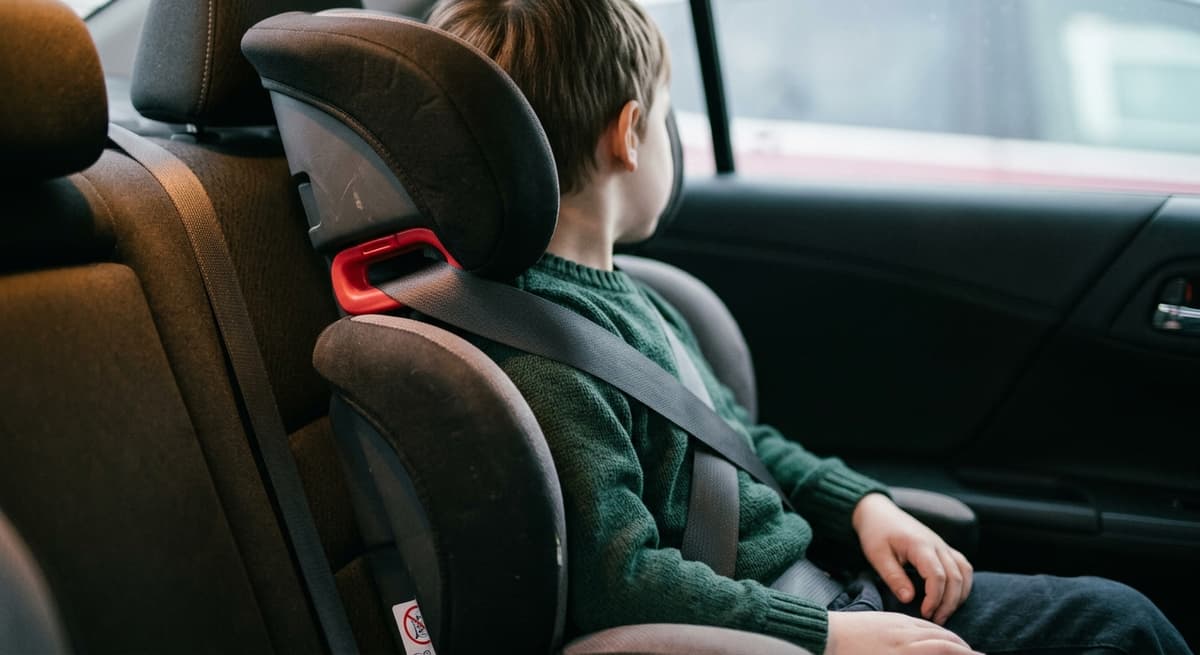
Division (C) requires a booster seat for "any child who is less than eight years of age and less than four feet nine inches in height, who is not required by division (A) or (B) of this section to be secured in a child restraint system." That limiting clause matters: the booster duty attaches only once a child is out of the (A)/(B) child-restraint tier, meaning at least 4 years old and at least 40 pounds, and it continues until the child turns 8 or reaches 4 feet 9 inches, whichever comes first. Like (A), the booster requirement applies only to a vehicle other than a taxicab or public safety vehicle that the USDOT requires to have seat belts.
There's a specific carve-out here that's easy to miss: a vehicle regulated under section 5104.015 (the section under which child care center rules are adopted) is also excluded from the booster requirement. That exclusion is narrower than it sounds, though. It removes only the booster-seat duty for that vehicle; the base child restraint system requirement in (A) or (B), for children under 4 or under 40 pounds, still applies to that vehicle just like any other. The exclusion is limited to the booster tier, not the whole statute, and it isn't new: it's present in the January 1, 2014 version of section 4511.81, more than a decade before the current version took effect.
Division (C), along with division (D) below, is also secondary enforcement only; see the enforcement section further down.
Ages 8 through 15: restraint system or seat belt
For a child at least 8 but not older than 15, and who isn't otherwise required by (A), (B), or (C) to be secured in a child restraint system or booster seat, section 4511.81(D) allows either option: a child restraint system used according to the manufacturer's instructions, or an occupant restraining device, meaning a seat belt, shoulder belt, harness, or other device meeting federal safety standards, as defined in section 4513.263. Either satisfies the law for this age range, and like (A) and (C), it applies only to a vehicle other than a taxicab or public safety vehicle that the USDOT requires to be equipped with seat belts.
There is a narrow gap this age structure creates. A child who is between 4 and 7 years old but has already reached 4 feet 9 inches falls outside (C), which requires the child be under 4 feet 9 inches, and outside (D), which requires the child be at least 8. Section 4511.81 itself imposes no restraint duty on that specific child. Ohio's general seat belt statute, section 4513.263, fills the gap for a front-seat passenger: it requires a front-seat occupant to wear a seat belt, and its carve-out for people already covered by 4511.81's restraint or booster duty (4513.263(C)(1)) doesn't apply to this child, since 4511.81 doesn't cover them. That belt duty comes from 4513.263, not from a height trigger inside 4511.81(D); 4511.81(D) has no height trigger at all, only an age band.
Secondary enforcement for the booster and 8-15 tiers
Section 4511.81(E) states that "no law enforcement officer shall cause an operator of a motor vehicle being operated on any street or highway to stop the motor vehicle for the sole purpose of determining whether a violation of division (C) or (D) of this section has been or is being committed," and that, absent another violation of law, an officer's view into or visual inspection of the vehicle "may not be used for the purpose of determining whether a violation of division (C) or (D)" has occurred. In practice, that makes the booster requirement in (C) and the 8-to-15 restraint-or-belt requirement in (D) secondary enforcement only: an officer needs an independent reason to stop the vehicle before a (C) or (D) violation can be cited. Ohio Rev. Code § 4511.043, the statute listing secondary traffic offenses, confirms this by naming "division (C) or (D) of section 4511.81" among them. Divisions (A) and (B), the base child-restraint duties, carry no such limit and are primary enforcement.
Exemptions
The taxicab and public-safety-vehicle exemption isn't a single, section-wide carve-out; it's written into each division's own operative clause, and it isn't uniform. Divisions (A), (C), and (D) each apply to a vehicle "other than a taxicab or public safety vehicle as defined in section 4511.01." Division (B) excludes only a taxicab; it has no public-safety-vehicle exclusion. Divisions (A), (C), and (D) also apply only to a vehicle the USDOT requires to be equipped with seat belts at the time of manufacture or assembly; division (B) carries no such limitation either.
A vehicle regulated under section 5104.015 (the section under which child care center rules are adopted) is excluded from the booster-seat tier in (C) specifically, as described above; the base restraint duty in (A) or (B) still applies to it.
The law also doesn't apply when a life-threatening emergency exists that threatens the life of a person operating or occupying the vehicle, under division (H).
Division (H) also carries a medical exemption. The statute doesn't apply to a person operating a vehicle who has an affidavit, signed by a physician licensed under Chapter 4731, a clinical nurse specialist or certified nurse practitioner licensed under Chapter 4723, or a chiropractor licensed under Chapter 4734, stating that the child who otherwise would be required to be restrained has a physical impairment making a child restraint system, booster seat, or occupant restraining device impossible or impractical. That exemption isn't unconditional: it applies only if the operator has safely and appropriately restrained the child in accordance with any recommendations the physician, nurse, or chiropractor noted on the affidavit.
Penalty for a car seat violation
A first violation of division (A), (B), (C), or (D) is a minor misdemeanor, carrying a fine between $25 and $75, under division (L)(1)(a). A prior conviction of, or guilty plea to, a violation of (A), (B), (C), or (D), or of a municipal ordinance substantially similar to any of those divisions, makes a later violation a fourth-degree misdemeanor under (L)(1)(b).
Failing to secure more than one child in a child restraint system, booster seat, or occupant restraining device, where the failure occurred at the same time, on the same day, and at the same location, is deemed a single violation under (L)(1), not a separate citation per child.
Division (I) creates the child highway safety fund in the state treasury, made up of the fines imposed under (L)(1) for violations of (A) through (D). Division (L)(2) requires those fines to be forwarded to the state treasurer for deposit into the fund, which the department of health uses to help defray the cost of designating pediatric trauma centers under section 3727.081 and to run a child restraint and booster seat education and distribution program.
Division (K) provides a defense: no one is required to carry a child's birth certificate to prove the child's age, but producing a valid birth certificate showing the child wasn't of an age the statute applies to is a defense against a ticket, citation, or summons issued for violating the section.
Front seat riding: not addressed by this statute
Ohio Rev. Code § 4511.81 contains no front-seat, back-seat, or seat-position provision anywhere in its twelve divisions, and it sets no minimum age for riding in the front seat. Ohio's general seat belt law, section 4513.263, separately requires a front-seat passenger to wear a seat belt, but that requirement doesn't apply to anyone already covered by 4511.81's restraint or booster duty. As explained above, that general front-seat belt requirement is what reaches the narrow group of 4-to-7-year-olds who have outgrown (C)'s height limit before turning 8.
A note on the March 2025 amendment
The current version of section 4511.81 took effect March 20, 2025, under Senate Bill 196 (135th General Assembly). Divisions (A) through (G) of the current text are unchanged from the version in effect since October 3, 2023, and the section 5104.015 day-care and nursery-school vehicle exclusion in division (C) is not new; it's present in the version of the statute in effect since January 1, 2014, more than a decade before SB 196. The one substantive change SB 196 made to 4511.81 is in division (H): it added clinical nurse specialists and certified nurse practitioners licensed under Chapter 4723 to the list of professionals who may sign the medical-impairment affidavit described in the Exemptions section above, which previously named only physicians licensed under Chapter 4731 and chiropractors licensed under Chapter 4734.
Federal guidance vs Ohio law
The federal standard that governs child car seats as products, FMVSS 213 (49 CFR 571.213), regulates what a manufacturer may sell, not how a parent must use the seat; Ohio's own statute, described above, sets the use requirement. The National Highway Traffic Safety Administration and the American Academy of Pediatrics separately recommend keeping a child rear-facing as long as the seat's own height and weight limits allow. That's safety guidance, not an Ohio legal floor, and Ohio's statute doesn't itself set an orientation-specific cutoff within the under-4/under-40-pound stage.
Related Ohio traffic law pages
Disclaimer: This article provides general legal information about Ohio's car seat law as of September 2026. It is not legal advice. Statutes, exemptions, and penalties change; verify the current text of the law before relying on it, and talk to a lawyer licensed in Ohio about a specific situation.
Statutes cited reflect their in-force version as of 2026-09-16. Last updated: 2026-09-17.
Frequently Asked Questions
Until what age does a child need a car seat in Ohio?
A federally compliant child restraint system is required for a child under 4 or under 40 pounds, under section 4511.81(A), or under (B) in a nursery-school or child-care-center vehicle. A booster seat is required once the child is out of that tier and remains under 8 and under 4 feet 9 inches, under (C). From 8 through 15, a restraint system or a seat belt satisfies the law, under (D). The booster and 8-to-15 requirements are secondary enforcement only, under (E).
Are day-care vans exempt from Ohio's car seat law?
Only partly, and the duty that applies to them comes from a different division than the general public. Section 4511.81(B) imposes the base child restraint system duty, for children under 4 or under 40 pounds, on any vehicle owned, leased, or controlled by a nursery school or child care center; that duty is broader than (A)'s, since (B) excludes only taxicabs, not public safety vehicles, and has no seat-belt-equipped vehicle limit. A vehicle regulated under section 5104.015 is excluded from the booster-seat requirement in (C) specifically. The base restraint duty under (B) still applies to those vehicles.
What is the fine for a car seat violation in Ohio?
A first violation of (A), (B), (C), or (D) is a minor misdemeanor with a fine of $25 to $75. A prior conviction or guilty plea under any of those divisions, or a substantially similar municipal ordinance, makes a later violation a fourth-degree misdemeanor. Failing to secure more than one child at the same time, day, and location is treated as a single violation. The fines fund the state's child highway safety fund.
Does Ohio's car seat law require rear-facing seats?
The statute requires a federally compliant child restraint system for children under 4 or under 40 pounds, but it doesn't separately mandate a rear-facing orientation by name; that's governed by the restraint system's own approval and the manufacturer's instructions.
Can police stop a driver in Ohio just for a booster seat or seat belt violation involving a child?
Not on its own. Section 4511.81(E) bars an officer from stopping a vehicle, or issuing a citation, for the sole purpose of checking for or citing a violation of the booster requirement in (C) or the 8-to-15 restraint-or-belt requirement in (D). Ohio Rev. Code 4511.043 separately lists (C) and (D) as secondary traffic offenses. The base child restraint system duties in (A) and (B) are primary enforcement, with no such limit.
Is there a medical exemption from Ohio's car seat law?
Yes. Section 4511.81(H) exempts a person operating a vehicle who has an affidavit, signed by a physician, a clinical nurse specialist or certified nurse practitioner, or a chiropractor licensed in Ohio, stating that the child has a physical impairment making a child restraint system, booster seat, or seat belt impossible or impractical. The exemption applies only if the operator has restrained the child according to any recommendations noted on the affidavit.
Updates
Rebuilt from the current statute text after an independent review: restraint stages, exemptions, front-seat rules and penalties re-verified against the statute.
Independently fact-checked against the cited primary sources
Removed a fabricated claim that Ohio law requires car seats and boosters to be placed in the back seat; Ohio Revised Code Section 4511.81 sets no seat-position requirement at all, though the back seat remains strongly recommended for safety by NHTSA and the Ohio Department of Health.
Independently fact-checked against the cited primary sources; governing law re-checked for recent changes
Corrected the rear-facing/forward-facing age and weight thresholds throughout the page (Ohio Revised Code 4511.81 sets one unified child-restraint-system requirement for children under 4 or under 40 pounds, not separate 1-year/20-lb and 1-3-year/20-40-lb tiers) and clarified that primary enforcement applies only to that requirement, not to the booster seat or 8-15 seat belt requirements, which the statute makes secondary-enforcement only.
Governing law re-checked for recent changes
Reviewed and approved by an editor
The Law Behind This Article
This article rests on the statutory provisions below, held in our own legal record and retrieved from the official source. Tap a section to read the operative text.
Ohio Revised Code
§ 4511.81Child restraint system - child highway safety fundIn forcecited in 2 of our articles
(A) When any child who is in either or both of the following categories is being transported in a motor vehicle, other than a taxicab or public safety vehicle as defined in section 4511.01 of the Revised Code, that is required by the United States department of transportation to be equipped with…
Official text (excerpt) · last checked 2026-07-31 · Read the full text in our law library · Verify at codes.ohio.gov
Cited in 9 court opinions in our collectionLatest citing opinion in our collection: 2025
Opinions citing this section in our collection:
- State v. Donkers (Ohio Court of Appeals 2007, 170 Ohio App. 3d 509)“…or failux-e to use a child-restraint device in violation of R.C. 4511.81, a minor misdemeanor. The citation also…”
- State v. Haynes (Ohio Court of Appeals 2020, 2020 Ohio 6977)“…use child safety seats when transporting the children. See R.C. 4511.81 (“Certain children to be secured in chi…”
- State v. Petrovich (Ohio Court of Appeals 2019, 2019 Ohio 3547)“…ation, a misdemeanor of the fourth degree, in violation of R.C. 4511.81(C). {¶3} On October 29, 2018,…”
Identified automatically from the court opinions citing this section — not a ranking of which case controls.
Also relied on in: Car Seat Laws by State 2026: Rear-Facing, Booster, Front Seat Rules
§ 2919.22Endangering childrenIn forcecited in 2 of our articles
(A) No person, who is the parent, guardian, custodian, person having custody or control, or person in loco parentis of a child under eighteen years of age or a child with a mental or physical disability under twenty-one years of age, shall create a substantial risk to the health or safety of the…
Official text (excerpt) · last checked 2026-07-31 · Read the full text in our law library · Verify at codes.ohio.gov
Cited in 1,470 court opinions in our collectionLatest citing opinion in our collection: 2026
Opinions citing this section in our collection:
- State v. Adams (Ohio Supreme Court 1980, 62 Ohio St. 2d 151)“…criminal liability under the endangering children statute (R. C. 2919.22). R. C. 2919.22(B)(2), 1 as submitte…”
- State v. Johnson (Ohio Supreme Court 2010, 128 Ohio St. 3d 153)“…R. 25: “Are the elements of child endangering [set forth in R.C. 2919.22(B)(1)] sufficiently similar to the elem…”
- State v. Homan (Ohio Supreme Court 2000, 89 Ohio St. 3d 421)“…the filing of the motion to suppress. We disagree. Under R.C. 2919.22, driving a motor vehicle while intoxica…”
Identified automatically from the court opinions citing this section — not a ranking of which case controls.
Also relied on in: Ohio Age of Consent Laws: Statutes, Penalties and Reporting
§ 4511.043Ticket, summons, or citation for secondary traffic offenseIn force
(A)(1) No law enforcement officer who stops the operator of a motor vehicle in the course of an authorized sobriety or other motor vehicle checkpoint operation or a motor vehicle safety inspection shall issue a ticket, citation, or summons for a secondary traffic offense unless in the course of the…
Official text (excerpt) · last checked 2026-07-31 · Read the full text in our law library · Verify at codes.ohio.gov
§ 4513.263Occupant restraining devicesIn forcecited in 2 of our articles
(A) As used in this section and in section 4513.99 of the Revised Code: (1) "Automobile" means any commercial tractor, passenger car, commercial car, or truck that is required to be factory-equipped with an occupant restraining device for the operator or any passenger by regulations adopted by the…
Official text (excerpt) · last checked 2026-07-31 · Read the full text in our law library · Verify at codes.ohio.gov
Cited in 240 court opinions in our collectionLatest citing opinion in our collection: 2026
Opinions citing this section in our collection:
- State ex rel. Ohio Academy of Trial Lawyers v. Sheward (Ohio Supreme Court 1999, 86 Ohio St. 3d 451)“…2305.131), collateral benefits (R.C. 2317.45), seat belts (R.C. 4513.263), alcohol and drug consumption (R.C. 23…”
- Vogel v. Wells (Ohio Supreme Court 1991, 57 Ohio St. 3d 91)“…ral Assembly squarely confronted this issue when it enacted R.C. 4513.263.141 Ohio Laws, Part I, 49, 73, 81. Subs…”
- Gable v. Village of Gates Mills (Ohio Supreme Court 2004, 103 Ohio St. 3d 449)“…to make improper statements throughout the trial. {¶ 11} R.C. 4513.263 is Ohio’s mandatory seat belt law. It p…”
Identified automatically from the court opinions citing this section — not a ranking of which case controls.
Code of Federal Regulations Title 49
§ 571.213Child restraint systems; Applicable unless a vehicle or child restraint system is certified to § 571.213b.In forcecited in 51 of our articles
S1. Scope. This standard specifies requirements for child restraint systems used in motor vehicles and aircraft. S2. Purpose. The purpose of this standard is to reduce the number of children killed or injured in motor vehicle crashes and in aircraft. S3. Application. This standard applies to passenger cars, multipurpose passenger vehicles, trucks and buses, and to child restraint systems for use in motor vehicles and aircraft, manufactured before December 5, 2026. FMVSS No. 213b applies to child restraint systems manufactured on or after December 5, 2026. S4. Definitions. Add-on child restraint system means any portable child restraint system. Backless child restraint system means a child restraint, other than a belt-positioning seat, that consists of a seating platform that does not extend up to provide a cushion for the child's back or head and has a structural element designed to restrain forward motion of the child's torso in a forward impact.
Official text (excerpt) · last checked 2026-07-28 · Read the full text in our law library · Verify at ecfr.gov
Cited in 16 court opinions in our collectionLatest citing opinion in our collection: 2022
Opinions citing this section in our collection:
- Welsh Ex Rel. Welsh v. Century Products, Inc. (District Court, D. Maryland 1990, 745 F. Supp. 313)“…afety Act”) and Federal Motor Vehicle Safety Standard 213, 49 C.F.R. § 571.213 (1989) (“FMVSS 213”). In particular, C…”
- Hendrix Ex Rel. Gp v. Evenflo Co., Inc. (Court of Appeals for the Eleventh Circuit 2010, 609 F.3d 1183)“…meets the requirements imposed by federal regulations. See 49 C.F.R. § 571.213. When used properly, the base is positio…”
- Hendrix v. Evenflo Co. (District Court, N.D. Florida 2009, 255 F.R.D. 568)“…ance requirements and a testing procedure for CRS modules. 49 C.F.R. § 571.213 . Van Arsdell’s mechanical engineering…”
Identified automatically from the court opinions citing this section — not a ranking of which case controls.
Also relied on in: Alabama Car Seat Laws (2026): Ages, Stages & Penalties, Alaska Car Seat Laws (2026): 5 Stages & Penalties, Arizona Car Seat Laws (2026): Booster Age & Penalty Rules
Search our full record of US law — 2.1 million sections, every state + federal →
Sources and References
- Ohio Rev. Code § 4511.81, Child restraint systems(codes.ohio.gov).gov
- Ohio Rev. Code § 4511.043, Ticket, summons, or citation for secondary traffic offense(codes.ohio.gov).gov
- Ohio Rev. Code § 4513.263, Occupant restraining devices(codes.ohio.gov).gov
- 49 CFR § 571.213, FMVSS No. 213, Child restraint systems(ecfr.gov).gov
- American Academy of Pediatrics, Car Safety Seats: Information for Families(healthychildren.org)