Dashboard Camera Legality and Privacy Laws: Is It Illegal to Use Dashcams in North America?
Independently fact-checked against primary sources (last audited August 4, 2026). · 14 primary sources cited on this page. How we verify our legal content
Dashcams are legal throughout the United States and Canada. Law enforcement in both countries actively encourages their use. Placement rules apply in every state and province, so mount the camera where it does not block your view. If your dashcam records audio, consent laws in your jurisdiction may affect whether that footage is admissible.
No, it is not illegal to use dashcams in the US and Canada. However, state and provincial laws determine where to place one and who may use the footage.
For the audio-consent status, mounting rules, and evidence treatment in a specific state, see our dashcam laws by state guide. For state-specific mounting dimensions, see our windshield mounting restrictions by state guide.
Quick take:
- Law enforcement across North America generally encourages dashcam use.
- Courts and insurers can use a driver's own dashcam footage against that driver.
- Police may legally order you to stop recording if your actions interfere with their work, but they need a warrant to view or confiscate your footage absent evidence of a crime.
Accidents, insurance disputes, and traffic fraud can happen at any time, and documentary evidence often determines who is at fault. A dashcam captures that evidence automatically. Dashcams themselves are legal everywhere in the US and Canada, but every state and province regulates where you can mount one, usually through a general windshield-obstruction or vehicle-equipment law rather than a dashcam-specific statute.
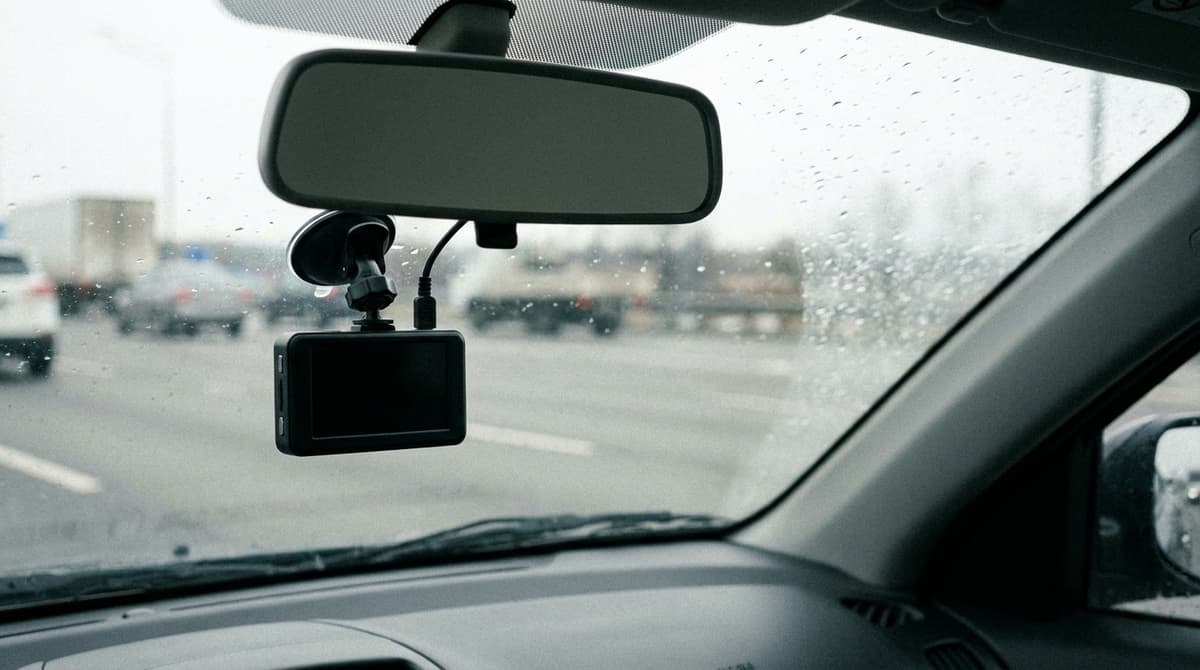
Placement rules differ enough from state to state that the safest approach, especially if you cross state lines, is to mount the camera on the dashboard or in a corner of the windshield that never blocks your view of the road.
Legal Placement of Dashcam
Windshield obstruction laws vary by state, but the general principle is the same. Wisconsin's version, Wis. Stat. section 346.88(3)(b), is typical: "No person shall drive any motor vehicle upon a highway with any object so placed or suspended in or upon the vehicle so as to obstruct the driver's clear view through the front windshield."
What to remember:
- Exact obstruction limits, such as how large an area near a corner of the windshield a device may cover, vary by state. See our windshield mounting restrictions by state guide for your state's specific rule.
- If a dashcam blocks the driver's view, evidence it collected may be challenged or excluded in court.
- An officer can cite or fine a driver for a windshield obstruction violation independent of any accident.
- Courts routinely allow properly obtained dashcam footage to be used as evidence, including against the person who recorded it.
Can Dashcam Footage Be Used Against You?
Yes, courts may use dashcam footage against you in every state. But there is the issue of consent. 13 US states require two-party or all-party consent before anyone can legally record audio of a conversation, including through a dashcam's built-in microphone.
What do I mean?
Privacy and wiretapping laws in your state may prevent dashcam footage from being admitted in legal matters. For example, if the dashcam records audio and you do not have the consent of a passenger or someone outside the vehicle to record audio, that audio track may not be admissible even if the video is.
What You Need to Know About Video Consent Laws
- In most states, video recording is legal with or without the other person's consent.
- Audio recording carries stricter rules than video, since state wiretapping statutes generally regulate audio, not video.
- 13 states require two-party or all-party consent before you can legally record someone's spoken conversation. For a full breakdown of one-party versus all-party states, see our video recording consent guide.
- Recording rules for audio and video vary enough by state that you should confirm your state's specific rule before relying on dashcam audio as evidence. A local traffic attorney can help with state-specific questions.
Dashcam Invasion of Privacy
As mentioned, privacy laws in some states effectively require you to have consent to record audio of people you are not a party to. If you do not, you may face wiretapping-related claims. However, the law allows you to record in any public space where there is no reasonable expectation of privacy.
That means it is legal to record on highways, roads, or other public spaces. What about private residences?
Reasonable Expectation of Privacy
When you park your car at a private residence, it is advisable to turn off your dashcam. Under US common law, intrusion on seclusion is one of the recognized privacy torts. Filming someone who has a reasonable expectation of privacy, such as inside their own home visible from a driveway, can expose you to liability if you deliberately aim the camera at that person.
What to remember:
- Recording without audio carries less legal risk than recording with audio, especially in two-party consent states, since only audio recording triggers wiretapping statutes in most states.
- Avoid pointing the camera at, or recording audio in, places where someone has a reasonable expectation of privacy, such as inside a private residence.
- Passengers in your own vehicle generally have a reduced expectation of privacy, but it is still good practice to tell them the dashcam is recording audio.
- On private property, you must follow the property owner's rules about recording.
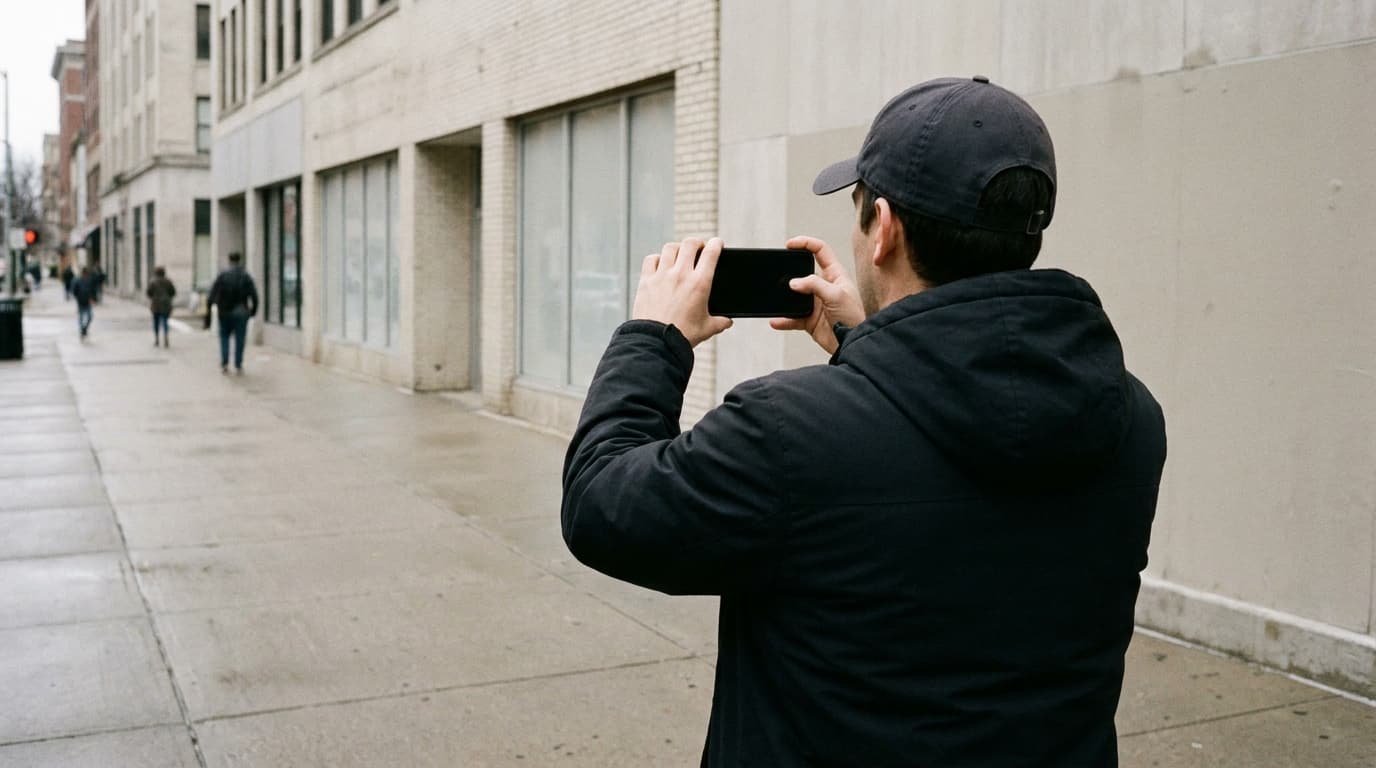
- Recording video or taking photos in public is generally protected activity, and police cannot stop you simply for holding a camera.
- An officer can order you to stop or move if your specific actions, not merely the presence of a camera, are physically interfering with law enforcement operations. This rarely applies to a dashcam that is simply running while parked or driving.
- Police generally need a warrant, your consent, or a recognized emergency exception to seize or view your dashcam footage.
- Recording audio during your own interaction with police, such as a traffic stop, does not require the officer's consent in one-party consent states.
- Filming a federal building from a public street or sidewalk is not illegal by itself; officers need reasonable suspicion or probable cause of a crime before they can detain you over it.
Federal property has its own rules. Under 41 CFR section 102-74.420, part of the GSA's rules governing conduct on federal property, a person may photograph "(a) space occupied by a tenant agency for non-commercial purposes only with the permission of the occupying agency concerned; (b) space occupied by a tenant agency for commercial purposes only with written permission of an authorized official of the occupying agency concerned; and (c) building entrances, lobbies, foyers, corridors, or auditoriums for news purposes."
The Department of Homeland Security's guidance for the Federal Protective Service adds that, absent reasonable suspicion or probable cause, individuals may photograph or videotape the exterior of federally owned or leased facilities from publicly accessible spaces without needing permission.
What About Radar Jammers and Detectors
Radar detectors are legal to own and use in most US states, with two notable exceptions. Virginia (Va. Code section 46.2-1079) makes it unlawful to operate a vehicle equipped with one, and the statute reaches "the presence of any such prohibited device or mechanism in or on a motor vehicle" without the Commonwealth having to prove the device "was in an operative condition or being operated." Virginia does give a driver one narrow out: there is no violation where the device, at the time of the alleged offense, "had no power source and was not readily accessible for use" by the driver or any passenger. An unplugged detector stowed out of reach is therefore treated differently from one sitting on the dash.
Washington, D.C. is stricter. Under 18 DCMR section 736.2, "No person shall use or have in his possession in an automobile in the District any device used to detect or counteract police radar." That section carries no equivalent power-source exception, so simple possession in the vehicle is enough.
Radar jammers are a different matter everywhere. Because a jammer actively transmits a signal to interfere with police radar, it is an illegal unlicensed transmitter under the Communications Act, enforced by the FCC in all 50 states regardless of any state's radar-detector rule.
What to remember:
- Operating a radar jammer is a federal offense under the Communications Act, regardless of state law.
- Radar detectors, as opposed to jammers, are legal to own and use in most states.
- Radar detector legality is a vehicle-equipment issue and is separate from the audio and video consent rules covered earlier on this page.
Are Dashcams Legal in Canada?
Just as in the US, using a dashcam is legal everywhere in Canada. Canada does not have a single national dashcam law. Windshield-obstruction rules come from each province's own highway traffic legislation, the same general approach US states take, so the safe rule is the same: mount the camera where it never blocks your view of the road.
If you are recording in Canada, keep the following in mind:
- Local police services generally encourage dashcam use, and some Canadian insurers offer discounts for vehicles equipped with one.
- Dashcam footage is admissible in Canadian courts and insurance proceedings, similar to the US.
- Radar detectors are legal for personal vehicles in Alberta, Saskatchewan, and British Columbia. Every other province and territory bans them, including Ontario under its Highway Traffic Act, which lets police search for and seize a detector without a warrant. Avoid a dashcam model with a built-in radar or laser detector if you drive through a province where detectors are banned.
- British Columbia is set to become the first Canadian jurisdiction to require dashcams in commercial vehicles. Bill M217, the Dashboard Cameras in Commercial Vehicles Act, is a private member's bill introduced by MLA Ward Stamer. The Legislative Assembly's own progress-of-bills record shows it passed third reading on May 25, 2026 and received Royal Assent on May 28, 2026 as chapter 17 of the 2026 Statutes of British Columbia. It reaches only heavier commercial vehicles, not personal passenger vehicles, and it is not in force yet, because the Act commences by regulation rather than automatically. See the note below before treating it as a live requirement.
If you plan to record audio as well as video in Canada, it is good practice to treat consent the way you would in a two-party consent US state and let passengers know the dashcam is recording.
What British Columbia's Bill M217 actually says
The Act is short, but the version you read matters. BC Laws still publishes the first-reading bill alongside the text the Clerk of the Legislative Assembly certified "correct as passed Third Reading on the 25th day of May, 2026," and the two differ on the points a fleet would actually plan around. Everything below is from the certified third-reading text.
Section 1 defines "commercial vehicle" as a commercial vehicle as defined in BC's Commercial Transport Act "that has a gross vehicle weight rating of more than 11 793 kg." That is a two-part test, not a borrowed list. The Commercial Transport Act supplies the first part, a set of vehicle types that includes a motor vehicle with a permanently attached truck or delivery body, an ambulance, casket wagon, fire apparatus, hearse, motor bus, tow car, road building machine, tractor, most taxis, and combinations of vehicles. Bill M217 then keeps only those rated above 11,793 kg, roughly 26,000 lbs. A vehicle under that rating falls outside the mandate even though it is a commercial vehicle in the ordinary sense, which leaves most taxis, hearses, and light delivery vans out. Note that the test is gross vehicle weight rating, as defined in BC's Motor Vehicle Act, and not the weight a vehicle happens to be carrying on a given trip.
Section 1 also specifies the camera, and those requirements sit in the statute rather than waiting on a regulation. A qualifying "dashboard camera" must continuously record the view of the road in front of the vehicle through the front windshield whenever the vehicle is operating, and must meet four criteria the Act lists: it "retains at least 72 hours of recording," "records at a minimum video format of high-definition video at a resolution of 1080p," "has night vision capability," and "records at the manufacturer's default settings on the device's local storage." The only camera the Act requires is forward facing. Nothing in it calls for an inward-facing camera aimed at the driver or the cab.
The duties are equally brief. The owner of a commercial vehicle must install and maintain a dashboard camera, and where the vehicle is leased that duty falls on the lessee instead of the owner. The operator must ensure the camera "is recording at all times the commercial vehicle is operated, subject to any regulations" and "is not obstructed or prevented from recording."
A privacy section was added before passage, and it is the part of this Act most relevant to anyone handling the footage. Any recording made by a dashboard camera "must be collected, used, disclosed, retained and destroyed in accordance with all applicable privacy and security requirements, including the Personal Information Protection Act." That points fleets at BC's private-sector privacy statute for notice, access, retention, and destruction, which matters because a rolling 72-hour record of a driver's route is personal information about that driver.
What the Act does not do is name an enforcement body or set a penalty. There is no offence section, and the only rule-making power is the general one under section 41 of the Interpretation Act. Commercial vehicle safety rules in BC are administered by the Commercial Vehicle Safety and Enforcement (CVSE) branch of the Ministry of Transportation and Transit, which was renamed from the Ministry of Transportation and Infrastructure in 2024, but the Act itself assigns nothing to CVSE.
Commencement is the detail most likely to trip up a fleet. The first-reading bill said the Act would come into force "on the date that is six months after the date of Royal Assent," and coverage written from that version still repeats the six-month clock. The text passed at third reading dropped it. Section 6 now reads: "This Act comes into force by regulation of the Lieutenant Governor in Council." The Legislative Assembly records Royal Assent on May 28, 2026, so the Act is on the books, but it takes effect only when Cabinet makes the commencement regulation. Watch for that regulation rather than counting six months from assent.
Choosing a Dashcam: Features That Matter Legally
A few features affect how well dashcam footage holds up as evidence or avoids privacy problems, separate from the placement and consent rules above:
- Loop recording overwrites old footage automatically so the camera never fills up, which means you should save any clip you may need before it gets overwritten.
- Parking mode, sometimes called motion or impact detection, keeps the camera recording while the car is parked, which is useful for hit-and-run and vandalism claims. In all-party consent states, consider disabling the audio channel while parked so the camera does not pick up conversations of people who have not consented.
- GPS and timestamp data help authenticate footage in court or an insurance claim by tying the recording to a specific time and location, which is often part of what a court requires to admit footage as evidence.
- Night vision matters because a disproportionate share of crashes and hit-and-runs happen after dark, when footage quality most affects whether a vehicle or driver can be identified.
None of these features change the underlying legal rules on placement or audio consent covered above.
Overall, law enforcement across North America generally encourages dashcam use. Placement is what most often creates legal exposure, not the decision to record, so make sure the camera never blocks your view of the road. If the dashcam also records audio, check whether your state or province is an all-party consent jurisdiction; in those 13 states, tell your passengers the dashcam is recording, while the one-party consent states that make up most of the country do not require notice.
Avoid pointing the camera at, or uploading footage of, a private residence or another clearly private space without the owner's permission, since that can create invasion-of-privacy exposure even though the dashcam itself is legal everywhere in the US and Canada.
Dashcam Laws by State
Our dashcam laws by state guide is the consolidated starting point. It sorts all 50 states and Washington, D.C. into the 37 one-party consent states plus D.C. and the 13 all-party consent states, and links through to each state's own dashcam page.
Every state page in our recording-law library includes a dedicated dashcam section covering local mounting rules, audio-consent status, and how courts treat dashcam evidence. You can also browse by consent rule under one-party consent states or two-party (all-party) consent states, for example California dashcam laws or Texas dashcam laws. For the precise mounting dimensions in your state, see our windshield mounting restrictions by state guide.
Related news
Frequently Asked Questions
Are dashcams legal in the United States and Canada?
Yes. No US state or Canadian province bans dashcams. Every jurisdiction regulates only where you can mount one, through general windshield-obstruction or vehicle-equipment laws rather than a dashcam-specific statute.
Do I have to tell my passengers that my dashcam is recording audio?
Only in all-party consent states, 13 of them including California, Illinois, and Washington. In the one-party consent states that make up most of the country, the driver's own consent is enough and no notice to passengers is legally required.
Can police take my dashcam or its footage without a warrant?
Generally no. Absent evidence of a crime, your consent, or another recognized exception, officers need a warrant to seize or view your dashcam footage.
Is it illegal to record police during a traffic stop with a dashcam?
No. Recording a police officer performing public duties, including your own traffic stop, is generally protected activity, and in one-party consent states your own presence in the conversation satisfies the audio-consent rule.
Are radar detectors legal to use alongside a dashcam?
In most US states, yes. Virginia and Washington, D.C. are the exceptions. D.C. prohibits using or possessing a radar detector in a vehicle outright, while Virginia's ban reaches a detector merely present in the vehicle but provides a defense where the device had no power source and was not readily accessible for use. In Canada, personal-vehicle radar detectors are legal only in Alberta, Saskatchewan, and British Columbia. Radar jammers, which actively interfere with police radar, are a federal offense everywhere in the United States.
Can dashcam footage be used against the driver who recorded it?
Yes. Courts, insurers, and opposing parties can introduce a driver's own dashcam footage as evidence, including footage that shows the recording driver's own traffic violation or fault in a collision.
Updates
Rebuilt the British Columbia section from the text of Bill M217 certified as passed at third reading, replacing an earlier reading that relied on the superseded first-reading bill. As passed, the Dashboard Cameras in Commercial Vehicles Act applies to commercial vehicles with a gross vehicle weight rating over 11,793 kg (about 26,000 lbs), so most taxis and light delivery vehicles fall outside it, and it writes the camera specification into the statute itself: at least 72 hours of retained recording, 1080p minimum, night vision, and recording at manufacturer default settings to local storage. It also carries a privacy duty tied to the Personal Information Protection Act. Corrected the commencement description: the Act as passed comes into force by regulation of the Lieutenant Governor in Council, not on the six-month clock from Royal Assent in the first-reading bill. Status updated to third reading on May 25, 2026 and Royal Assent on May 28, 2026 per the Legislative Assembly's record. Also corrected the ministry name, added the statutory defense in Virginia's radar-detector law and a source for the District of Columbia ban, replaced a dead federal regulation link, and added a link to our 51-state dashcam laws by state guide.
Independently fact-checked against the cited primary sources
Fact-check pass on the British Columbia commercial-vehicle section and the citation list. Rebuilt the section from the text of Bill M217 certified correct as passed at third reading on May 25, 2026, replacing an earlier reading that relied on the superseded first-reading bill. As passed, the Act applies to Commercial Transport Act commercial vehicles with a gross vehicle weight rating over 11,793 kg (about 26,000 lbs), a cutoff that leaves most taxis and light delivery vehicles outside the mandate, and it writes the camera specification into the statute itself: at least 72 hours of retained recording, a minimum 1080p high-definition format, night vision capability, and recording at the manufacturer's default settings to local storage. Added the privacy section, which requires recordings to be collected, used, disclosed, retained and destroyed in accordance with applicable privacy and security requirements, including the Personal Information Protection Act. Corrected the commencement description: the first-reading six-month clock from Royal Assent was dropped, and the Act as passed comes into force by regulation of the Lieutenant Governor in Council. Updated the status to third reading on May 25, 2026 and Royal Assent on May 28, 2026 per the Legislative Assembly's progress-of-bills record. Corrected the ministry name to the Ministry of Transportation and Transit, renamed in 2024. Tightened the Virginia radar-detector line to include the statutory defense for a device with no power source that is not readily accessible, and cited the District of Columbia regulation that had been asserted without a source. Replaced a dead eCFR link for 41 CFR 102-74.420 with a working full-text source, made the certified third-reading bill text the primary Bill M217 citation, and added the committee report and the progress-of-bills record. Added a link to the site's 51-state dashcam laws by state hub, which previously linked here without a link back.
Content audit: repaired five broken WordPress-migration links (including a triple-mangled windshield-mounting link), rewrote the malformed video-consent bullet list, corrected the two-party consent state count and the inaccurate Canada windshield-view claim, removed a stale unregistered Amazon affiliate link and 2022 buying guide, added Virginia/DC and Ontario/Alberta/Saskatchewan/British Columbia radar detector citations, added a note on British Columbia's 2026 commercial-vehicle dashcam mandate (Bill M217), added an FAQ section, and cross-linked to the site's one-party and two-party consent state hubs, individual state dashcam pages, and the windshield mounting restrictions cluster instead of re-stating state-by-state rules.
The Law Behind This Article
This article rests on the statutory provisions below, held in our own legal record and retrieved from the official source. Tap a section to read the operative text.
Commercial Transport Act (British Columbia)
s. 1DefinitionsIn forcecited in 2 of our articles
In this Act: axle means an axle as defined in the regulations; axle unit means an axle unit as defined in the regulations; combination of vehicles means every combination of truck, truck tractor, semi-trailer and trailer; commercial vehicle includes a a motor vehicle having permanently attached to i
Official text (excerpt) · last checked 2026-08-13 · Read the full text in our law library · Verify at bclaws.gov.bc.ca
Highway Traffic Act (Ontario)
s. 79Speed measuring warning devicesIn forcecited in 2 of our articles
(1) In this section, “speed measuring warning device” means any device or equipment designed or intended for use in a motor vehicle to warn the driver of the presence of speed measuring equipment in the vicinity and includes any device or equipment designed or intended for use in a motor vehicle to
Official text (excerpt) · last checked 2026-08-13 · Read the full text in our law library · Verify at ontario.ca
Code of Virginia, Title 46.2: Motor Vehicles
§ 46.2-1079Radar detectors; demerit points not to be awardedIn forcecited in 2 of our articles
A. It shall be unlawful for any person to operate a motor vehicle on the highways of the Commonwealth when such vehicle is equipped with any device or mechanism, passive or active, to detect or purposefully interfere with or diminish the measurement capabilities of any radar, laser, or other device or mechanism employed by law-enforcement personnel to measure the speed of motor vehicles on the highways of the Commonwealth for law-enforcement purposes. It shall be unlawful to use any such device or mechanism on any such motor vehicle on the highways. It shall be unlawful to sell any such device or mechanism in the Commonwealth. However, provisions of this section shall not apply to any receiver of radio waves utilized for lawful purposes to receive any signal from a frequency lawfully licensed by any state or federal agency. This section shall not be construed to authorize the forfeiture to the Commonwealth of any such device or mechanism.
Official text (excerpt) · last checked 2026-07-29 · Read the full text in our law library · Verify at law.lis.virginia.gov
Cited in 1 court opinions in our collectionLatest citing opinion in our collection: 1994
Opinions citing this section in our collection:
- United States v. Christopher J. Brehany (Court of Appeals for the Fourth Circuit 1994, 39 F.3d 1178)“…gton Memorial Parkway in northern Virginia, in violation of Va.Code Ann. Sec. 46.2-1079 (Michie 1994), as assimilated by 36 C.F…”
Identified automatically from the court opinions citing this section — not a ranking of which case controls.
Also relied on in: Are Radar Detectors Legal? State Laws Explained (2026)
Wisconsin Statutes, Chapter 346: Rules Of The Road
§ 346.88Obstruction of operator’s view or driving mechanism.In forcecited in 4 of our articles
(1) No person shall drive a vehicle when it is so loaded or when there are in the front seat such number of persons, or any persons so situated, as to obstruct the view of the operator to the front or to the sides or as to interfere with the operator having free use of both hands and feet to the operating mechanisms or controls of the vehicle. (2) No passenger in a vehicle shall ride in such a position as to interfere with the operator’s view ahead or to the sides or to interfere with the operator’s control of the operating mechanism of the vehicle. (3) (a) No person shall drive any motor vehicle with any sign, poster or other nontransparent material upon the front windshield, front side wings, side windows in the driver’s compartment or rear window of such vehicle other than a certificate or other sticker issued by order of a governmental agency. Such permitted sticker shall not cover more than 15 square inches of glass surface and shall be placed in the lower left-hand corner of the windshield; the left corner being on the driver’s left when seated behind the wheel.
Official text (excerpt) · last checked 2026-09-08 · Read the full text in our law library · Verify at docs.legis.wisconsin.gov
Cited in 1 court opinions in our collectionLatest citing opinion in our collection: 2015
Opinions citing this section in our collection:
- State v. Richard E. Houghton, Jr. (Wisconsin Supreme Court 2015, 364 Wis. 2d 234)“…pull Houghton over for a violation of Wis. Stat. § 346.88(3)(b) (2011-12),3 "Obstruction of opera…”
Identified automatically from the court opinions citing this section — not a ranking of which case controls.
Also relied on in: Wisconsin Dashcam Laws: Mounting Rules, Audio Recording, and Evidence (2026), Windshield Mounting Restrictions by State (2026 Guide), Wisconsin Windshield Mounting Laws
Search our full record of US law — 2.1 million sections, every state + federal →
Sources and References
- Wis. Stat. section 346.88(3)(b) (Obstruction of operator's view or driving mechanism)(docs.legis.wisconsin.gov).gov
- 41 CFR section 102-74.420 (What is the policy concerning photographs for news, advertising, or commercial purposes?), Cornell Legal Information Institute full text(law.cornell.edu)
- 41 CFR section 102-74.420, official text via GovInfo (2024 CFR, Title 41, Vol. 3)(govinfo.gov).gov
- DHS/Federal Protective Service, Operational Readiness Order: Photography and Videotaping Federal Facilities(dhs.gov).gov
- Va. Code section 46.2-1079 (Radar detectors; demerit points not to be awarded), including the subsection B defense for a device with no power source that is not readily accessible for use(law.lis.virginia.gov).gov
- 18 DCMR section 736 (Radar Detectors and Jammers), District of Columbia Municipal Regulations, Title 18 (Vehicles and Traffic)(dcregs.dc.gov).gov
- FCC, Jammer Enforcement(fcc.gov).gov
- Ontario Highway Traffic Act, R.S.O. 1990, c. H.8, s. 79 (Speed measuring warning devices)(ontario.ca).gov
- British Columbia Bill M 217, Dashboard Cameras in Commercial Vehicles Act, text certified correct as passed Third Reading on May 25, 2026 (BC Laws)(bclaws.gov.bc.ca).gov
- Legislative Assembly of British Columbia, Progress of Bills (Members' Bills), 2nd Session, 43rd Parliament: Bill M 217 third reading May 25, 2026, Royal Assent May 28, 2026, S.B.C. chapter 17(bclaws.gov.bc.ca).gov
- Select Standing Committee on Private Bills and Private Members' Bills, Tenth Report on Bill (No. M 217), May 19, 2026 (amendment substituting the gross vehicle weight rating of more than 11 793 kg)(bclaws.gov.bc.ca).gov
- British Columbia Bill M 217, Dashboard Cameras in Commercial Vehicles Act, first reading text (1st Session, 43rd Parliament, 2025), superseded by the third reading text above(bclaws.gov.bc.ca).gov
- Commercial Transport Act, RSBC 1996, c. 58, s. 1 (definition of commercial vehicle, the vehicle-type list Bill M 217 narrows by weight rating)(bclaws.gov.bc.ca).gov
- Province of British Columbia, notice that the Ministry of Transportation and Infrastructure is now the Ministry of Transportation and Transit(www2.gov.bc.ca).gov
- Province of British Columbia, About Commercial Vehicle Safety and Enforcement (CVSE)(www2.gov.bc.ca).gov
- Williams Lake Tribune, Bill requiring dash cams in B.C. commercial vehicles moves forward (May 26, 2026)(wltribune.com)