
Tennessee
Tennessee Car Seat Laws (2026): 5 Stages, Ages & Penalty
Independently fact-checked against primary sources (last audited September 17, 2026). · Reviewed by the RecordingLaw editorial team. · Law checked current as of August 20, 2026. · 2 primary sources cited on this page. How we verify our legal content
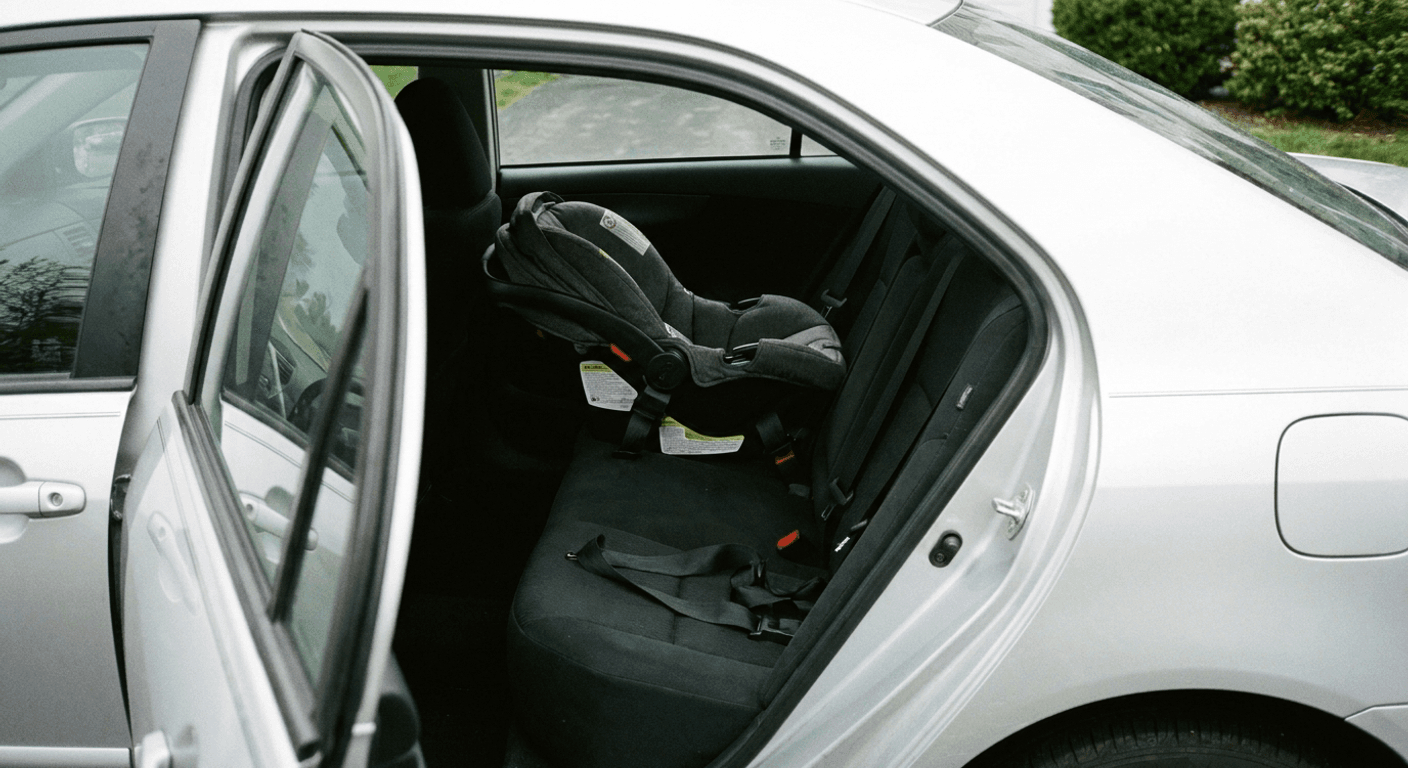
Tennessee runs one of the most granular car seat laws in the country: five separate age-and-size stages running from birth through age 15, under Tenn. Code Ann. § 55-9-602. This page reflects the statute's text as codified.
Jurisdiction scope: This article covers car seat and child-restraint law in the state of Tennessee only. It does not address any other state. For other states, see the car seat laws hub.
| Stage | Who | Rule | Statute |
|---|---|---|---|
| Rear-facing | Under 1 year old, OR 20 lbs or less | Child passenger restraint system in a rear-facing position, in the rear seat if available OR per the manufacturer's instructions | § 55-9-602(a)(1) |
| Forward-facing harness | Age 1-3 AND over 20 lbs | Child passenger restraint system in a forward-facing position, in the rear seat if available OR per the manufacturer's instructions | § 55-9-602(a)(2) |
| Booster | Age 4-8 AND under 4'9" | Belt-positioning booster seat system, in the rear seat if available OR per the manufacturer's instructions | § 55-9-602(a)(3) |
| Seat belt | Age 9-12, OR any age through 12 who is 4'9" or taller | Seat belt system; rear seat recommended, not required | § 55-9-602(g)(1)(A) |
| Seat belt | Age 13-15 | Passenger restraint system, including seat belts | § 55-9-602(g)(1)(B) |
Birth to under 1 (or 20 lbs): rear-facing
Under subsection (a)(1), a child stays in a rear-facing child passenger restraint system if the child is under 1 year of age, or weighs 20 pounds or less, whichever condition keeps the child in this stage longer. A child who is still under 1 but already weighs more than 20 pounds remains covered by this rear-facing stage because the age condition alone is enough; the two conditions are an "or," not an "and." The restraint has to be used "in the rear seat if available or according to the child safety restraint system or vehicle manufacturer's instructions," which is itself a disjunctive: rear-seat placement if a rear seat is available, or compliance with the manufacturer's own instructions, not an unconditional rear-seat mandate.
Age 1 through 3, over 20 lbs: forward-facing harness
Subsection (a)(2) moves a child to a forward-facing child passenger restraint system only once the child satisfies both conditions at once: the child is age 1 through 3 AND weighs more than 20 pounds. A child who turns 1 but still weighs 20 pounds or less stays in the rear-facing stage under (a)(1) rather than moving to this stage, because the forward-facing stage requires both the age and weight thresholds together. This restraint, too, carries the same "rear seat if available or according to the... manufacturer's instructions" language as the rear-facing stage above; it isn't an unconditional rear-seat requirement.
Age 4 through 8, under 4'9": booster
Subsection (a)(3) requires a belt-positioning booster seat system for a child who is age 4 through 8 AND measures less than 4 feet 9 inches in height. Both conditions have to be true together. A child who reaches 4 feet 9 inches before turning 9 is pulled out of this booster stage early, because subsection (g)(1)(A), below, separately covers "any child through twelve (12) years of age, measuring four feet, nine inches (4'9") or more in height" as a seat belt case regardless of that child's exact age. The booster restraint, like the two stages before it, carries the same "rear seat if available or according to the... manufacturer's instructions" disjunctive.
Age 9-12, or 4'9"+ through 12: seat belt, rear seat recommended
Subsection (g)(1)(A) covers a child who is age 9 through 12, or any child through age 12 who measures 4 feet 9 inches or taller (which can pull a younger, taller child out of the booster stage above). At this stage, the law requires a properly adjusted and fastened seat belt system. Rear-seat placement changes character here: the statute says only that "it is recommended that any such child be placed in the rear seat if available," not that the child must be. This is the one stage in Tennessee's law where back-seat placement is advice rather than a legal duty.
Age 13-15: seat belt
Subsection (g)(1)(B) requires a passenger restraint system, including a seat belt, for any child age 13 through 15 riding in a passenger motor vehicle. The statute does not add a rear-seat recommendation or requirement at this stage.
Rear-seat placement: an "or" for the youngest three stages, a recommendation after that
It's worth reading this carefully because the statutory language is easy to misread. For every child covered by subsections (a)(1) through (a)(3), the restraint has to be used "in the rear seat if available or according to the child safety restraint system or vehicle manufacturer's instructions." That's a disjunctive, not a standalone rear-seat mandate: a driver satisfies the requirement either by placing the restraint in the rear seat when one is available, or by following the seat's or vehicle's own manufacturer instructions. Once a child reaches the (g)(1)(A) stage, age 9-12 or 4'9"+ through 12, the law changes character again: it drops to recommending, rather than conditioning compliance on, rear-seat placement ("it is recommended that any such child be placed in the rear seat if available").

Exemptions
A child who cannot safely use a conventional restraint system may instead ride in a specially modified, professionally manufactured restraint system, under subsection (a)(4)(A); the operator has to possess a copy of the physician's signed prescription that authorizes the professional manufacture of that modified system. The statute is explicit that this exception cannot be satisfied simply by using the vehicle's standard lap or shoulder belt on its own, independent of any restraint system. Two relief routes attach to this exception: under (a)(4)(B), presenting a copy of the prescription to the arresting officer at the time of the alleged violation means the person is not charged in the first place; under (a)(4)(C), a person already charged may submit the prescription and evidence of possessing the modified system to the court on or before the court date, and if the court is satisfied compliance was in effect at the time of the violation, the charge may be dismissed.
There is no blanket commercial-vehicle or taxi exemption covering every stage of Tennessee's law. Subsections (a)(1) and (a)(2), the rear-facing and forward-facing stages, apply to any "motor vehicle," an undefined and unrestricted term. Only subsection (a)(3) and subsection (g) use the narrower term "passenger motor vehicle." Subsection (h) defines that term, for purposes of this section, as any motor vehicle with a manufacturer's gross vehicle weight rating of 10,000 pounds or less that is not used as a public or livery conveyance for passengers; the definition doesn't apply to a vehicle not required by federal law to be equipped with safety belts. A commercial vehicle under that weight threshold that isn't a livery conveyance is not exempt from the booster or seat belt stages either.
Penalty
A violation of the age-based restraint requirements in subsection (a) is a Class C misdemeanor under subsection (c)(1). Under (c)(2), a court may additionally, or instead, require a court-approved offenders' class, but only for a first offense; the statute doesn't extend that option to a second or later violation. For the age 9-15 bracket covered by subsection (g), the statute offers a specific alternative: a violator may pay a $50 fine directly to the court clerk in lieu of appearing in court, with no litigation tax or court costs added on top. Subsection (g)(5)(A) adds a citation-limiting and responsibility rule for that same age 9-15 bracket: no more than one citation may be issued per vehicle per occasion, and if the driver is neither the child's parent nor legal guardian but the parent or legal guardian is present in the vehicle, the parent or legal guardian, not the driver, is responsible for ensuring compliance. Tennessee's statute does not tie points to a violation of this section, and it does not describe a general waiver of the fine on proof that a compliant restraint was later purchased. The statute's relief routes are the two physician's-prescription paths in (a)(4)(B) and (a)(4)(C), the first-offense offenders' class under (c)(2), and the $50 payment-in-lieu-of-appearance option under (g)(2) for the age 9-15 brackets.
Leaving a child unattended in a vehicle
Tennessee has a dedicated unattended-child-in-a-vehicle statute separate from the restraint law above, Tenn. Code Ann. § 55-10-803. It's an offense for a person responsible for a child younger than 7 to knowingly leave the child in a motor vehicle located on public property, or on the premises of a shopping center, trailer park, apartment complex, or other premises frequented by the public, without supervision by someone at least 13 years old, if any one of three conditions is present: the surrounding conditions pose a risk to the child's health or safety, the vehicle's engine is running, or the keys are anywhere inside the passenger compartment. Any one of those three triggers is enough on its own; none of them requires the others. A violation is a Class B misdemeanor, punishable by a fine only, $200 for a first offense and $500 for a second or subsequent offense.
Federal guidance vs. Tennessee law
The federal standard governing car seats as products, FMVSS 213 (49 CFR 571.213), sets crash-test and construction requirements a manufacturer must meet before selling a seat; it does not tell a Tennessee driver how or when to use one. That's the job of the staged statute described above. The National Highway Traffic Safety Administration and the American Academy of Pediatrics separately recommend keeping a child rear-facing as long as the seat's own height and weight limits allow, then moving through a forward-facing harness, a booster, and finally a seat belt. That progression is safety guidance layered on top of Tennessee's own statutory stages, not a separate legal requirement, and it can call for staying in an earlier stage longer than the state's own thresholds require.
Related Tennessee traffic law pages
Disclaimer: This article provides general legal information about Tennessee's car seat law as codified. Tennessee's official Code is published through LexisNexis rather than a free, section-linkable state site, so readers who want to check the current official text themselves can do so through Lexis's public Tennessee Code portal, linked below, or through the Tennessee General Assembly's own legislation site. This article is not legal advice. Statutes, exemptions, and penalties change; verify the current text of the law before relying on it, and talk to a lawyer licensed in Tennessee about a specific situation.
Statute text is presented as codified. Tennessee's official Code is Lexis-published rather than hosted on a free, government-run, section-linkable site, so this page states the law as codified rather than asserting a specific current in-force date. Last updated: 2026-09-17.
Frequently Asked Questions
What are Tennessee's car seat age and weight requirements?
Tennessee stages restraint requirements by age and size: rear-facing until age 1 or 20 lbs; forward-facing from age 1-3 and over 20 lbs; a booster from age 4-8 while under 4'9"; a seat belt from age 9-12 or once a child reaches 4'9"; and a seat belt through age 15, under Tenn. Code Ann. section 55-9-602.
Does a car seat have to go in the back seat in Tennessee?
For the rear-facing, forward-facing, and booster stages (generally under age 9), the restraint has to be used in the rear seat if one is available, or according to the seat's or vehicle's own manufacturer instructions; it's an 'or,' not an unconditional rear-seat mandate. For the age 9-12 seat belt stage, rear-seat placement is only recommended, not required.
What is the fine for a car seat violation in Tennessee?
A violation of the age-based restraint law is a Class C misdemeanor. A court may additionally, or instead, require a court-approved offenders' class, but only for a first offense. For the 9-15 age bracket, a violator may instead pay a $50 fine to the court clerk without appearing in court.
Is it illegal to leave a child alone in a car in Tennessee?
Yes, for a child under 7. Tenn. Code Ann. section 55-10-803 makes it an offense to knowingly leave such a child unattended in a vehicle on public property or certain public-facing premises if the engine is running, the keys are inside, or conditions pose a risk to the child's health or safety. It's a Class B misdemeanor, $200 for a first offense.
Are commercial vehicles or taxis exempt from Tennessee's car seat law?
Not entirely. Tennessee's rear-facing and forward-facing infant and toddler stages apply to any motor vehicle, with no commercial exemption. Only the booster and seat belt stages are limited to a defined 'passenger motor vehicle' that excludes vehicles used as a public or livery conveyance.
Updates
Rebuilt from the current statute text after an independent review: restraint stages, exemptions, front-seat rules and penalties re-verified against the statute.
Independently fact-checked against the cited primary sources
Corrected the seat-belt eligibility summary to match the statute's age-9-or-height test rather than an age-8-and-height test, fixed the leaving-a-child-unattended supervisor age from 12 to 13 and added the statute's under-7 scope, and added primary Tennessee Code citations (§ 55-9-602, § 55-10-803) that were previously missing entirely.
Independently fact-checked against the cited primary sources; governing law re-checked for recent changes
Reviewed and approved by an editor
The Law Behind This Article
This article rests on the statutory provisions below, held in our own legal record and retrieved from the official source. Tap a section to read the operative text.
Tennessee Code Annotated
§ 55-9-602Child passenger restraint systems — Violations — Penalties.In forcecited in 2 of our articles
(a)(1) Any person transporting any child, under one (1) year of age, or any child, weighing twenty pounds (20 lbs.) or less, in a motor vehicle upon a road, street or highway of this state is responsible for the protection of the child and properly using a child passenger restraint system in a rear…
Official text (excerpt) · last checked 2021-05-21 · Read the full text in our law library
Cited in 5 court opinions in our collectionLatest citing opinion in our collection: 2026
Opinions citing this section in our collection:
- In Re Braxton M. (Court of Appeals of Tennessee 2026)“…d’s safety, even if he or she is not the driver. See Tenn. Code Ann. § 55-9-602(g)(5)(A) (“If the driver is neit…”
- In Re Azay C. (Court of Appeals of Tennessee 2024)“…y restrained in accordance with the child’s weight and age. Tenn. Code Ann. § 55-9-602. And a parent is responsible for a chil…”
- State v. Jones (Tennessee Supreme Court 2004, 151 S.W.3d 494)“…Jones as a passenger rather than a driver, see Tenn.Code Ann. § 55-9-602(a) (1998) (amended 2004), the child res…”
Identified automatically from the court opinions citing this section — not a ranking of which case controls.
Also relied on in: Car Seat Laws by State 2026: Rear-Facing, Booster, Front Seat Rules
§ 55-10-803Offense of leaving child unattended in motor vehicle — Penalty.In force
(a) It is an offense for a person responsible for a child younger than seven (7) years of age to knowingly leave that child in a motor vehicle located on public property or while on the premises of any shopping center, trailer park, or any apartment house complex, or any other premises that is…
Official text (excerpt) · last checked 2021-05-21 · Read the full text in our law library
Code of Federal Regulations Title 49
§ 571.213Child restraint systems; Applicable unless a vehicle or child restraint system is certified to § 571.213b.In forcecited in 51 of our articles
S1. Scope. This standard specifies requirements for child restraint systems used in motor vehicles and aircraft. S2. Purpose. The purpose of this standard is to reduce the number of children killed or injured in motor vehicle crashes and in aircraft. S3. Application. This standard applies to passenger cars, multipurpose passenger vehicles, trucks and buses, and to child restraint systems for use in motor vehicles and aircraft, manufactured before December 5, 2026. FMVSS No. 213b applies to child restraint systems manufactured on or after December 5, 2026. S4. Definitions. Add-on child restraint system means any portable child restraint system. Backless child restraint system means a child restraint, other than a belt-positioning seat, that consists of a seating platform that does not extend up to provide a cushion for the child's back or head and has a structural element designed to restrain forward motion of the child's torso in a forward impact.
Official text (excerpt) · last checked 2026-07-28 · Read the full text in our law library · Verify at ecfr.gov
Cited in 16 court opinions in our collectionLatest citing opinion in our collection: 2022
Opinions citing this section in our collection:
- Welsh Ex Rel. Welsh v. Century Products, Inc. (District Court, D. Maryland 1990, 745 F. Supp. 313)“…afety Act”) and Federal Motor Vehicle Safety Standard 213, 49 C.F.R. § 571.213 (1989) (“FMVSS 213”). In particular, C…”
- Hendrix Ex Rel. Gp v. Evenflo Co., Inc. (Court of Appeals for the Eleventh Circuit 2010, 609 F.3d 1183)“…meets the requirements imposed by federal regulations. See 49 C.F.R. § 571.213. When used properly, the base is positio…”
- Hendrix v. Evenflo Co. (District Court, N.D. Florida 2009, 255 F.R.D. 568)“…ance requirements and a testing procedure for CRS modules. 49 C.F.R. § 571.213 . Van Arsdell’s mechanical engineering…”
Identified automatically from the court opinions citing this section — not a ranking of which case controls.
Also relied on in: Alabama Car Seat Laws (2026): Ages, Stages & Penalties, Alaska Car Seat Laws (2026): 5 Stages & Penalties, Arizona Car Seat Laws (2026): Booster Age & Penalty Rules
Search our full record of US law — 2.1 million sections, every state + federal →
Sources and References
- Tenn. Code Ann. § 55-9-602, Child passenger restraint systems(lexisnexis.com)
- Tenn. Code Ann. § 55-10-803, Leaving child unattended in motor vehicle(lexisnexis.com)
- Tennessee General Assembly, official legislation and Tennessee Code access point(capitol.tn.gov).gov
- 49 CFR § 571.213, FMVSS No. 213, Child restraint systems(ecfr.gov).gov
- American Academy of Pediatrics, Car Safety Seats: Information for Families(healthychildren.org)