
Michigan
Michigan Car Seat Laws (2026): Ages, Booster & Penalty
Independently fact-checked against primary sources (last audited September 17, 2026). · Reviewed by the RecordingLaw editorial team. · Law checked current as of August 20, 2026. · 5 primary sources cited on this page. How we verify our legal content
Michigan requires a rear-facing car seat until a child turns 2 (or outgrows the seat's own manufacturer limits, whichever comes first), then a forward-facing harness seat until 5, then a booster until age 8 or 4 feet 9 inches, under MCL 257.710d. The statute also requires rear seating whenever the vehicle has a rear seat. This page reflects the statute's text as of September 2026.
Jurisdiction scope: This article covers car seat and child-restraint law in the state of Michigan only. It does not address any other state. For other states, see the car seat laws hub.
| Stage | Who | Rule | Statute |
|---|---|---|---|
| Rear-facing | From birth | Rear-facing child restraint system until the child reaches the seat's own manufacturer weight or height limit, or turns 2, whichever comes first | MCL 257.710d(2)(a) |
| Forward-facing harness | Children who have exited the rear-facing stage | Forward-facing child restraint system with an internal harness until the child reaches the seat's manufacturer limit, or turns 5, whichever comes first | MCL 257.710d(2)(b) |
| Booster | Children who have exited the forward-facing stage | Belt-positioning booster seat secured with a lap-shoulder safety belt until the child reaches 4 feet 9 inches, or turns 8, whichever comes first | MCL 257.710d(2)(c) |
| Front-seat / rear-seat positioning | All three stages above, plus belted children under 13 | Must ride in a rear seat if the vehicle has one; front seat allowed only if all rear seats are occupied by children; a rear-facing seat may go in front only if the front passenger air bag is deactivated | MCL 257.710d(2), 710d(4) |
Rear-facing: birth until 2 or the seat's own limit
Section 710d(2)(a) requires a rear-facing child restraint system until the child meets either of two conditions: reaching the weight or height limit the seat's own manufacturer has set, or turning 2 years old. Because the statute uses "either," a child who outgrows the seat's manufacturer limit before turning 2 can move on early, and a child who is small for their age can stay rear-facing past 2 under the same seat if it still fits, up to whatever the seat itself allows. Michigan's law sets the age-2 floor; it doesn't set an outer limit on how long a family may keep a child rear-facing. This staging is recent: the tie-barred 2024 PA 21 (House Bill 4511), effective April 2, 2025, rewrote section 710d to extend restraint coverage from under-4 to under-8 and create this age/height/weight staging; it did not exist before that date.
Forward-facing harness: after rear-facing, until 5 or the seat's own limit
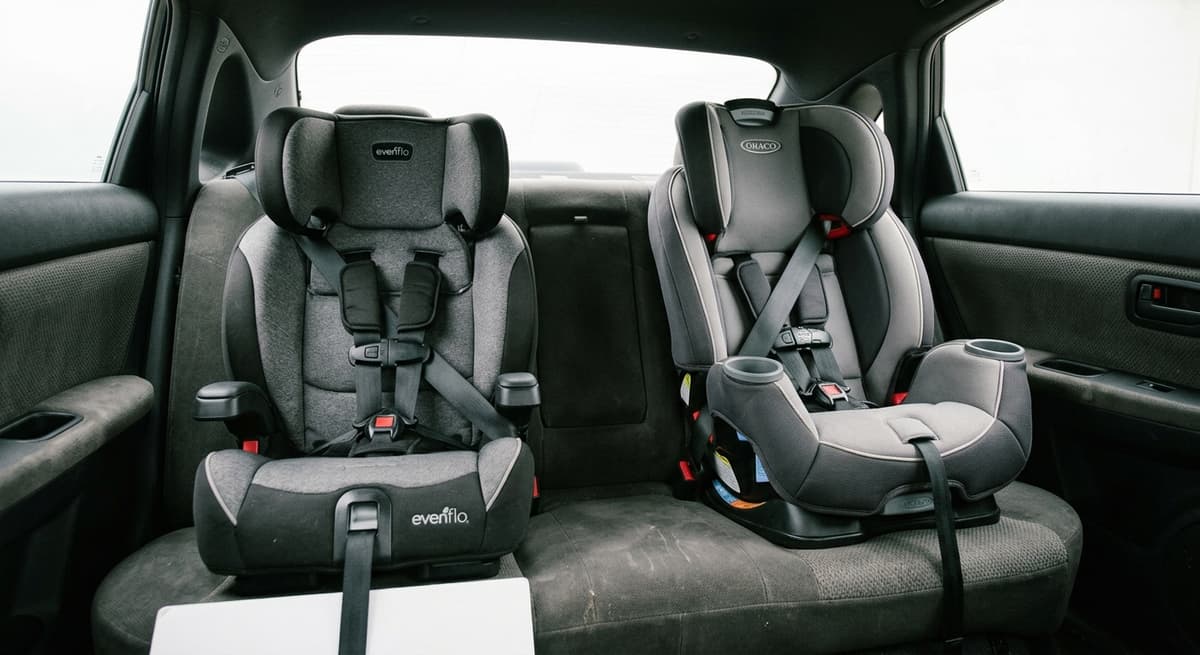
Once a child exits the rear-facing stage, section 710d(2)(b) requires a forward-facing restraint system with an internal harness, again until either the seat's manufacturer weight or height limit is reached or the child turns 5. The same either/or structure applies: whichever threshold arrives first ends this stage.
Booster: after forward-facing, until 8 or 4'9"
Section 710d(2)(c) then requires a belt-positioning booster seat secured with the vehicle's lap-shoulder belt, until the child reaches 4 feet 9 inches in height or turns 8, whichever comes first. Once a child clears the booster stage but is still under 13, section 710d(4) itself keeps governing: the child must wear a properly adjusted and fastened safety belt and still ride in a rear seat if the vehicle has one (front seat only if all rear seats are occupied by children). Michigan's general seat belt law, section 710e, takes over only at 13.
Where the child restraint sits in the vehicle
Section 710d(2) requires a driver to position the child restraint system in a rear seat if the vehicle is equipped with one. A child may be positioned in the front seat only if all available rear seats are already occupied by children. A child in a rear-facing child restraint system may be placed in the front seat only if the front passenger air bag is deactivated. That same rear-seat rule carries over to the post-booster, under-13 seat belt stage under 710d(4).
Exemptions
Section 710d(6) exempts buses, school buses, taxicabs, mopeds, motorcycles, and any other motor vehicle that federal law or regulations do not require to be equipped with safety belts in the first place. The statute doesn't carve out a separate physician-certification exemption in its own text; a medical exception, if one exists, runs through the Secretary of State's rulemaking authority rather than a self-executing doctor's note provision written into 710d itself.
Penalty and the 2024 change to the fine waiver
A violation of MCL 257.710d is a civil infraction, and the civil fine itself is capped at $10 under MCL 257.907(2)(n), among the smallest car seat fine caps in the country. That $10 figure is not the full exposure: a court may also tax costs of up to $100 under 907(4), and must add a $40 justice system assessment under 907(12) in most cases (the assessment does not apply when the total fine and costs come to $10 or less).
A court has long been able to waive that fine, cost, or assessment under 907(11) on evidence, supplied before the appearance date on the citation, that the driver acquired, purchased, or rented a child seating system meeting 710d's requirements. That waiver isn't new. What changed is 2024 PA 22, effective April 2, 2025: it added a second requirement to the same waiver, evidence that the driver also received education from a certified child passenger safety technician. The amendment narrowed an existing waiver route; it didn't create the waiver itself. It is the staging itself, not the waiver, that is new: the tie-barred 2024 PA 21 (House Bill 4511), also effective April 2, 2025, created the age-2 rear-facing threshold, the age-5 forward-facing threshold, and the age-8/4'9" booster threshold described above and extended restraint coverage from under-4 to under-8.
Leaving a child unattended in a vehicle
Michigan has a dedicated unattended-child statute, MCL 750.135a, separate from the restraint law above. It covers a "child," defined as an individual less than 6 years of age, and prohibits a person responsible for that child's care from leaving the child unattended in a vehicle "for a period of time or under circumstances posing an unreasonable risk of harm or injury." That's a contextual standard, not a fixed number of minutes. Penalties scale with outcome: a base misdemeanor if no injury results (up to 93 days and a $500 fine), an enhanced misdemeanor if the child suffers non-serious physical harm (up to 1 year and $1,000), a felony if the child suffers serious physical harm (up to 10 years and $5,000), and a felony if the child dies (up to 15 years and $10,000).
Federal guidance vs. Michigan law
The federal standard governing car seats as products, FMVSS 213 (49 CFR 571.213), regulates what a manufacturer may sell, not how a driver must use the seat; Michigan's own statute, described above, sets the use requirement. NHTSA and the American Academy of Pediatrics separately recommend keeping a child rear-facing as long as the seat's own height and weight limits allow, which can mean well past age 2. That's safety guidance, not a separate legal floor, and it can call for a longer rear-facing period than Michigan's own age-2 threshold requires. A newer federal side-impact standard for car seats themselves, FMVSS 213a/213b, becomes mandatory for manufacturers on December 5, 2026; it changes what a seat must be built to withstand, not what Michigan law requires a driver to do.
Related Michigan traffic law pages
Disclaimer: This article provides general legal information about Michigan's car seat law as of September 2026. It is not legal advice. Statutes, exemptions, and penalties change; verify the current text of the law before relying on it, and talk to a lawyer licensed in Michigan about a specific situation.
Statutes cited reflect their in-force version as of 2026-09-16. Last updated: 2026-09-16.
Frequently Asked Questions
Until what age does a child need a car seat in Michigan?
A child needs a rear-facing seat until 2 (or the seat's manufacturer limit, if earlier), then a forward-facing harness seat until 5, then a booster until 8 or 4 feet 9 inches, under MCL 257.710d.
When can a child face forward in a car seat in Michigan?
At age 2, or earlier if the child reaches the rear-facing seat's own manufacturer weight or height limit first, under MCL 257.710d(2)(a).
Does Michigan require a child restraint to go in the back seat?
Yes. Section 710d(2) requires the child restraint to be positioned in a rear seat if the vehicle has one. The front seat is allowed only if all available rear seats are already occupied by children, and a rear-facing seat may go in front only if the front passenger air bag is deactivated. The same rear-seat rule applies to belted children under 13 under 710d(4).
Can you get a Michigan car seat fine waived?
Yes. A court can waive the fine, cost, and assessment on proof, supplied before the appearance date on the citation, that the driver acquired a child seating system. As of 2024 PA 22, effective April 2, 2025, the waiver also requires proof the driver received education from a certified child passenger safety technician.
What is the penalty for a car seat violation in Michigan?
It's a civil infraction with a civil fine capped at $10 under MCL 257.907(2)(n), one of the lowest fine caps in the country. A court can also tax costs of up to $100 and, in most cases, add a $40 justice system assessment.
Is it illegal to leave a young child alone in a car in Michigan?
Yes. MCL 750.135a makes it a crime to leave a child under 6 unattended in a vehicle for a period of time or under circumstances posing an unreasonable risk of harm. Penalties range from a 93-day misdemeanor up to a 15-year felony depending on whether the child is injured or killed.
Updates
Rebuilt from the current statute text after an independent review: restraint stages, exemptions, front-seat rules and penalties re-verified against the statute.
Independently fact-checked against the cited primary sources
Independently fact-checked against the cited primary sources; governing law re-checked for recent changes
Corrected the child-left-unattended penalty (MCL 750.135a) to reflect that it escalates from a misdemeanor to a 10-15 year felony when the child is harmed or dies, rather than being uniformly a misdemeanor.
Governing law re-checked for recent changes
Reviewed and approved by an editor
The Law Behind This Article
This article rests on the statutory provisions below, held in our own legal record and retrieved from the official source. Tap a section to read the operative text.
Michigan Compiled Laws
§ 257.710dChild restraint system required; position; exceptions; violation as civil infraction; points; abstract; exemption by rules; alternate means of protectionIn forcecited in 2 of our articles
(1) Except as provided in this section, or as otherwise provided by law, a rule promulgated under the administrative procedures act of 1969, 1969 PA 306, MCL 24.201 to 24.328, or federal regulation, each driver transporting a child in a motor vehicle shall properly secure that child in a child restraint system that meets the standards prescribed in 49 CFR 571.213. (2) A driver transporting a child as required under subsection (1) shall position the child in the child restraint system in a rear seat, if the vehicle is equipped with a rear seat. If all available rear seats are occupied by children, then a child may be positioned in the child restraint system in the front seat. A child in a rear-facing child restraint system may be placed in the front seat only if the front passenger air bag is deactivated. In addition, a child must be seated and positioned in a child restraint system as follows: (a) A child must be restrained in a rear-facing child restraint system until the child meets either of the following conditions: (i) The child has reached the weight or height limit of the rear-facing child restraint system set by the manufacturer.
Official text (excerpt) · last checked 2026-09-14 · Read the full text in our law library · Verify at legislature.mi.gov
Cited in 4 court opinions in our collectionLatest citing opinion in our collection: 2016
Opinions citing this section in our collection:
- People v. Nix (Michigan Court of Appeals 2013, 301 Mich. App. 195)“…ither seatbelts or legally mandated child safety seats. See MCL 257.710d. Defendant contends that the prosecut…”
- Farm Bureau Mutual Insurance v. Stark (Michigan Supreme Court 1991, 437 Mich. 175)“…7.705(l)(a); MSA 9.2405(l)(a), MCL 257.679a; MSA 9.2379(1), MCL 257.710d(3); MSA 9.2410(4)(3), MCL 257.801e; MSA…”
- Fire Insurance Exchange v. Fox (Michigan Court of Appeals 1988, 167 Mich. App. 710)“…ification of title provision); MCL 257.679a; MSA 9.2379(1), MCL 257.710d(3); MSA 9.2410(4X3) (child restraint pr…”
Identified automatically from the court opinions citing this section — not a ranking of which case controls.
§ 257.907Civil infraction; payment of civil fine and costs; certification of repair of defective equipment; collection of civil fines or costs; waiver of fine, cost, and assessment; civil infraction arising out of ownership or operation of commercial quadricycle; "moving violation" definedIn forcecited in 4 of our articles
(1) A violation of this act, or a local ordinance that substantially corresponds to a provision of this act, that is designated a civil infraction must not be considered a lesser included offense of a criminal offense. (2) Permission may be granted for payment of a civil fine and costs to be made within a specified period of time or in specified installments but, unless permission is included in the order or judgment, the civil fine and costs must be payable immediately. Except as otherwise provided, a person found responsible or responsible "with explanation" for a civil infraction must pay costs as provided in subsection (4) and 1 or more of the following civil fines, as applicable: (a) Except as otherwise provided, for a civil infraction under this act or a local ordinance that substantially corresponds to a provision of this act, the person must be ordered to pay a civil fine of not more than $100.00. (b) If the civil infraction was a moving violation that resulted in an at-fault collision with another vehicle, an individual, or any other object, the civil fine ordered under this section is increased by $25.00 but the total civil fine must not be more than $100.00.
Official text (excerpt) · last checked 2026-07-30 · Read the full text in our law library · Verify at legislature.mi.gov
Cited in 7 court opinions in our collectionLatest citing opinion in our collection: 2020
Opinions citing this section in our collection:
- Board of Library Commissioners v. Judges of the 70th District Court (Michigan Court of Appeals 1982, 118 Mich. App. 379)“…ts represented approximately 89% and fines 11%. Pursuant to MCL 257.907(3); MSA 9.2607(3), amounts collected th…”
- In re Justin (Michigan Supreme Court 2012, 490 Mich. 394)“…nd 3(A)(5) of the Code of Judicial Conduct; MCL 257.32¿(3); MCL 257.907(9); and MCL 257.732. Additionally, the…”
- in Re Hon James M Justin (Michigan Supreme Court 2012)“…sly not limited to, violations of MCL 257.732; MCL 257.328; MCL 257.907; MCL 769.1(f); MCL 769.6; MCL 771.1(2);…”
Identified automatically from the court opinions citing this section — not a ranking of which case controls.
Also relied on in: Michigan Windshield Mounting Laws (2026 Guide)
§ 750.135aLeaving child unattended in vehicle; prohibition; violation; definitionsIn forcecited in 2 of our articles
(1) A person who is responsible for the care or welfare of a child shall not leave that child unattended in a vehicle for a period of time that poses an unreasonable risk of harm or injury to the child or under circumstances that pose an unreasonable risk of harm or injury to the child. (2) A person who violates this section is guilty of a crime as follows: (a) Except as otherwise provided in subdivisions (b) to (d), the person is guilty of a misdemeanor punishable by imprisonment for not more than 93 days or a fine of not more than $500.00, or both. (b) If the violation results in physical harm other than serious physical harm to the child, the person is guilty of a misdemeanor punishable by imprisonment for not more than 1 year or a fine of not more than $1,000.00, or both. (c) If the violation results in serious physical harm to the child, the person is guilty of a felony punishable by imprisonment for not more than 10 years or a fine of not more than $5,000.00, or both. (d) If the violation results in the death of the child, the person is guilty of a felony punishable by imprisonment for not more than 15 years or a fine of not more than $10,000.00, or both.
Official text (excerpt) · last checked 2026-07-30 · Read the full text in our law library · Verify at legislature.mi.gov
Cited in 2 court opinions in our collectionLatest citing opinion in our collection: 2019
Opinions citing this section in our collection:
- People of Michigan v. Terra Lee Haveman (Michigan Court of Appeals 2019)“…JJ. PER CURIAM. At issue in this case is whether MCL 750.135a, which proscribes leaving children “una…”
- People of Michigan v. Audrionna Maria Rhoades (Michigan Court of Appeals 2015)“…leaving a child unattended in a vehicle resulting in death, MCL 750.135a(2)(d). We affirm. This case ari…”
Identified automatically from the court opinions citing this section — not a ranking of which case controls.
Search our full record of US law — 2.1 million sections, every state + federal →
Sources and References
- MCL 257.710d, child restraint systems required: age/height/weight staging, rear-seat positioning, exceptions (official statute text, amended by 2024 PA 21 eff. Apr. 2, 2025)(legislature.mi.gov).gov
- MCL 257.907, civil infractions: fines, costs, and the child-seating-system waiver (official statute text, amended by 2024 PA 22 eff. Apr. 2, 2025)(legislature.mi.gov).gov
- MCL 750.135a, child left unattended in vehicle: definitions and tiered penalties(legislature.mi.gov).gov
- 2024 PA 21 (enrolled House Bill 4511), effective April 2, 2025, tie-barred to 2024 PA 22: created the current 710d age/height/weight staging and extended restraint coverage from under-4 to under-8(legislature.mi.gov).gov
- 49 CFR 571.213, FMVSS No. 213: child restraint systems, federal product standard(ecfr.gov).gov
- American Academy of Pediatrics, Car Safety Seats: Information for Families(healthychildren.org)