
Massachusetts
Massachusetts Recording Laws (2026): Two-Party Consent Rules
Independently fact-checked against primary sources (last audited August 22, 2026). · Reviewed by the RecordingLaw editorial team. · Law checked current as of August 22, 2026. · 21 primary sources cited on this page. How we verify our legal content

Massachusetts prohibits secretly recording any wire or oral communication under Mass. Gen. Laws ch. 272, Section 99. The law targets secrecy, not formal consent: if all parties know a recording is being made, no violation occurs. Illegal interception is a felony carrying up to five years in state prison and a $10,000 fine, with civil damages on top.
Massachusetts recording law at a glance
| Question | Answer |
|---|---|
| Consent rule | Secret recording prohibited (all-party awareness required) |
| Main statute | Mass. Gen. Laws ch. 272, Section 99 |
| When is recording illegal? | When done secretly, without the knowledge of any party |
| Criminal penalty | Up to 5 years state prison and $10,000 fine (interception); up to 2 years house of correction and $5,000 fine (disclosure/use) |
| Civil penalty | $100/day or $1,000 minimum (whichever is greater), plus punitive damages and attorney fees |
| Hidden cameras | Secretly recording a nude or partially nude person where privacy is expected is a crime under Section 105; non-consensual intimate images under ch. 265, Section 43A |
| Recording police | Protected by First Amendment (Glik v. Cunniffe, 1st Cir. 2011; Project Veritas v. Rollins, 1st Cir. 2020); separately, troopers who openly used body cameras beside a posted recording sign did not "willfully" intercept under Section 99 (Grimaldi, SJC 2026) |
For the full in-depth analysis, see the Massachusetts recording laws in depth section below.
Recording in-person conversations in Massachusetts

Under Mass. Gen. Laws ch. 272, Section 99(B)(4), "interception" means to secretly hear, secretly record, or aid another to secretly hear or secretly record the contents of any wire or oral communication. The word "secretly" is the operative element of every offense under the statute.
An "oral communication" under Section 99(B)(2) is "speech, except such speech as is transmitted over the public air waves by radio or other similar device." Speech broadcast over public radio waves falls outside the definition entirely.
The analysis for in-person conversations turns on two questions: Was the conversation a private oral communication (did the speakers have a reasonable expectation it would not be intercepted)? Was the recording done secretly? If both are true, Section 99 is violated.
Open recording eliminates the secrecy element. Placing a visible voice recorder on a table before a meeting is lawful. Hiding a phone in a pocket to record the same conversation is a felony. An announced recording satisfies the statute; no formal written consent is required.
Commonwealth v. Hyde, 434 Mass. 594 (2001) confirmed that Massachusetts has no participant exception. A conversation participant who secretly records commits the same offense as a third-party eavesdropper. Good intentions are not a defense: recording someone secretly to document wrongdoing remains a felony under Section 99.
Curtatone v. Barstool Sports, Inc., 487 Mass. 655 (2021) illustrates the same secrecy-not-identity point from the other direction: a Barstool reporter who used a false name to get Somerville's mayor on the phone did not commit an interception, because the mayor knew the call itself was being recorded. It is the recording being concealed that violates Section 99, not the recorder's true identity.
Commonwealth v. Du, 495 Mass. 103 (2024) (SJC-13557, decided Nov. 27, 2024) held that the suppression remedy under Section 99(P) extends to both the audio and video components of an unlawful interception: where police secretly record an oral communication without a warrant, the entire recording must be suppressed, not just the audio track. Du did not decide whether that recording was secret: the Commonwealth's argument that the officer's cell phone was visible to the defendant was raised for the first time on appeal and held waived, leaving the motion judge's conclusion that the defendant was secretly recorded undisturbed.
Recording phone calls in Massachusetts
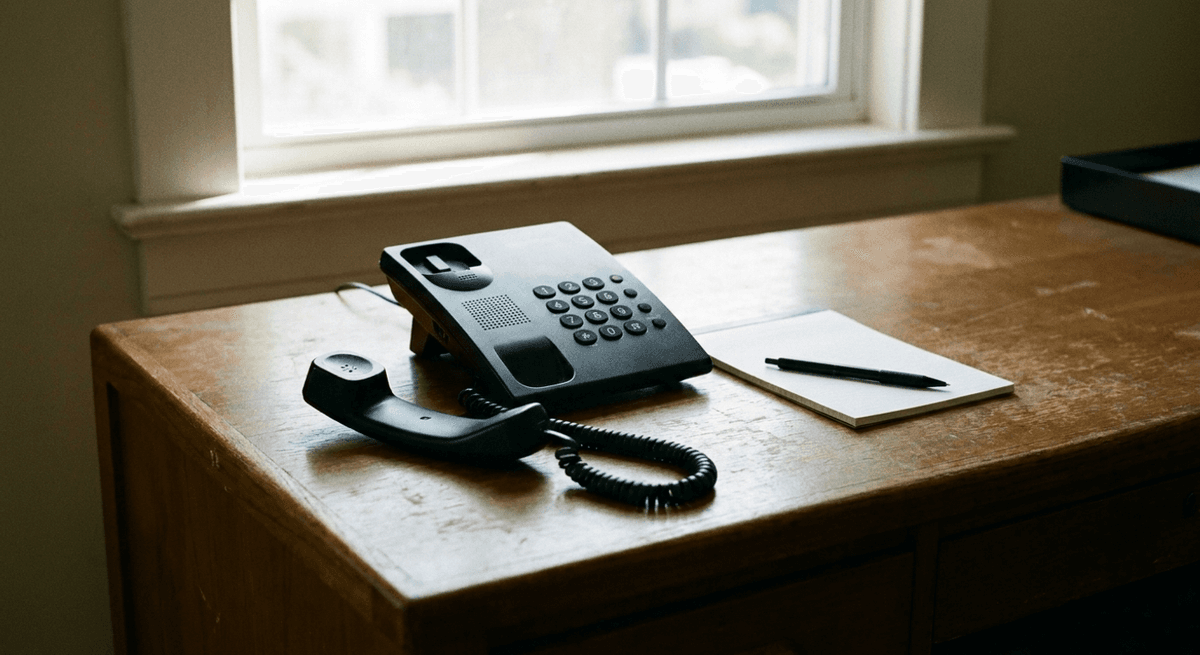
The same rule applies to telephone calls. Recording a phone call in Massachusetts without informing all participants violates Section 99. A verbal announcement at the start of the call is the safest approach. The automated message "this call may be recorded for quality assurance" satisfies the statute because it puts all parties on notice before the conversation begins.
When a call crosses state lines, apply Massachusetts law regardless of where the other party is located. The federal one-party consent baseline under 18 U.S.C. § 2511(2)(d) does not override Massachusetts law for recordings made in-state.
For full rules on business call recording, VoIP, and interstate calls, see the Massachusetts Phone Call Recording Laws page.
For a quick look at how Massachusetts's secret-recording rule compares with another state's, use our recording consent checker.
Hidden cameras, doorbells, and nanny cams
Mass. Gen. Laws ch. 272, Section 105 prohibits criminal voyeurism. The offense reaches willfully photographing, videotaping, or electronically surveilling a person who is "nude or partially nude," with the intent to secretly conduct or hide the activity, where that person would have a reasonable expectation of privacy and has not given knowledge and consent. Separate paragraphs cover so-called upskirt recording of "the sexual or other intimate parts of a person under or around the person's clothing." The base offense carries up to 2.5 years in a house of correction and a fine up to $5,000. Where the subject of an upskirt recording is a child under 18, the penalty rises to up to 5 years in state prison and a $10,000 fine.
Governor Healey signed St. 2024, ch. 118 in June 2024, and it took effect September 18, 2024. The law amended Mass. Gen. Laws ch. 265, Section 43A to add criminal and civil causes of action for non-consensual disclosure of intimate images, with a companion juvenile provision at Mass. Gen. Laws ch. 272, Section 29D. A first offense carries fines up to $10,000 and up to 2.5 years in a house of correction; a second or subsequent offense raises the fine to up to $15,000 and allows up to 10 years in state prison. This is separate from Section 99: it does not require proving audio interception, and it covers distribution as well as capture.
Silent video recording in public spaces is generally permitted because no wire or oral communication is being intercepted. A camera that also records audio falls under Section 99's secrecy prohibition. Employers and business owners who install security cameras with audio capability should post visible signage and notify employees.
For more detail, see Massachusetts Voyeurism and Hidden Camera Laws and Massachusetts Security Camera Laws.
Penalties for illegal recording in Massachusetts
Violating Section 99 carries serious criminal and civil consequences. There is no reduced-penalty misdemeanor tier for the interception offense itself.
Criminal penalties
| Offense | Max prison | Max fine |
|---|---|---|
| Secret interception (Section 99(C)(1)) | 5 years state prison, or 2.5 years house of correction | $10,000 |
| Possession of intercepting device with intent (Section 99(C)(5)) | 2 years house of correction | $5,000 |
| Disclosure of illegally intercepted communications (Section 99(C)(3)) | 2 years house of correction | $5,000 |
| Using illegally intercepted communications (Section 99(C)(3)) | 2 years house of correction | $5,000 |
Civil liability under Section 99(Q)
An aggrieved party may recover actual damages, or a minimum of $100 per day of violation or $1,000 (whichever is greater) if actual damages are less. Courts may also award punitive damages and reasonable attorney fees. The per-day calculation can result in substantial exposure for ongoing violations.
Suppression under Section 99(P)
Section 99(P) provides that any person "who is a defendant in a criminal trial in a court of the commonwealth may move to suppress the contents of any intercepted wire or oral communication or evidence derived therefrom." By its own terms it is a suppression remedy for criminal defendants. Section 99 contains no general rule making illegally recorded evidence inadmissible in civil proceedings.
The exposure in a divorce, custody, or other civil case runs through different provisions. Section 99(C)(3) makes it a crime to willfully use or disclose the contents of a communication knowing it was obtained through interception, and Section 99(Q) gives the recorded party a civil damages claim. Before offering a secretly made recording in any Massachusetts proceeding, ask a Massachusetts attorney how those provisions apply to your situation.
Recording the police in Massachusetts
Recording police officers performing official duties in a public place is constitutionally protected under the First Amendment. This right traces to Glik v. Cunniffe, 655 F.3d 78 (1st Cir. 2011), where the First Circuit held that Simon Glik had a clearly established First Amendment right to openly film Boston police officers making an arrest on Boston Common, and that his arrest under Section 99 violated that right. The First Circuit extended this protection in Project Veritas Action Fund v. Rollins, 982 F.3d 813 (1st Cir. 2020), holding that Section 99 violates the First Amendment in criminalizing the secret, nonconsensual audio recording of police officers discharging their official duties in public spaces. Together, these cases extend First Amendment protection to both open and secret recording of on-duty police officers in public spaces. Neither case creates a right to secretly record private citizens or government officials generally.
The SJC addressed a related question in Commonwealth v. Grimaldi (SJC-13842, decided June 2, 2026). State troopers used openly displayed bodycams and posted a large roadside sign announcing audio-visual recording at a sobriety checkpoint. The SJC held that the troopers did not commit a "willful" interception under Section 99 because willfulness requires "an intent to secretly record -- i.e., an intent to record someone without their knowledge." The open display of cameras and the visible warning sign showed the troopers had no intent to secretly record; the court expressly declined to decide whether the recording was in fact secret. The ruling confirms that openly displayed police recording equipment at announced checkpoints does not violate the wiretap statute.
Officers cannot order you to stop recording or confiscate your device when you are recording them in a public space while they perform official duties.
For complete coverage, see Massachusetts Laws on Recording Police.
Special topics in Massachusetts
Workplace recording
Massachusetts employees retain full Section 99 rights in the workplace. Employers who secretly record employee conversations without notification violate state law. Employees who secretly record workplace meetings are equally subject to Section 99, even when their purpose is to document alleged discrimination or harassment. Hyde leaves no room for a sympathetic-purpose exception. For full analysis, see Massachusetts Workplace Recording Laws.
Federal NLRA overlay
Under Stericycle, Inc., 372 NLRB No. 113 (Aug. 2, 2023), employer workplace recording prohibitions are presumptively unlawful under Section 7 of the NLRA unless the employer shows a legitimate justification that outweighs employee rights. A broadly written no-recording policy may violate the NLRA even if it complies with Section 99. NLRB GC Memorandum GC 25-07 (June 25, 2025) provides prosecutorial guidance directing regional offices to treat surreptitious recording of collective-bargaining sessions as a per se unfair labor practice; this is Tier 2 guidance, not binding Board precedent.
Website tracking and Section 99
Vita v. New England Baptist Hospital, 494 Mass. 824 (2024) (SJC-13542) held that website tracking technologies such as Google Analytics and Meta Pixel do not violate Section 99. The SJC ruled that Section 99 was designed to protect person-to-person communications and does not extend to automated data collection through web browsing. The decision does not affect the all-party awareness rule for audio or oral communications.
Federal law overlay (ECPA, TCPA)
The federal Electronic Communications Privacy Act permits a participant to record a conversation under 18 U.S.C. § 2511(2)(d) without telling the other party, provided the recording is not for a criminal or tortious purpose. Massachusetts state law is stricter and prevails for recordings made in-state. The FCC One-to-One Consent Rule (FCC DA 24-17) was vacated by the Eleventh Circuit; the mandate issued April 30, 2025, and the rule is not in force.
Medical recordings and HIPAA
A patient recording a conversation with a healthcare provider must do so openly under Section 99. If the provider is a HIPAA-covered entity, the recording may also implicate protected health information disclosure obligations under 45 CFR § 164.502. See Massachusetts Medical Recording Laws.
School recordings and FERPA
Recording an IEP or school meeting is subject to both Section 99 (open recording required) and FERPA (20 U.S.C. § 1232g) limits on capturing third-party student information. Advance written notice to the school satisfies the Section 99 openness requirement and IDEA procedural safeguards. See Massachusetts School Recording Laws.
Public body meetings
Massachusetts' open meeting law, Mass. Gen. Laws ch. 30A, Section 20, lets any person record an open session of a public body, such as a city council, select board, or school committee meeting, after notifying the chair. The chair may set reasonable rules on the placement and operation of recording equipment so it does not disrupt the meeting, but cannot prohibit recording outright. This right applies only to open sessions; executive sessions remain closed to the public and are not covered.
Recent legal developments
- June 2, 2026: Commonwealth v. Grimaldi (SJC-13842) decided. The SJC held that openly displayed bodycams with visible warning signage do not constitute willful secret recording under Section 99. "Willfulness" requires an intent to secretly record.
- June 2024 (signed) / September 18, 2024 (effective): St. 2024, ch. 118 amended Mass. Gen. Laws ch. 265, Section 43A, and added ch. 272, Section 29D, creating criminal and civil causes of action for non-consensual disclosure of intimate images.
- 2024: Vita v. New England Baptist Hospital, 494 Mass. 824 (2024) held that website tracking technologies (Google Analytics, Meta Pixel) do not violate Section 99.
- Pending - S.1215: Received a favorable report from the Joint Committee on the Judiciary on October 9, 2025; currently in Senate Ways and Means. If enacted, would create a participant exception for recordings made to document workplace harassment, domestic abuse, or civil rights violations. Not enacted as of June 2026.
Massachusetts recording laws in depth
Want to know more about how Massachusetts law applies to your situation? The pages below provide dedicated, in-depth coverage of each major context.
By type of recording
- Massachusetts Audio Recording Laws
- Massachusetts Video Recording Laws
- Massachusetts Voyeurism and Hidden Camera Laws
- Massachusetts Phone Call Recording Laws
- Massachusetts Dashcam Laws
- Massachusetts Security Camera Laws
By place or relationship
- Massachusetts Workplace Recording Laws
- Massachusetts Laws on Recording Police
- Massachusetts Laws on Recording in Public
- Massachusetts School Recording Laws
- Massachusetts Medical Recording Laws
- Massachusetts Landlord-Tenant Recording Laws
More Massachusetts laws
- Massachusetts AI Meeting Recording Laws
- Massachusetts At-Will Employment Laws
- Massachusetts Data Privacy Laws
- Massachusetts Divorce Laws
- Massachusetts Landlord-Tenant Laws
This article is general legal information, not legal advice. Recording laws change and apply differently to each situation. For advice about your situation, consult a licensed Massachusetts attorney.
More Massachusetts Laws
- Massachusetts AI Meeting Recording Laws
- Massachusetts Dashcam Laws
- Massachusetts Data Privacy Laws
- Massachusetts Deepfake Laws
- Massachusetts Employee Monitoring Laws
- Massachusetts GPS Tracking Laws
- Massachusetts Police Bodycam Laws
- Massachusetts Smart Glasses Recording Laws
Frequently Asked Questions
Is Massachusetts a one-party or two-party consent state?
Massachusetts is a 'secret recording' state, not a simple one- or two-party consent state. Under Mass. Gen. Laws ch. 272, Section 99, recording a private conversation is prohibited when done secretly, meaning without the knowledge of any party. If all participants know that recording is taking place, no violation occurs, even without formal verbal consent from each person. This standard is functionally stricter than most two-party consent states.
Can I record my own conversations in Massachusetts?
Only if you do so openly. Recording a conversation you are part of, without telling the other person, is a felony under Section 99. Commonwealth v. Hyde, 434 Mass. 594 (2001) confirmed that Massachusetts has no participant exception. A conversation participant who secretly records commits the same offense as a third-party eavesdropper.
What is the penalty for illegally recording someone in Massachusetts?
Criminal penalties for secret interception include up to 5 years in state prison (or 2.5 years in a house of correction) and a $10,000 fine. Civil liability allows an aggrieved party to recover a minimum of $100 per day of violation or $1,000 (whichever is greater), plus punitive damages and attorney fees. Section 99(P) also lets a defendant in a Massachusetts criminal trial move to suppress an unlawfully intercepted recording, and Section 99(C)(3) makes willfully using or disclosing a communication known to have been illegally intercepted a separate crime.
Can I record police in Massachusetts?
Yes. Recording police performing official duties in a public place is protected by the First Amendment. Glik v. Cunniffe, 655 F.3d 78 (1st Cir. 2011), recognized a right to openly record police officers discharging their duties in public, and Project Veritas Action Fund v. Rollins, 982 F.3d 813 (1st Cir. 2020), held Section 99 unconstitutional as applied to the secret, nonconsensual audio recording of police officers discharging their official duties in public spaces. The SJC confirmed in Commonwealth v. Grimaldi (SJC-13842, June 2, 2026) that openly displayed police bodycams with visible warning signs do not constitute willful secret recording under the wiretap statute.
Can my employer record me at work in Massachusetts?
Not secretly. Employers must notify employees before recording conversations under Section 99. Federal NLRA rules under Stericycle, Inc., 372 NLRB No. 113 (2023) also make broadly written employer recording prohibitions presumptively unlawful unless the employer shows a legitimate justification. NLRB GC Memo 25-07 (June 2025) adds prosecutorial guidance on this standard.
Can secretly recorded conversations be used as evidence in Massachusetts?
It depends on the proceeding. Section 99(P) lets a defendant in a Massachusetts criminal trial move to suppress the contents of an unlawfully intercepted communication, and Commonwealth v. Du, 495 Mass. 103 (2024) holds that both the video and the audio parts of an unlawful audio-visual recording must be suppressed. Section 99 contains no comparable evidentiary bar for civil cases such as divorce or custody disputes. The risk there is different: Section 99(C)(3) makes it a crime to willfully use or disclose a communication knowing it was obtained through interception, and Section 99(Q) gives the recorded person a civil damages claim. Ask a Massachusetts attorney before offering a secretly made recording in any proceeding.
Are Ring doorbells and nanny cams legal in Massachusetts?
Silent video cameras in your own home or pointed at public areas are generally permitted. The problem arises when the camera also captures audio: any audio recording must be done openly, with all parties aware, under Section 99. Section 105 (voyeurism) separately makes it a crime to secretly record a nude or partially nude person, in a bathroom, locker room, or anywhere else the person reasonably expects privacy, regardless of audio. Non-consensual distribution of intimate images is a separate offense under Mass. Gen. Laws ch. 265, Section 43A.
What did Vita v. New England Baptist Hospital decide?
In Vita v. New England Baptist Hospital, 494 Mass. 824 (2024) (SJC-13542), the SJC held that website tracking technologies like Google Analytics and Meta Pixel do not violate the Massachusetts wiretap statute. The court ruled that Section 99 was designed to protect person-to-person communications and does not extend to automated data collection through web browsing. The decision narrowed Section 99's digital reach without affecting the all-party awareness rule for audio recordings.
Updates
Corrected the descriptions of Project Veritas Action Fund v. Rollins, Commonwealth v. Grimaldi and Commonwealth v. Du to what those courts actually held, including an earlier changelog note that overstated Rollins.
Corrected the Section 99(P) discussion, which describes a suppression remedy available to criminal defendants rather than a bar on using illegally made recordings in divorce, custody or other civil cases; tightened the Section 105 voyeurism elements to the statute’s nude-or-partially-nude and upskirt provisions; replaced a broken Commonwealth v. Du link and added its 495 Mass. 103 reporter citation; and narrowed the Grimaldi summary to the willfulness holding the court actually reached.
Corrected the citations column's mismatched Commonwealth v. Du link and two fabricated 'Grimaldi v. Schnabel' entries; fixed a fabricated 'Section 105C' for the 2024 intimate-images law (the real amendment is ch. 265, Section 43A, plus a juvenile provision at ch. 272, Section 29D), corrected its first-offense fine from $5,000 to $10,000 and its enactment date, scoped the Project Veritas v. Rollins holding to police officers specifically, and added Curtatone v. Barstool Sports to the secrecy-element discussion.
Independently fact-checked against the cited primary sources; governing law re-checked for recent changes
Governing law re-checked for recent changes
Governing law re-checked for recent changes
Reviewed and approved by an editor
Full restructure per template spec: condensed to core sections (lede, at-a-glance table, in-person, phone, hidden cameras, penalties, police, special topics), all verified legal facts preserved, special topics condensed to short subsections, in-depth index added, FAQ refreshed to 8 questions. Key fact correction: Grimaldi v. Schnabel (SJC-13842) was decided June 2, 2026 (previously listed as pending); SJC held open bodycam use with visible warning signs is not willful secret recording. Penalty table corrected to show Section 99(C)(1) offers alternative of 2.5 years house of correction (not only state prison). Du citation URL corrected (prior URL pointed to commonwealth-v-williams, a different case). No em-dashes, no banned-domain links. Audit 2026-06-05: Du citation corrected from '482 Mass. 247 (2019)' (nonexistent) to SJC-13557 (Nov. 27, 2024); holding description updated to accurately reflect suppression-remedy scope ruling; google Scholar link replaced with Suffolk University SJC archive; all other statutory cites and penalty figures verified against malegislature.gov primary source.
Accuracy fixes: (1) Section 99(B)(2) oral communication description corrected to actual statutory text; reasonable-expectation gloss now attributed to case law, not the statute. (2) Project Veritas Action Fund v. Rollins (1st Cir. 2020) holding corrected: the court held Section 99 unconstitutional as applied to the secret, nonconsensual audio recording of police officers discharging their official duties in public spaces. (3) Penalty table corrected: Section 99(C)(3) disclosure/use offense is 2 years (house of correction), not 2.5 years.
Refresh: Title rewritten from 'Massachusetts Recording Laws: Consent Rules and Penalties' to 'Massachusetts Recording Laws (2026): Secret Recording Rules' and meta_description rewritten to lead with AEO answer based on GSC click-failure diagnosis (page at pos 18 with 0 clicks across 12 tracked queries). Added Federal Law Overlay H2 (ECPA, FCC vacatur), Special Contexts H2 (HIPAA + FERPA), Topic Index H2 (12 MA subtopic spokes). Added Grimaldi v. Schnabel pending SJC case caveat. Added NLRB Stericycle and GC Memo 25-07 federal overlay in workplace section. Updated Vita citation to 494 Mass. 824 (2024) (SJC-13542). Added S.1215 Oct 2025 Judiciary favorable report milestone. Removed inline-1774131572082-13.png image reference (Phase 6 image agent will insert vision-verified replacements). Corrected Du citation to 482 Mass. 247 (2019). Updated Vita citation to full reporter form 494 Mass. 824 (2024) (SJC-13542); preserved the existing accurate web-tracking holding description (binder draft had incorrectly mischaracterized the case as hospital-employee secret recording; corrected before commit).
Refresh: Title rewritten and meta_description rewritten to lead with AEO answer. Added Federal Law Overlay section (ECPA, FCC vacatur), Special Contexts section (HIPAA and FERPA), Topic Index (12 MA subtopic spokes). Added Grimaldi v. Schnabel pending SJC case caveat. Added NLRB Stericycle and GC Memo 25-07 federal overlay in workplace section. Updated Vita citation to 494 Mass. 824 (2024) (SJC-13542). Added S.1215 Oct 2025 Judiciary favorable report milestone. Corrected Du citation to 482 Mass. 247 (2019).
Added wearable recording devices section and 2 FAQs
The Law Behind This Article
This article rests on the statutory provisions below, held in our own legal record and retrieved from the official source. Tap a section to read the operative text.
Massachusetts General Laws, Chapter 272
§ 99Interception of wire and oral communicationsIn forcecited in 24 of our articles
Section 99. Interception of wire and oral communications.— A. Preamble. The general court finds that organized crime exists within the commonwealth and that the increasing activities of organized crime constitute a grave danger to the public welfare and safety. Organized crime, as it exists in the commonwealth today, consists of a continuing conspiracy among highly organized and disciplined groups to engage in supplying illegal goods and services. In supplying these goods and services organized crime commits unlawful acts and employs brutal and violent tactics. Organized crime is infiltrating legitimate business activities and depriving honest businessmen of the right to make a living. The general court further finds that because organized crime carries on its activities through layers of insulation and behind a wall of secrecy, government has been unsuccessful in curtailing and eliminating it. Normal investigative procedures are not effective in the investigation of illegal acts committed by organized crime.
Official text (excerpt) · last checked 2026-09-23 · Read the full text in our law library · Verify at malegislature.gov
Cited in 271 court opinions in our collectionLatest citing opinion in our collection: 2026
In the courts (editorial summary, independently checked):Commonwealth v. Blood (1987) read Section 99 as generally proscribing secret recording of oral communications without all parties' consent, and suppressed under art. 14 a warrantless police recording made with one party's consent. Commonwealth v. Vitello (1975) held Section 99 substantially complies with federal Title III.
Opinions citing this section in our collection:
- Commonwealth v. Vitello (Massachusetts Supreme Judicial Court 1975, 367 Mass. 224)✓In a gaming prosecution built on wiretapped phone calls, the SJC gave chapter 272 section 99 its first full review and held the state wiretap statute substantially complies with federal Title III and that the warrants issued under it met both standards.
- Commonwealth v. Blood (Massachusetts Supreme Judicial Court 1987, 400 Mass. 61)✓Police wired an informant who recorded conversations in private homes about a planned break-in; the SJC held the recordings fell within section 99's one-party-consent exception but that article 14 nonetheless required a warrant, and reversed the convictions.
- Commonwealth v. D'Amour (Massachusetts Supreme Judicial Court 1999, 428 Mass. 725)✓The SJC upheld a section 99 wiretap of a widow suspected of arranging her husband's murder for insurance money, holding the district attorney's written designation of an assistant satisfied Vitello and that probable cause supported the organized crime connection.
Identified automatically from the court opinions citing this section — not a ranking of which case controls.
§ 105Photographing, videotaping or electronically surveilling partially nude or nude person or the sexual or other intimate parts of a person around the person's clothing; exceptions; punishmentIn forcecited in 11 of our articles
Section 105. (a) As used in this section, the following words shall have the following meanings unless the context clearly requires otherwise: ''Electronically surveils'' or ''electronically surveilled'', to view, obtain or record a person's visual image by the use or aid of a camera, cellular or other wireless communication device, computer, television or other electronic device. ''Partially nude'', the exposure of the human genitals, buttocks, pubic area or female breast below a point immediately above the top of the areola. ''Sexual or other intimate parts'', human genitals, buttocks, pubic area or female breast below a point immediately above the tip of the areola, whether naked or covered by clothing or undergarments.
Official text (excerpt) · last checked 2026-08-31 · Read the full text in our law library · Verify at malegislature.gov
Cited in 11 court opinions in our collectionLatest citing opinion in our collection: 2025
In the courts (editorial summary, independently checked):Massachusetts courts have applied section 105 to secret imaging. Commonwealth v. Robertson (2014) held section 105(b) as then written did not reach upskirt photography of fully clothed people, which prompted a 2014 amendment, and Commonwealth v. Wassilie (2019) held the unit of prosecution under paragraph one is each victim.
Opinions citing this section in our collection:
- Commonwealth v. Wassilie (Massachusetts Supreme Judicial Court 2019, 482 Mass. 562)✓A man hid a phone in paper towels facing a public unisex toilet and recorded adults and children; the court held the unit of prosecution under section 105(b), first paragraph, is each victim, and that the third paragraph child upskirting language is not unconstitutionally vague.
- Commonwealth v. Robertson (Massachusetts Supreme Judicial Court 2014, 467 Mass. 371)✓A man was charged with aiming his phone camera up the skirts of clothed women on an MBTA trolley; the court held section 105(b) reaches only a person nude or partially nude at the time, so the charged upskirting fell outside it, and reversed the denial of his motion to dismiss.
- COMMONWEALTH v. MARKUS COOPER. (Massachusetts Appeals Court 2021, 100 Mass. App. Ct. 345)✓A man pointed a phone camera into a bathroom stall where a woman was urinating, then fled; the court held section 105(b), first paragraph, does not require the Commonwealth to produce the photograph, so the camera sound plus his flight supported the conviction.
Identified automatically from the court opinions citing this section — not a ranking of which case controls.
United States Code Title 18
§ 2511Interception and disclosure of wire, oral, or electronic communications prohibitedIn forcecited in 441 of our articles
Except as otherwise specifically provided in this chapter any person who— intentionally intercepts, endeavors to intercept, or procures any other person to intercept or endeavor to intercept, any wire, oral, or electronic communication; intentionally uses, endeavors to use, or procures any other person to use or endeavor to use any electronic, mechanical, or other device to intercept any oral communication when— such device is affixed to, or otherwise transmits a signal through, a wire, cable, or other like connection used in wire communication; or such device transmits communications by radio, or interferes with the transmission of such communication; or such person knows, or has reason to know, that such device or any component thereof has been sent through the mail or transported in interstate or foreign commerce; or such use or endeavor to use (A) takes place on the premises of any business or other commercial establishment the operations of which affect interstate or foreign commerce; or (B) obtains or is for the purpose of obtaining information relating to the operations of any business or other commercial establishment the operations of which affect interstate or foreign…
Official text (excerpt) · last checked 2026-09-17 · Read the full text in our law library · Verify at uscode.house.gov
Cited in 2,045 court opinions in our collectionLatest citing opinion in our collection: 2026
In the courts (editorial summary, independently checked):Griggs-Ryan v. Smith (1990) applied the Section 2511(2)(d) prior-consent exception, treating a tenant repeatedly told that all incoming calls were taped as having impliedly consented. United States v. United States District Court (1972) read the then-current Section 2511(3) as conferring no presidential surveillance power.
Opinions citing this section in our collection:
- Mitchell v. Forsyth (Supreme Court of the United States 1985, 472 U.S. 511)✓The Attorney General authorized a warrantless 1970 national security wiretap that caught the plaintiff's calls; the Court held the since-repealed Section 2511(3) disclaimer left the tap lawful under Title III, and that Mitchell had qualified immunity.
- United States v. United States District Court for the Eastern District of Michigan (Supreme Court of the United States 1972, 407 U.S. 297)✓The Attorney General approved warrantless wiretaps on members of a domestic group accused of bombing a CIA office; the Court read Section 2511(3) as a congressional disclaimer conferring no surveillance power, then held the Fourth Amendment required prior judicial approval.
- Forsyth v. Barr (Court of Appeals for the Fifth Circuit 1994, 19 F.3d 1527)✓Dallas police used, in an internal affairs probe of an officer, calls private parties allegedly intercepted illegally; assuming that was unlawful, the Fifth Circuit held Section 2517(1) and (2) allowed the disclosure and use, defeating the Section 2511(1)(c) and (d) claims.
Identified automatically from the court opinions citing this section — not a ranking of which case controls.
Code of Federal Regulations Title 45
§ 164.502Uses and disclosures of protected health information: General rules.In forcecited in 16 of our articles
(a) Standard. A covered entity or business associate may not use or disclose protected health information, except as permitted or required by this subpart or by subpart C of part 160 of this subchapter. (1) Covered entities: Permitted uses and disclosures. A covered entity is permitted to use or disclose protected health information as follows: (i) To the individual; (ii) For treatment, payment, or health care operations, as permitted by and in compliance with § 164.506; (iii) Incident to a use or disclosure otherwise permitted or required by this subpart, provided that the covered entity has complied with the applicable requirements of §§ 164.502(b), 164.514(d), and 164.530(c) with respect to such otherwise permitted or required use or disclosure; (iv) Except for uses and disclosures prohibited under § 164.502(a)(5)(i), pursuant to and in compliance with a valid authorization under § 164.508; (v) Pursuant to an agreement under, or as otherwise permitted by, § 164.510; and (vi) As permitted by and in compliance with any of the following: (A) This section. (B) Section 164.512 and, where applicable, § 164.509. (C) Section 164.514(e), (f), or (g).
Official text (excerpt) · last checked 2026-09-16 · Read the full text in our law library · Verify at ecfr.gov
Cited in 290 court opinions in our collectionLatest citing opinion in our collection: 2026
In the courts (editorial summary, independently checked):Section 164.502 is the Privacy Rule's general bar on using or disclosing protected health information. Opis Management Resources, LLC (2013) held it preempted a Florida law compelling release of deceased residents' records to a spouse or named representative; Disability Rights Texas v. Hollis (2024) applied the required-by-law exception.
Opinions citing this section in our collection:
- Northwestern Memorial Hospital v. John Ashcroft, Attorney General of the United States (Court of Appeals for the Seventh Circuit 2004, 362 F.3d 923)“…sub-part or by subpart C of part 160 of this subchapter.” 45 C.F.R. § 164.502 (a). Before looking to the various exce…”
- Opis Management Resources, LLC v. Secretary, Florida Agency for Health Care Administration (Court of Appeals for the Eleventh Circuit 2013, 713 F.3d 1291)✓Nursing homes refused to give deceased residents' records to spouses who were not personal representatives under 45 CFR 164.502(g); the Eleventh Circuit held Florida's statute compelling those blanket disclosures was preempted as an obstacle to HIPAA's privacy objectives.
- United States ex rel. Baltazar v. Warden (District Court, N.D. Illinois 2014, 302 F.R.D. 256)“…nduct was protected under HIPAA’s whistleblower exception, 45 C.F.R. § 164.502 (j)(l). 2 Regardless of whether Baltaz…”
Identified automatically from the court opinions citing this section — not a ranking of which case controls.
United States Code Title 20
§ 1232gFamily educational and privacy rightsIn forcecited in 29 of our articles
No funds shall be made available under any applicable program to any educational agency or institution which has a policy of denying, or which effectively prevents, the parents of students who are or have been in attendance at a school of such agency or at such institution, as the case may be, the right to inspect and review the education records of their children. If any material or document in the education record of a student includes information on more than one student, the parents of one of such students shall have the right to inspect and review only such part of such material or document as relates to such student or to be informed of the specific information contained in such part of such material. Each educational agency or institution shall establish appropriate procedures for the granting of a request by parents for access to the education records of their children within a reasonable period of time, but in no case more than forty-five days after the request has been made.
Official text (excerpt) · last checked 2026-09-03 · Read the full text in our law library · Verify at uscode.house.gov
Cited in 981 court opinions in our collectionLatest citing opinion in our collection: 2026
In the courts (editorial summary, independently checked):Courts have held Section 1232g is enforced by the Secretary of Education, not by suit. Gonzaga University v. Doe (2002) held FERPA's nondisclosure provisions create no personal rights enforceable under 42 U.S.C. 1983. Kate Frazier v. Fairhaven School Committee (2002) held FERPA confers no private right of action, express or implied.
Opinions citing this section in our collection:
- Goss v. Lopez (Supreme Court of the United States 1975, 419 U.S. 565)“…ucation Amendments of 1974, Pub. L. 93-380, 88 Stat. 571, 20 U. S. C. § 1232g (1970 ed., Supp. IV), adding § 438 to t…”
- Gonzaga University v. Doe (Supreme Court of the United States 2002, 536 U.S. 273)✓A university official told the state teacher-licensing agency about sexual misconduct allegations against a student, who then lost the affidavit he needed to teach; the Supreme Court held FERPA's nondisclosure provisions create no personal rights enforceable under section 1983.
- Foster Children v. Jeb Bush, Kathleen Kearney, Chuck Bates, Robert Williams, Ester Tibbs (Court of Appeals for the Eleventh Circuit 2003, 329 F.3d 1255)“…Family Educational Rights and Privacy Act of 1974 (FERPA), 20 U.S.C. § 1232g. In FERPA Congress directed the Secreta…”
Identified automatically from the court opinions citing this section — not a ranking of which case controls.
United States Code Title 47
§ 227Restrictions on use of telephone equipmentIn forcecited in 39 of our articles
As used in this section— The term “automatic telephone dialing system” means equipment which has the capacity— to store or produce telephone numbers to be called, using a random or sequential number generator; and to dial such numbers. The term “established business relationship”, for purposes only of subsection (b)(1)(C)(i), shall have the meaning given the term in section 64.1200 of title 47, Code of Federal Regulations, as in effect on January 1, 2003, except that— such term shall include a relationship between a person or entity and a business subscriber subject to the same terms applicable under such section to a relationship between a person or entity and a residential subscriber; and an established business relationship shall be subject to any time limitation established pursuant to paragraph (2)(G)).1 So in original. Second closing parenthesis probably should not appear.
Official text (excerpt) · last checked 2026-09-16 · Read the full text in our law library · Verify at uscode.house.gov
Cited in 3,209 court opinions in our collectionLatest citing opinion in our collection: 2026
In the courts (editorial summary, independently checked):Facebook, Inc. v. Duguid (2021) held that to qualify as an automatic telephone dialing system under Section 227(a)(1), equipment must have the capacity to use a random or sequential number generator to store or produce the numbers it dials. Nicole Blow v. Bijora, Inc. (2017) applied the prior express consent defense to promotional texts.
Opinions citing this section in our collection:
- Campbell-Ewald Co. v. Gomez (Supreme Court of the United States 2016, 577 U.S. 153)✓A marketing firm hired by the Navy had a subcontractor text a recruiting message to 100,000 phones, reaching a man who never consented; the Supreme Court held a contractor gets no derivative sovereign immunity from TCPA suit when it violates the Act and the Navy's orders.
- Auto-Owners Insurance Company v. Stevens & Ricci Inc (Court of Appeals for the Third Circuit 2016, 835 F.3d 388)✓An insured let an advertiser send 18,879 unsolicited fax ads, drawing a $2 million TCPA class judgment; the Third Circuit read the TCPA as protecting seclusion, not secrecy, so the faxes were no covered 'advertising injury' and the insurer need not pay the judgment.
- Facebook, Inc. v. Duguid (Supreme Court of the United States 2021, 592 U.S. 395)✓Facebook texted login alerts to a man who had no account and never gave it his number; the Supreme Court held a device is an autodialer under 227(a)(1) only if it uses a random or sequential number generator to store or produce numbers, excluding Facebook's system.
Identified automatically from the court opinions citing this section — not a ranking of which case controls.
Explore the law
This article also draws on these acts and chapters (opening at their first section): Massachusetts General Laws, Chapter 272 § 1 (Enticing away person under 16 for marriage)
Related law for further reading — not part of this article’s citations.
Search our full record of US law — 2.1 million sections, every state + federal →
Sources and References
- Mass. Gen. Laws ch. 272, § 99(malegislature.gov).gov
- Mass. Gen. Laws ch. 272, § 99(B)(4)(malegislature.gov).gov
- Mass. Gen. Laws ch. 272, § 99(B)(2)(malegislature.gov).gov
- Commonwealth v. Hyde, 434 Mass. 594 (2001)(courtlistener.com)
- Mass. Gen. Laws ch. 272, § 99; Commonwealth v. Hyde, 434 Mass. 594 (2001)(malegislature.gov).gov
- Mass. Gen. Laws ch. 272, § 105(malegislature.gov).gov
- St. 2024, ch. 118 (amending Mass. Gen. Laws ch. 265, Section 43A; adding ch. 272, Section 29D)(malegislature.gov).gov
- Stericycle, Inc., 372 NLRB No. 113 (2023)(nlrb.gov).gov
- NLRB GC Memo 25-07 (June 26, 2025)(nlrb.gov).gov
- Commonwealth v. Grimaldi, SJC-13842 (decided June 2, 2026)(socialaw.com)
- Project Veritas Action Fund v. Rollins, 982 F.3d 813 (1st Cir. 2020)(courtlistener.com)
- 18 U.S.C. § 2511(2)(d)(uscode.house.gov).gov
- FCC DA 24-17; 47 CFR § 64.501; 11th Cir. mandate Apr. 30, 2025 (vacated)(fcc.gov).gov
- 47 U.S.C. § 227; 47 CFR § 64.501(uscode.house.gov).gov
- 45 CFR § 164.502 (HIPAA Privacy Rule); Mass. Gen. Laws ch. 272, § 99(hhs.gov).gov
- 20 U.S.C. § 1232g (FERPA); 34 CFR Part 99(studentprivacy.ed.gov).gov
- Mass. Gen. Laws ch. 272, § 99(C)(1)(malegislature.gov).gov
- Mass. Gen. Laws ch. 272, § 99(Q)(malegislature.gov).gov
- Mass. Gen. Laws ch. 272, § 99(P)(malegislature.gov).gov
- Mass. Gen. Laws ch. 272, § 99 (secrecy analysis by analogy)(malegislature.gov).gov
- Commonwealth v. Du, 495 Mass. 103 (2024) (SJC-13557)(mass.gov).gov
- Vita v. New England Baptist Hospital, 494 Mass. 824 (2024) (SJC-13542)(mass.gov).gov
- S.1215, 194th Mass. Gen. Court (2025-2026); Judiciary Comm. favorable report Oct. 9, 2025(malegislature.gov).gov
- mass.gov.gov
- Curtatone v. Barstool Sports, Inc., 487 Mass. 655 (2021)(law.justia.com)
- Commonwealth v. Du, 495 Mass. 103 (2024) (SJC-13557, decided Nov. 27, 2024)(courtlistener.com)