
Washington
Washington Hit and Run Laws: Penalties and What to Do
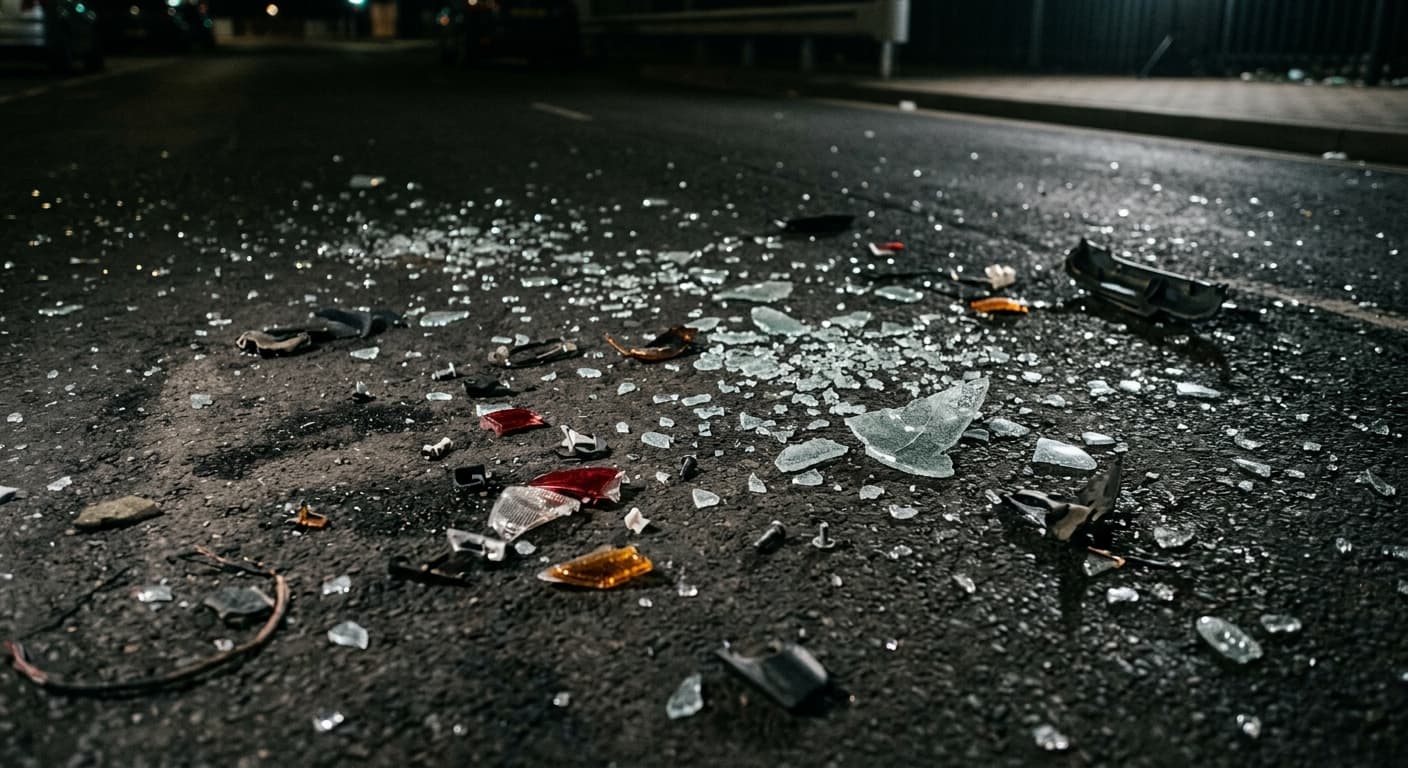
Under , Washington requires drivers involved in any accident to stop, provide identifying information, and assist injured persons. Penalties range from a misdemeanor for property-damage-only incidents to a Class B felony carrying up to 10 years in prison and a $20,000 fine when the accident results in death.
Hurt in a hit-and-run? If the driver who hit you fled or had no insurance, your own uninsured/underinsured-motorist (UM/UIM) coverage may pay your injury claim. Estimate what it could be worth with our free Washington Car Accident Settlement Calculator.
Overview of Washington Hit and Run Laws
Last verified: March 2026. This page reflects current , , and applicable penalty classifications under .
Washington State takes hit-and-run offenses seriously. Under RCW 46.52.020, every driver involved in an accident must stop immediately, provide identifying information, and render reasonable assistance to anyone who is injured.
The law draws a clear line between accidents that cause only property damage and those involving injury or death. Penalties range from a simple misdemeanor for striking an unattended vehicle all the way to a Class B felony for leaving the scene of a fatal accident.
Washington is an at-fault (tort) state that follows a pure comparative fault rule. The driver responsible for the accident pays damages, and injured victims can recover compensation even if they share some blame. Recovery is reduced by the victim's percentage of fault.
Driver Duties After an Accident
RCW 46.52.020 spells out specific obligations every driver must follow after an accident. You must:
- Stop immediately at the scene or as close to it as safely possible without blocking traffic.
- Remain at the scene until you have met every requirement the statute lists.
- Provide your information to the other driver, passengers, or property owner. This includes your name, address, insurance company, policy number, and vehicle license plate number.
- Show your driver's license if anyone at the scene asks to see it.
- Help injured persons by arranging transportation to a hospital or medical facility when needed.
If the accident involves only property damage, subsection (2) of the statute requires you to move your vehicle off the roadway, freeway lanes, shoulders, and medians to a safe location such as an exit ramp or cross street. Moving your vehicle does not affect fault determination.
Important exception: The law does not apply to drivers who are injured or incapacitated by the accident to the point that they are physically unable to comply.
Striking an Unattended Vehicle or Property
Under RCW 46.52.010, if you hit an unattended vehicle or other property, you must make a reasonable effort to find the owner. If you cannot locate the owner, you must leave a written note in a conspicuous place on the vehicle or property. The note must include your name and address. Failing to do so is a misdemeanor.
Reporting Requirements
Under RCW 46.52.030, you must file a written accident report within four days if the accident involves:
- Death or bodily injury of any person
- Property damage of $1,000 or more to any one person's property
File the report with the chief of police if the accident happened inside city limits, or with the county sheriff or Washington State Patrol if it happened outside city limits. If no one at the scene can receive your information and no police officer is present, report the accident to the nearest police authority right away.
When Hit and Run Is a Misdemeanor
Washington law classifies hit and run as a misdemeanor in two situations:
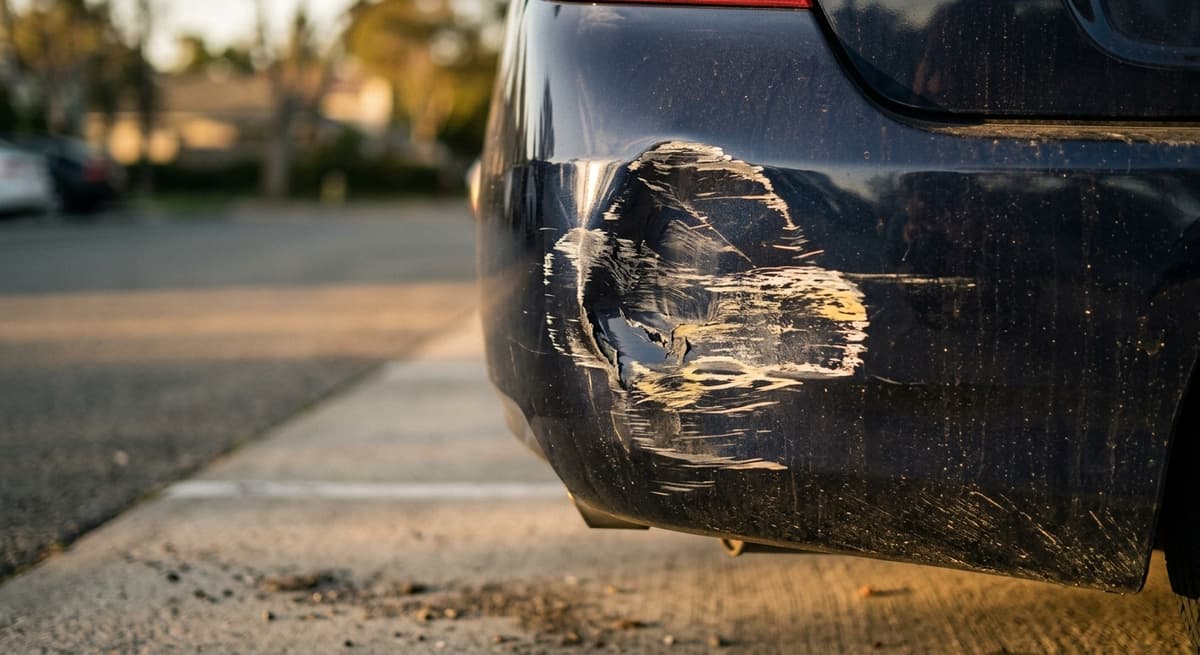
| Situation | Classification | Maximum Jail Time | Maximum Fine |
|---|---|---|---|
| Striking an unattended vehicle or property without leaving a note | Simple Misdemeanor | 90 days | $1,000 |
| Leaving the scene of an attended vehicle accident with property damage only | Gross Misdemeanor | 364 days | $5,000 |
| Leaving the scene after striking the body of a deceased person | Gross Misdemeanor | 364 days | $5,000 |
A simple misdemeanor applies when you hit an unattended car or mailbox and drive away without leaving your information. The penalties are up to 90 days in jail and a $1,000 fine under RCW 9A.20.021.
A gross misdemeanor applies when you leave the scene of an accident involving an occupied or attended vehicle where only property was damaged. Penalties increase to up to 364 days in jail and a $5,000 fine. The same classification applies if you leave the scene after striking the body of a deceased person.
When Hit and Run Is a Felony
Under RCW 46.52.020(4), leaving the scene becomes a felony when the accident involves injury or death:
| Situation | Classification | Maximum Prison Time | Maximum Fine |
|---|---|---|---|
| Accident resulting in injury | Class C Felony | 5 years | $10,000 |
| Accident resulting in death | Class B Felony | 10 years | $20,000 |
These penalties are set by RCW 9A.20.021, which establishes maximum sentences for felony classifications in Washington.
A felony hit-and-run conviction also triggers mandatory license revocation by the Washington Department of Licensing. Under RCW 46.20.285, the revocation period is at least one year. After the revocation period ends, you must file proof of financial responsibility (SR-22 insurance) for three years before your license can be reinstated.
Evading Police
Under RCW 46.61.024, attempting to evade or elude a police officer is a separate Class C felony. Conviction results in mandatory license revocation. One affirmative defense exists: if a reasonable person would not have believed the signal came from a police officer and the decision to keep driving was reasonable under the circumstances.
Vehicular Homicide
Under RCW 46.61.520, vehicular homicide occurs when death results within three years as a proximate result of driving a vehicle under any of these three circumstances:
- While under the influence of intoxicating liquor or drugs (as defined by )
- In a reckless manner (operating a vehicle in a rash or heedless manner, indifferent to the consequences)
- With disregard for the safety of others
Vehicular homicide is a Class A felony punishable by up to life imprisonment and a $50,000 fine. For convictions involving DUI, an additional two years are added to the sentence for each prior DUI-related offense.
License Revocation and Administrative Consequences
Beyond criminal penalties, a hit-and-run conviction carries administrative consequences through the Washington Department of Licensing (DOL):
- Mandatory license revocation for any hit-and-run conviction involving an attended vehicle
- Minimum revocation period of one year under RCW 46.20.285
- SR-22 insurance requirement for three years after your license is eligible for reinstatement
- Driving while license revoked during the revocation period is a separate criminal offense under RCW 46.20.342
The DOL revocation is separate from any court-imposed penalties. Even if you avoid jail time, your driving privileges will still be revoked.
Statute of Limitations
Washington sets different time limits for prosecutors to file hit-and-run charges depending on the severity of the offense. Under RCW 9A.04.080:
| Offense Level | Time Limit to File Charges |
|---|---|
| Simple Misdemeanor (unattended vehicle) | 1 year from date of incident |
| Gross Misdemeanor (attended vehicle, property damage) | 2 years from date of incident |
| Class C Felony (injury) | 3 years from date of incident |
| Class B Felony (death) | No limit if death results |
The statute of limitations is paused during any period when the accused is not usually and publicly a resident of Washington State.
For civil claims, injured victims have three years to file a personal injury, wrongful death, or property damage lawsuit in Washington.
Washington Felony Diversion Program
Washington offers a felony diversion program for first-time hit-and-run offenders. Key details:
- Available only to first-time offenders with no pending felony charges in any state
- Participation is voluntary and subject to prosecutor approval
- The program requires full restitution to victims
- Upon successful completion, charges are dismissed and no criminal record results
- Decisions denying entry may be appealed to the Chief Criminal Deputy Prosecuting Attorney
Offenses that disqualify you from the diversion program:
- Vehicular assault or vehicular homicide
- DUI-related hit and run
- Eluding or attempting to elude police
- Having pending felony charges in any state
Insurance Implications for Hit-and-Run Victims
If you are the victim of a hit and run in Washington and the at-fault driver cannot be identified, you still have options for recovering compensation.
Under RCW 48.22.030, Washington requires all auto liability insurance policies to include uninsured motorist (UM) coverage unless you specifically reject it in writing. UM coverage applies when an at-fault driver has no insurance or cannot be found, which is the typical hit-and-run scenario.
To file a UM claim after a hit and run, you must:
- Report the accident to law enforcement within 72 hours
- Provide evidence corroborating the accident beyond your own testimony alone
- Notify your insurance company promptly
Washington also requires insurers to offer underinsured motorist (UIM) coverage. If the hit-and-run driver is later identified but carries insufficient insurance, UIM coverage can make up the difference.
Complete Penalties Summary
| Offense | Classification | Max Jail/Prison | Max Fine | License Impact |
|---|---|---|---|---|
| Unattended vehicle (no note) | Simple Misdemeanor | 90 days | $1,000 | None |
| Attended vehicle (property damage) | Gross Misdemeanor | 364 days | $5,000 | Revoked 1+ year |
| Striking body of deceased person | Gross Misdemeanor | 364 days | $5,000 | Revoked 1+ year |
| Injury accident | Class C Felony | 5 years | $10,000 | Revoked 1+ year |
| Death accident | Class B Felony | 10 years | $20,000 | Revoked 1+ year |
| Vehicular homicide (DUI/reckless) | Class A Felony | Life | $50,000 | Revoked |
| Evading police | Class C Felony | 5 years | $10,000 | Revoked |
Additional consequence: All hit-and-run convictions involving attended vehicles require SR-22 proof of financial responsibility for three years after license reinstatement eligibility.
Washington Crash Statistics
According to the Washington Traffic Safety Commission (WTSC):
- 731 traffic fatalities occurred in Washington in 2024, a 10% decrease from 809 fatalities in 2023.
- 2023 marked a 33-year high for traffic deaths in Washington, the most since 1990.
- 348 fatalities (48%) in 2024 involved driver impairment by alcohol or drugs.
- 247 fatalities (34%) in 2024 involved excessive speed.
- King, Pierce, Snohomish, Spokane, and Yakima Counties together accounted for more than half of all fatal crashes statewide.
The 2024 decrease represented the first decline in five years. Despite the improvement, traffic fatalities remain significantly higher than a decade ago. Hit-and-run incidents continue to be a concern in urban areas like Seattle, Tacoma, and Spokane.
Related Washington Laws
- Washington Recording Laws
- Washington Car Seat Laws
- Washington Child Support Laws
- Washington Lemon Law
- Washington Sexting Laws
- Washington Statute of Limitations
- Washington Whistleblower Laws
- Washington Dog Bite Laws
- Murder Sentencing Guidelines by State
More Washington Laws
Frequently Asked Questions
What should I do immediately after a hit-and-run accident in Washington?
Stop your vehicle at the scene or as close as safely possible. Provide your name, address, insurance information, and license plate number to the other driver, passengers, or property owner. Show your driver's license if asked. Render reasonable assistance to any injured person, including arranging transportation to a hospital. Report the accident to police, especially if it involves injury, death, or property damage of $1,000 or more.
Is Washington a no-fault state for car accidents?
No. Washington is an at-fault (tort) state that follows a pure comparative fault rule. The driver who caused the accident is responsible for paying damages. Injured victims can recover compensation even if they share some responsibility, but their recovery is reduced by their percentage of fault.
What is the statute of limitations for hit-and-run charges in Washington?
It depends on the severity. Simple misdemeanor charges (unattended vehicle) must be filed within 1 year. Gross misdemeanor charges (attended vehicle, property damage) must be filed within 2 years. Class C felony charges (injury) must be filed within 3 years. There is no time limit for filing charges when a hit and run results in death. For civil lawsuits, injured victims have 3 years to file a personal injury or property damage claim.
Can I use my own insurance after being a hit-and-run victim?
Yes. Under RCW 48.22.030, Washington requires auto insurers to include uninsured motorist (UM) coverage in every policy unless you reject it in writing. UM coverage applies when the at-fault driver cannot be found. You must report the hit and run to law enforcement within 72 hours and provide corroborating evidence beyond your own testimony.
What if I was physically unable to stop after the accident?
Washington law specifically exempts persons who are injured or incapacitated by the accident to the extent that they are physically incapable of complying with the stop-and-report requirements. If you lost consciousness or suffered injuries that prevented you from stopping, this may serve as a valid defense. Medical records documenting your condition at the time of the accident would support this defense.
Injured in Washington? Get a free case review from a personal-injury attorney
If someone else's negligence caused your injury, you may be owed compensation for medical bills, lost wages, and pain and suffering. Get a free, no-obligation review from a Washington personal-injury attorney. Most work on contingency, so there is no upfront cost.
Updates
Governing law re-checked for recent changes
The Law Behind This Article
This article rests on the statutory provisions below, held in our own legal record and retrieved from the official source. Tap a section to read the operative text.
Revised Code of Washington
§ 46.20.285Offenses requiring revocation.In force
The department shall revoke the license of any driver for the period of one year unless otherwise provided in this section, upon receiving a record of the driver's conviction of any of the following offenses, when the conviction has become final: (1) For vehicular homicide the period of revocation shall be two years. The revocation period shall be tolled during any period of total confinement for the offense; (2) Vehicular assault. The revocation period shall be tolled during any period of total confinement for the offense; (3) Driving a motor vehicle while under the influence of intoxicating liquor or a narcotic drug, or under the influence of any other drug to a degree that renders the driver incapable of safely driving a motor vehicle, for the period prescribed in RCW 46.61.5055; (4) Any felony where the sentencing court determines that in the commission of the offense a motor vehicle was used in a manner that endangered persons or property; (5) Failure to stop and give information or render aid as required under the laws of this state in the event of a motor vehicle accident resulting in the death or personal injury of another or resulting in damage to a vehicle that is…
Official text (excerpt) · last checked 2026-07-29 · Read the full text in our law library · Verify at app.leg.wa.gov
Cited in 38 court opinionsMost recently applied by a court: 2025
Leading cases:
- State v. Dykstra (Court of Appeals of Washington 2005, 127 Wash. App. 1)“…red the mandatory driver’s license revocation provisions of RCW 46.20.285. 3 DISCUSSION Admission of Mr. Dyk…”
- State v. Batten (Washington Supreme Court 2000, 140 Wash. 2d 362)“…David, Deputy, Vancouver, for Respondent. ALEXANDER, J. RCW 46.20.285(4) requires revocation of the driver's…”
- State v. R.L.D. (Court of Appeals of Washington 2006, 132 Wash. App. 699)“…nt of Licensing to revoke his driver’s license under former RCW 46.20.285 (2004). 5 He appeals. 6 ANALYSIS…”
Identified automatically from the court opinions citing this section — not a ranking of which case controls.
§ 46.20.342Driving while license invalidated—Penalties—Extension of invalidation.In force
(1) It is unlawful for any person to drive a motor vehicle in this state while that person is in a suspended or revoked status or when his or her privilege to drive is suspended or revoked in this or any other state. Any person who has a valid Washington driver's license is not guilty of a violation of this section. (a) A person found to be a habitual offender under chapter 46.65 RCW, who violates this section while an order of revocation issued under chapter 46.65 RCW prohibiting such operation is in effect, is guilty of driving while license suspended or revoked in the first degree, a gross misdemeanor. Upon the first such conviction, the person shall be punished by imprisonment for not less than 10 days. Upon the second conviction, the person shall be punished by imprisonment for not less than 90 days. Upon the third or subsequent conviction, the person shall be punished by imprisonment for not less than 180 days. If the person is also convicted of the offense defined in RCW 46.61.502 or 46.61.504, when both convictions arise from the same event, the minimum sentence of confinement shall be not less than 90 days.
Official text (excerpt) · last checked 2026-07-29 · Read the full text in our law library · Verify at app.leg.wa.gov
Cited in 118 court opinionsMost recently applied by a court: 2026
Leading cases:
- State v. Jasper (Washington Supreme Court 2012, 174 Wash. 2d 96)“…furnish proof of financial responsibility for the future,” RCW 46.20.342(1)(c)(ii), or he “failed to respond to…”
- State v. Smith (Washington Supreme Court 2005, 155 Wash. 2d 496)“…ant here, one count of DWLS in the first degree pursuant to RCW 46.20.342(1)(a). Specifically, the amended inform…”
- State v. Potter (Washington Supreme Court 2006, 156 Wash. 2d 835)“…cers in the present case arrested petitioners for violating RCW 46.20.342(l)(c). This statute makes it unlawful f…”
Identified automatically from the court opinions citing this section — not a ranking of which case controls.
§ 46.52.010Duty on striking unattended car or other property—Penalty.In force
(1) The operator of any vehicle which collided with any other vehicle which is unattended shall immediately stop and shall then and there either locate and notify the operator or owner of such vehicle of the name and address of the operator and owner of the vehicle striking the unattended vehicle or shall leave in a conspicuous place in the vehicle struck a written notice, giving the name and address of the operator and of the owner of the vehicle striking such other vehicle. (2) The driver of any vehicle involved in an accident resulting only in damage to property fixed or placed upon or adjacent to any public highway shall take reasonable steps to locate and notify the owner or person in charge of such property of such fact and of the name and address of the operator and owner of the vehicle striking such property, or shall leave in a conspicuous place upon the property struck a written notice, giving the name and address of the operator and of the owner of the vehicle so striking the property, and such person shall further make report of such accident as in the case of other accidents upon the public highways of this state.
Official text (excerpt) · last checked 2026-07-29 · Read the full text in our law library · Verify at app.leg.wa.gov
Cited in 20 court opinionsMost recently applied by a court: 2025
Leading cases:
- State v. Apodaca (Court of Appeals of Washington 1992, 67 Wash. App. 736)“…e he had notified the owner of the vehicle of the incident. RCW 46.52.010. In reviewing a trial court's fi…”
- State v. Johnson (Washington Supreme Court 1992, 119 Wash. 2d 167)“…different from the nature of permitting prostitution. Under RCW 46.52.010 or .020, one must be involved in a coll…”
- State v. Reding (Washington Supreme Court 1992, 119 Wash. 2d 685)“…striking an unattended car or property (a misdemeanor under RCW 46.52.010); falling to take the necessary steps w…”
Identified automatically from the court opinions citing this section — not a ranking of which case controls.
§ 46.52.020Duty in case of personal injury or death or damage to attended vehicle or other property—Penalties.In force
(1) A driver of any vehicle involved in an accident resulting in the injury to or death of any person or involving striking the body of a deceased person shall immediately stop such vehicle at the scene of such accident or as close thereto as possible but shall then forthwith return to, and in every event remain at, the scene of such accident until he or she has fulfilled the requirements of subsection (3) of this section; every such stop shall be made without obstructing traffic more than is necessary. (2)(a) The driver of any vehicle involved in an accident resulting only in damage to a vehicle which is driven or attended by any person or damage to other property must move the vehicle as soon as possible off the roadway or freeway main lanes, shoulders, medians, and adjacent areas to a location on an exit ramp shoulder, the frontage road, the nearest suitable cross street, or other suitable location. The driver shall remain at the suitable location until he or she has fulfilled the requirements of subsection (3) of this section. Moving the vehicle in no way affects fault for an accident.
Official text (excerpt) · last checked 2026-07-29 · Read the full text in our law library · Verify at app.leg.wa.gov
Cited in 99 court opinionsMost recently applied by a court: 2026
Leading cases:
- State v. Keller (Washington Supreme Court 2001, 143 Wash. 2d 267)“…der former RCW 46.61.522(1)(b) and felony hit and run under RCW 46.52.020. 1 Petitioner was determined to be a p…”
- In Re the Personal Restraint of Williams (Washington Supreme Court 1988, 111 Wash. 2d 353)“…riving (RCW 46.61.500), or hit-and-run an attended vehicle (RCW 46.52.020(5)); or " (b) Any federal, out-of-sta…”
- State v. Martin (Washington Supreme Court 1968, 73 Wash. 2d 616)“…g, a misdemeanor, and with the gross misdemeanor defined in RCW 46.52.020, generally referred to as the hit and r…”
Identified automatically from the court opinions citing this section — not a ranking of which case controls.
§ 46.52.030Accident reports.In forcecited in 2 of our articles
(1) Unless a report is to be made by a law enforcement officer under subsection (3) of this section, the driver of any vehicle involved in an accident resulting in injury to or death of any person or damage to the property of any one person to an apparent extent equal to or greater than the minimum amount established by rule adopted by the chief of the Washington state patrol in accordance with subsection (5) of this section, shall, within four days after such accident, make a written report of such accident to the chief of police of the city or town if such accident occurred within an incorporated city or town or the county sheriff or state patrol if such accident occurred outside incorporated cities and towns. Nothing in this subsection prohibits accident reports from being filed by drivers where damage to property is less than the minimum amount or where a law enforcement officer has submitted a report. (2) The original of the report shall be immediately forwarded by the authority receiving the report to the chief of the Washington state patrol at Olympia, Washington. The Washington state patrol shall give the department of licensing full access to the report.
Official text (excerpt) · last checked 2026-07-29 · Read the full text in our law library · Verify at app.leg.wa.gov
Cited in 11 court opinionsMost recently applied by a court: 2022
Leading cases:
- Guillen v. Pierce County (Washington Supreme Court 2001, 181 A.L.R. Fed. 741)“…ts” in RCW 46.52.080 refers to reports prepared pursuant to RCW 46.52.030(1) or .040 by persons involved in the a…”
- Gendler v. Batiste (Washington Supreme Court 2012, 174 Wash. 2d 244)“…o prepare accident reports for accidents on state highways. RCW 46.52.030 (Laws of 1937, ch. 189, § 135). Drivers…”
- Brown v. Pro West Transport Ltd. (Court of Appeals of Washington 1995, 76 Wash. App. 412)“…417 Failure to Comply With RCW 46.52.020 and RCW 46.52.030 We first decide whether there ex…”
Identified automatically from the court opinions citing this section — not a ranking of which case controls.
Also relied on in: Washington Car Accident Laws: Fault, Insurance, and Your Claim
§ 46.61.024Attempting to elude police vehicle—Defense—License revocation.In force
(1) Any driver of a motor vehicle who willfully fails or refuses to immediately bring his or her vehicle to a stop and who drives his or her vehicle in a reckless manner while attempting to elude a pursuing police vehicle, after being given a visual or audible signal to bring the vehicle to a stop, shall be guilty of a class C felony. The signal given by the police officer may be by hand, voice, emergency light, or siren. The officer giving such a signal shall be in uniform and the vehicle shall be equipped with lights and sirens. (2) It is an affirmative defense to this section which must be established by a preponderance of the evidence that: (a) A reasonable person would not believe that the signal to stop was given by a police officer; and (b) driving after the signal to stop was reasonable under the circumstances. (3) The license or permit to drive or any nonresident driving privilege of a person convicted of a violation of this section shall be revoked by the department of licensing.
Official text (excerpt) · last checked 2026-07-29 · Read the full text in our law library · Verify at app.leg.wa.gov
Cited in 185 court opinionsMost recently applied by a court: 2025
Leading cases:
- State v. Thomas (Washington Supreme Court 1987, 109 Wash. 2d 222)“…sel's failure to offer it did not prejudice Thomas. Under RCW 46.61.024, the State is required to prove that th…”
- State v. Hoffman (Washington Supreme Court 1991, 116 Wash. 2d 51)“…es that probable cause existed to arrest for a violation of RCW 46.61.024, "Attempting to Elude Pursuing Police V…”
- State v. Brett (Washington Supreme Court 1995, 126 Wash. 2d 136)“…jury may never have considered the subjective component of RCW 46.61.024 [the felony flight statute]. Thus, we b…”
Identified automatically from the court opinions citing this section — not a ranking of which case controls.
§ 46.61.502Driving under the influence.In forcecited in 3 of our articles
(1) A person is guilty of driving while under the influence of intoxicating liquor, cannabis, or any drug if the person drives a vehicle within this state: (a) And the person has, within two hours after driving, an alcohol concentration of 0.08 or higher as shown by analysis of the person's breath or blood made under RCW 46.61.506; or (b) The person has, within two hours after driving, a THC concentration of 5.00 or higher as shown by analysis of the person's blood made under RCW 46.61.506; or (c) While the person is under the influence of or affected by intoxicating liquor, cannabis, or any drug; or (d) While the person is under the combined influence of or affected by intoxicating liquor, cannabis, and any drug. (2) The fact that a person charged with a violation of this section is or has been entitled to use a drug under the laws of this state shall not constitute a defense against a charge of violating this section.
Official text (excerpt) · last checked 2026-09-05 · Read the full text in our law library · Verify at app.leg.wa.gov
Cited in 458 court opinionsMost recently applied by a court: 2026
Leading cases:
- State v. Thomas (Washington Supreme Court 1987, 109 Wash. 2d 222)“…er influence of intoxicating liquor or drug in violation of RCW 46.61.502. Thomas pleaded guilty to the DWI charg…”
- State v. Franco (Washington Supreme Court 1982, 96 Wash. 2d 816)“…ast one of the alternative theories by which a violation of RCW 46.61.502 might occur. I The analytical struc…”
- State v. Wittenbarger (Washington Supreme Court 1994, 124 Wash. 2d 467)“…has been widely challenged in recent DWI prosecutions under RCW 46.61.502, Washington’s driving while under the i…”
Identified automatically from the court opinions citing this section — not a ranking of which case controls.
Also relied on in: Washington Expungement Laws: How to Vacate a Conviction (2026), Washington DUI Laws: Penalties, BAC Limit & License (2026)
§ 46.61.520Vehicular homicide—Penalty.In force
(1) When the death of any person ensues within three years as a proximate result of injury proximately caused by the driving of any vehicle by any person, the driver is guilty of vehicular homicide if the driver was operating a motor vehicle: (a) While under the influence of intoxicating liquor or any drug, as defined by RCW 46.61.502; or (b) In a reckless manner; or (c) With disregard for the safety of others. (2) Vehicular homicide is a class A felony punishable under chapter 9A.20 RCW, except that, for a conviction under subsection (1)(a) of this section, an additional two years shall be added to the sentence for each prior offense as defined in RCW 46.61.5055.
Official text (excerpt) · last checked 2026-07-29 · Read the full text in our law library · Verify at app.leg.wa.gov
Cited in 234 court opinionsMost recently applied by a court: 2026
Leading cases:
- State v. Roggenkamp (Washington Supreme Court 2005, 153 Wash. 2d 614)“…r” is not defined in either the vehicular homicide statute, RCW 46.61.520, or the vehicular assault statute, RCW…”
- State v. Elgin (Washington Supreme Court 1992, 118 Wash. 2d 551)“…lony-class crimes within RCW 46.61 are: vehicular homicide (RCW 46.61.520), vehicular assault (RCW 46.61.522), an…”
- State v. Rivas (Washington Supreme Court 1995, 126 Wash. 2d 443)“…g and of the injuries to HEATHER M. NIHOUL, in violation of RCW 46.61.520, said crime being a Class "B” felony; c…”
Identified automatically from the court opinions citing this section — not a ranking of which case controls.
§ 48.22.030Underinsured, hit-and-run, phantom vehicle coverage to be provided—Purpose—Definitions—Exceptions—Conditions—Deductibles—Information on motorcycle or motor-driven cycle coverage—Intended victims.In forcecited in 2 of our articles
(1) "Underinsured motor vehicle" means a motor vehicle with respect to the ownership, maintenance, or use of which either no bodily injury or property damage liability bond or insurance policy applies at the time of an accident, or with respect to which the sum of the limits of liability under all bodily injury or property damage liability bonds and insurance policies applicable to a covered person after an accident is less than the applicable damages which the covered person is legally entitled to recover.
Official text (excerpt) · last checked 2026-07-29 · Read the full text in our law library · Verify at app.leg.wa.gov
Cited in 280 court opinionsMost recently applied by a court: 2026
Leading cases:
- Clements v. Travelers Indemnity Co. (Washington Supreme Court 1993, 121 Wash. 2d 243)“…to meet the statutory requirement for written waivers under RCW 48.22.030(4). *249 Discussion…”
- Touchette v. Northwestern Mutual Insurance (Washington Supreme Court 1972, 80 Wash. 2d 327)“…ghn E. Evans, for respondent. HALE, J. Is the statute (RCW 48.22.030) relating to uninsured motorist coverag…”
- Britton v. Safeco Insurance Co. of America (Washington Supreme Court 1985, 104 Wash. 2d 518)“…ctive coverages. Laws of 1980, ch. 117, § 1, p. 361 (RCW 48.22.030). Under this 1980 enactment,…”
Identified automatically from the court opinions citing this section — not a ranking of which case controls.
§ 9A.20.021Maximum sentences for crimes committed July 1, 1984, and after.In forcecited in 3 of our articles
(1) Felony. Unless a different maximum sentence for a classified felony is specifically established by a statute of this state, no person convicted of a classified felony shall be punished by confinement or fine exceeding the following: (a) For a class A felony, by confinement in a state correctional institution for a term of life imprisonment, or by a fine in an amount fixed by the court of fifty thousand dollars, or by both such confinement and fine; (b) For a class B felony, by confinement in a state correctional institution for a term of ten years, or by a fine in an amount fixed by the court of twenty thousand dollars, or by both such confinement and fine; (c) For a class C felony, by confinement in a state correctional institution for five years, or by a fine in an amount fixed by the court of ten thousand dollars, or by both such confinement and fine. (2) Gross misdemeanor.
Official text (excerpt) · last checked 2026-07-29 · Read the full text in our law library · Verify at app.leg.wa.gov
Cited in 505 court opinionsMost recently applied by a court: 2026
Leading cases:
- State v. Manussier (Washington Supreme Court 1996, 129 Wash. 2d 652)“…93 violates this constitutional provision because it amends RCW 9A.20.021, the section of the criminal code provi…”
- State v. Ritchie (Washington Supreme Court 1995, 126 Wash. 2d 388)“…tence for this class A felony offense is life imprisonment. RCW 9A.20.021(1)(a). The trial court imposed an excep…”
- State v. Anderson (Washington Supreme Court 2000, 141 Wash. 2d 357)“…t a *1252 maximum term of five years' imprisonment ( see RCW 9A.20.021) is clearly a factor that weighs in fav…”
Identified automatically from the court opinions citing this section — not a ranking of which case controls.
Also relied on in: Washington Ring Doorbell Laws: What You Need to Know in 2026, Washington Surveillance Camera Laws (2026 Guide)
Search our full record of US law — 2.1 million sections, every state + federal →
Sources and References
- RCW 46.52.020: Duty in case of personal injury or death or damage to attended vehicle or other property(app.leg.wa.gov).gov
- RCW 46.52.010: Duty on striking unattended car or other property(app.leg.wa.gov).gov
- RCW 46.52.030: Accident reports(app.leg.wa.gov).gov
- RCW 9A.20.021: Maximum sentences for crimes committed July 1, 1984, and after(app.leg.wa.gov).gov
- RCW 46.20.285: Offenses requiring revocation(app.leg.wa.gov).gov
- RCW 9A.04.080: Limitation of actions(app.leg.wa.gov).gov
- RCW 46.61.520: Vehicular homicide(app.leg.wa.gov).gov
- RCW 46.61.024: Attempting to elude a police vehicle(app.leg.wa.gov).gov
- RCW 48.22.030: Underinsured, hit-and-run, phantom vehicle coverage(app.leg.wa.gov).gov
- RCW 46.20.342: Driving while license invalidated(app.leg.wa.gov).gov
- Washington DOL: Hit and run of an occupied vehicle(dol.wa.gov).gov
- WTSC: Preliminary Traffic Fatality Numbers for 2024(wtsc.wa.gov).gov