
Canada
Canada Recording Laws: One-Party Consent Rules and Penalties (2026)
Independently fact-checked against primary sources (last audited June 18, 2026). · Law checked current as of August 9, 2026. · 30 primary sources cited on this page. How we verify our legal content

Canada is a one-party consent country under Criminal Code s.184(2)(a), meaning any participant in a private conversation may record it without notifying the other parties. This federal rule applies uniformly across all provinces and territories. Non-participants who intercept private communications face an indictable offence under s.184(1) carrying up to five years in prison.
Quick Answer: Is Canada a One-Party Consent Country?
Yes. Canada is a one-party consent country for recording conversations. Under Section 184(2)(a) of the Criminal Code, any participant in a private communication can record it without informing or obtaining consent from anyone else involved. You do not need a warrant, a court order, or the other person's permission. Your own participation is sufficient.
This federal rule applies uniformly across all provinces and territories. Provincial privacy statutes in British Columbia, Alberta, and Quebec add obligations for businesses and organizations, but they do not strip individuals of the right to record their own conversations.
The one-party consent standard has been in place since Parliament enacted Part VI of the Criminal Code in 1974. It was deliberately designed to allow individuals to protect themselves by preserving evidence of conversations, while reserving criminal penalties for third-party eavesdroppers who have no stake in the communication.
| Key Point | Details |
|---|---|
| Federal Consent Standard | One-party consent |
| Governing Statute | Criminal Code, R.S.C. 1985, c. C-46, Part VI |
| Core Section | s.184(2)(a) |
| Maximum Criminal Penalty | 5 years imprisonment (indictable offence under s.184(1)) |
| Business Recording Framework | PIPEDA (federal) + BC PIPA, Alberta PIPA, Quebec Law 25 |
| Last Major Criminal Code Amendment | October 10, 2025 |
Jurisdiction scope: This article addresses recording laws in Canada under the federal Criminal Code (R.S.C. 1985, c. C-46), the Canadian Charter of Rights and Freedoms, PIPEDA (SC 2000, c. 5), and provincial privacy statutes in British Columbia, Alberta, and Quebec. It does not address the recording laws of individual US states; for those, see our US state recording laws hub.
Criminal Code Section 184: The Federal Foundation
Section 184(1): The Prohibition
Section 184(1) makes it a criminal offence to knowingly intercept a private communication using any electromagnetic, acoustic, mechanical, or other device. The term "intercept" covers recording, capturing, and secretly listening in real time.
The penalties reflect the seriousness Parliament attaches to privacy violations:
- Indictable offence: Up to 5 years imprisonment
- Summary conviction: Fine and/or imprisonment up to 2 years less a day
These are not merely theoretical. Canadian courts have convicted individuals for systematic wiretapping, and the Crown treats organized interception schemes, particularly those tied to stalking or harassment, as serious matters.
Section 184(2)(a): The One-Party Consent Exception
The operative provision for everyday recording sits in s.184(2)(a). The statute provides that the prohibition in subsection (1) does not apply to:
"a person who has the consent to intercept, express or implied, of the originator of the private communication or of the person intended by the originator thereof to receive it." Criminal Code, RSC 1985, c C-46, s 184(2)(a)
In practice: if you are a party to the call, message, or conversation, your own consent satisfies the statute. You are both the interceptor and a consenting party. No notification is required. No disclosure is required. You may record freely.
This applies equally to:
- Phone calls (landline or mobile)
- Video calls (Zoom, Teams, FaceTime, Google Meet)
- In-person conversations
- VoIP and internet communications
Section 183: Key Definitions
Before the prohibition in s.184 applies, a recording must involve a "private communication." Section 183 of the Criminal Code defines the term with precision:
"'private communication' means any oral communication, or any telecommunication, that is made by an originator who is in Canada or is intended by the originator to be received by a person who is in Canada and that is made under circumstances in which it is reasonable for the originator to expect that it will not be intercepted by any person other than the intended recipient, and includes any radio-based telephone communication that is treated electronically or otherwise for the purpose of preventing intelligible reception by any person other than the intended recipient." Criminal Code, RSC 1985, c C-46, s 183
The reasonableness test is objective. Courts examine the context: a conversation in a crowded restaurant where strangers could overhear carries a weaker privacy expectation than a one-on-one phone call. The law protects reasonable expectations, not perfect confidentiality.
Section 183 also defines "intercept" to include "listen to, record or acquire a communication or acquire the substance, meaning or purport thereof." This breadth means that passive real-time listening, recording to a file, and machine-capture of communication content are all treated equivalently under Part VI.
Section 184(2)(b): Bulk Interception Authorization
Section 184(2)(b) and the subsequent provisions in Part VI authorize lawful interception by police and intelligence agencies with judicial authorization. This is the wiretap warrant regime. It is entirely separate from the citizen one-party consent rule and requires a judge's approval based on reasonable grounds to believe a serious offence is being committed.
R. v. Duarte and the State/Citizen Distinction
The Supreme Court of Canada's decision in R v Duarte, [1990] 1 SCR 30, 1990 CanLII 150 (SCC) is the foundational case on participant electronic surveillance in Canada. Understanding it correctly is essential because it is frequently misread as restricting one-party consent for ordinary citizens. It does not.
What Duarte Held
The facts in Duarte involved an Ontario Provincial Police investigation in which a police informer and an undercover officer, both of whom consented to being recorded, wore body-worn audio-visual devices during drug-related meetings with the accused. The recordings were made without judicial authorization.
The Supreme Court, per La Forest J., held that surreptitious electronic surveillance of an individual by a state agent constitutes an unreasonable search and seizure under s.8 of the Charter when conducted without prior judicial authorization, even though one party to the conversation (the state agent) consented. The Court drew a sharp distinction between the social risk of one person repeating what another said and the far more intrusive risk of the state, in its unfettered discretion, recording and transmitting words indefinitely:
"The regulation of electronic surveillance is not directed at protecting a person from the risk that someone will repeat his words but from the much more insidious danger inherent in allowing the state, in its unfettered discretion, to record and transmit his words." R v Duarte, [1990] 1 SCR 30 at para 23
The Critical Distinction: State Agents vs. Private Individuals
Duarte governs state action. The Criminal Code's s.184(2)(a) one-party consent exception continues to protect private individuals who record their own conversations. A person recording a call with a business, employer, or family member is not a state agent and does not require judicial authorization.
The distinction is confirmed by subsequent SCC cases. In R v Fliss, 2002 SCC 16, the Court revisited participant recording in the police-agent context and affirmed that Duarte applies to police-directed surveillance; the s.184(2)(a) exception for private individuals remained intact. The Court distinguished the officer's testimony (admissible under certain conditions) from the excluded recording itself.
Practical Significance
For private citizens, Duarte does not limit the s.184(2)(a) right. The case's significance for ordinary Canadians is its articulation of the constitutional principle: the state cannot conduct electronic surveillance, even with one consenting participant, without prior judicial oversight. This background principle shapes the legitimacy of law enforcement wiretap warrants but leaves citizen recording rights untouched.
Charter Section 8: The Constitutional Foundation
Section 8 of the Canadian Charter of Rights and Freedoms protects against unreasonable search or seizure. Because intercepting or recording a private communication is treated as a "search" for Charter purposes, s.8 provides the constitutional backdrop against which Part VI of the Criminal Code operates.
The Reasonable Expectation of Privacy Doctrine
The Supreme Court established in Hunter v. Southam, [1984] 2 SCR 145 that s.8 protects a reasonable expectation of privacy (REP). In the recording context, the leading articulation comes from Duarte (state surveillance requires judicial authorization) and R v Wong, [1990] 3 SCR 36, 1990 CanLII 56 (SCC) (covert video surveillance by police without authorization violates s.8).
The REP doctrine has been substantially developed through subsequent SCC decisions:
- R v Tessling, 2004 SCC 67: thermal imaging of a residence from a public place did not engage s.8; the Court applied an objective test asking whether society would recognize the privacy interest as reasonable.
- R v Spencer, 2014 SCC 43: subscriber information associated with an IP address attracts a REP in the context of internet communications; police cannot demand it without a warrant.
- R v Fearon, 2014 SCC 77: searches of cell phone incident to arrest are permitted but the scope is narrow; most digital content on a phone requires a warrant. This case directly governs police seizure of phones containing recording footage.
- R v Bykovets, 2024 SCC 6: an IP address, by its nature, creates a reasonable expectation of privacy. The relevant perspective is whether the person can reasonably expect privacy from state intrusion, not from all third parties.
- R v Campbell, 2024 SCC 42: warrantless police use of a suspect's phone to continue a text conversation is subject to s.8 Charter analysis; the SCC found a s.8 violation but admitted the evidence under s.24(2) on the basis of exigent circumstances under the Controlled Drugs and Substances Act, s.11(7).
Section 8 and Citizen Recordings
Section 8 protects individuals against unreasonable state searches. It does not govern private citizens recording other private citizens, which is regulated entirely by s.184 of the Criminal Code. When a citizen makes a one-party consent recording and later produces it in litigation, s.8 issues can arise if police subsequently seize the device without warrant. The recording itself, made by a private party, does not implicate s.8.
Phone Seizure and Charter Rights
Police cannot seize a phone simply because it contains footage of their conduct or other recording evidence. The search of a phone incident to arrest is limited to evidence directly related to the offence for which the arrest was made (R v Fearon, 2014 SCC 77). A general review of a phone's recording files or gallery requires a warrant. Any warrantless search of a seized phone is presumptively a s.8 breach triggering s.24(2) analysis.
Penalties for Recording-Related Offences
The Criminal Code contains a suite of provisions targeting different forms of illegal recording and disclosure:
| Offence | Section | Maximum Penalty |
|---|---|---|
| Unauthorized interception of private communications | s.184(1) | 5 years imprisonment (indictable) |
| Possession of interception device | s.191(1) | 2 years imprisonment (indictable) |
| Unauthorized disclosure of intercepted communication | s.193(1) | 2 years imprisonment (indictable) |
| Voyeurism (covert visual recording) | s.162(1) | 5 years imprisonment (indictable) |
| Non-consensual distribution of intimate images | s.162.1(1) | 5 years imprisonment (indictable) |
Section 194(1) separately authorizes courts to award up to $5,000 in punitive damages payable to any person aggrieved by an unauthorized disclosure under s.193. Civil remedies are available in addition to criminal prosecution: victims may sue for invasion of privacy, breach of confidence, and intentional infliction of emotional distress.
Civil Liability: Privacy Act and PIPEDA
Beyond the Criminal Code, two bodies of law create civil exposure for improper recording.
Federal Privacy Act
The federal Privacy Act governs how federal government institutions handle personal information, including recordings. Individuals whose information is collected or disclosed unlawfully may file complaints with the Privacy Commissioner and seek Federal Court review. The Act does not apply to private individuals or private-sector organizations.
PIPEDA and Provincial Equivalents
The Personal Information Protection and Electronic Documents Act (PIPEDA) governs the private sector. Organizations covered by PIPEDA must have a legitimate purpose for recording, collect only what is necessary, and use recordings only for stated purposes. The Office of the Privacy Commissioner investigates complaints and can recommend remedies. Federal Court enforcement is available for serious violations.
As of May 2026, PIPEDA remains the in-force federal private sector statute. Bill C-15 (Budget 2025 Implementation Act, No. 1), tabled November 4, 2025, adds a data-mobility framework to PIPEDA, giving individuals the right to request that organizations transfer their personal information to a designated recipient organization. The Privacy Commissioner appeared before the Standing Committee on Industry and Technology on January 26, 2026 to discuss these provisions. A comprehensive replacement for PIPEDA as a whole, following the death of Bill C-27 in January 2025, remains under development; commentary from the Minister of Digital Innovation indicates a targeted, narrower approach is expected rather than a direct reintroduction of the C-27 structure.
Phone Call Recording Rules
Recording a phone call you participate in is straightforwardly legal under s.184(2)(a). The same rule governs whether you are using a landline, a mobile, a VoIP service, or an internet calling platform.
Practical points:
- You can use any recording method: a dedicated call recorder, your phone's built-in screen recording, a second device held nearby, or call-recording software.
- The other party need not know they are being recorded.
- Recordings may be used as evidence in civil proceedings, though admissibility depends on authentication and relevance tests.
- If you are a business, PIPEDA (or a provincial equivalent) applies on top of the Criminal Code rule and requires notification, purpose disclosure, and consent alternatives.

In-Person Conversation Recording
The one-party consent rule applies with equal force to in-person conversations. You may record a meeting, an interview, a confrontation, or any other face-to-face exchange you are participating in.
The key limitation: you must actually be present and participating. Leaving a recording device in a room and departing converts the recording into unauthorized interception once you exit the conversation. The statute draws the line at participation, not physical proximity at the moment of setup.
Covert recording via body-worn device worn during a meeting you attend is lawful under the Criminal Code. Courts have regularly received such recordings as evidence. The use of the recording post-capture (sharing it publicly, providing it to a journalist) may engage PIPEDA or provincial privacy law depending on the context.
Recording Police in Canada
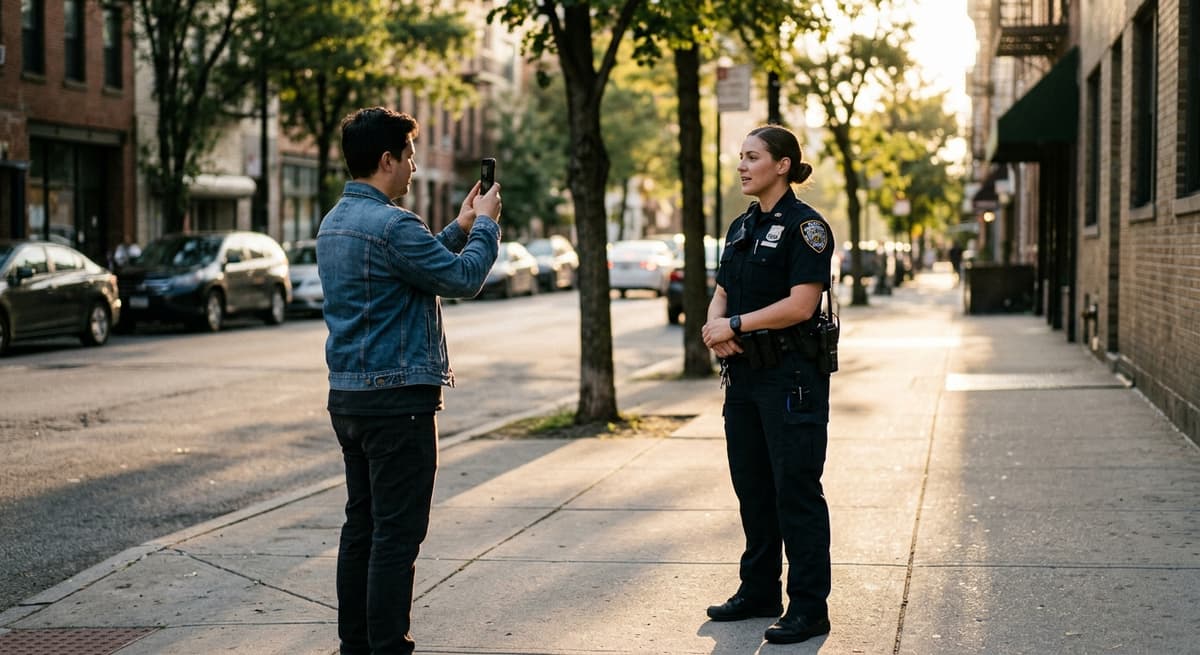
You have an established right to record police officers performing their duties in public spaces. This right flows from the guarantee of freedom of expression in s.2(b) of the Canadian Charter of Rights and Freedoms, which the Supreme Court has interpreted to protect the gathering of information, not only its dissemination.
There is no Canadian law that prohibits filming or recording police. Multiple courts and disciplinary tribunals have held that officers cannot lawfully order bystanders to stop recording as a routine matter.
The Dalman Case (BC, 2024-2025)
The right to record police received renewed affirmation when a BC Provincial Court judge found RCMP Constable Arthur Dalman guilty of attempting to obstruct justice after he asked bystanders to delete video they had recorded during the arrest of Dale Culver and then lied under oath during his trial. The case reinforced that not only may the public record police, but officers who interfere with that recording face criminal consequences.
What You Can and Cannot Do
You may:
- Stand at a reasonable distance and record any police interaction in a public place
- Continue recording even if an officer expresses displeasure
- Decline to delete footage you have lawfully obtained
You may not:
- Obstruct officers physically or interfere with an arrest or detention (Criminal Code s.129)
- Enter a cordon, secured scene, or restricted area to obtain footage
- Refuse a lawful order to move back, provided you can still record from the new position
Phone Seizure and Charter s.8
Police cannot seize your phone simply because it contains footage of their conduct. Searches of digital devices require a warrant absent a recognized exception. The Supreme Court affirmed the heightened constitutional protection of phones in R v Fearon, 2014 SCC 77 and R v Spencer, 2014 SCC 43. R v Bykovets, 2024 SCC 6 further affirmed that IP addresses attract a reasonable expectation of privacy from state intrusion. Any search of a seized phone without proper authorization is presumptively a Charter s.8 breach.
Journalism and Public Interest Recording
Canadian journalists and media organizations operate under the same Criminal Code framework as private citizens. The one-party consent rule in s.184(2)(a) permits a journalist who is party to a conversation to record it without the other party's knowledge. This is lawful whether the journalist records by phone, in person, or via a body-worn device.
No Special Press Exemption in Part VI
Part VI of the Criminal Code contains no dedicated exemption for journalism or public interest recording. A journalist who is not a party to a conversation and who records it surreptitiously commits the same s.184(1) offence as any other third-party interceptor. The press privilege in Canadian law relates to protecting sources and resisting production orders, not to expanding the scope of lawful interception.
PIPEDA and Journalism
PIPEDA exempts "journalistic, artistic, or literary purposes" from many of its requirements under s.4(2)(c), provided the collection, use, and disclosure of personal information are for one of those purposes and for no other purpose. This means media organizations collecting recordings for broadcast or publication have more flexibility under PIPEDA than commercial organizations, though the Criminal Code limits remain fully applicable.
Public Interest Defence at Common Law
Courts have recognized that recordings made in the public interest, and subsequently published in a manner consistent with responsible journalism, attract constitutional protection under Charter s.2(b). The Supreme Court's framework in Grant v Torstar Corp., 2009 SCC 61 established the responsible communication defence in defamation; similar principles inform how courts assess the publication of recordings obtained through newsgathering. The public interest does not authorize initial interception; it informs how courts assess damages and remedies in civil proceedings arising from publication.
Practical Guidance for Journalists
Journalists conducting recorded interviews should:
- Be a participant in the conversation before recording (satisfies s.184(2)(a))
- Document the recording circumstances, including date, parties, and method
- Apply editorial judgment before publishing covertly recorded material involving private individuals
- Consider whether PIPEDA's journalism exemption applies, or whether an provincial statute applies instead
Workplace Recording in Canada
Employee Rights
Employees can legally record workplace conversations they participate in. The one-party consent rule contains no carve-out for employment settings. Courts have accepted covertly recorded workplace conversations as evidence in wrongful dismissal, human rights, and harassment proceedings.
However, legal permissibility under the Criminal Code does not insulate an employee from workplace discipline. Canadian courts have held that covert recording of colleagues can itself constitute just cause for dismissal, even where the recording was technically lawful. The analysis turns on whether the recording was proportionate, whether it breached a reasonable expectation of trust, and whether the employment relationship is irreparably harmed.
Best practice for employees who believe they need to protect themselves: limit recording to conversations in which you are directly involved, retain recordings securely, and seek legal advice before using them.
Employer Obligations
Employers who record employees or monitor workplace communications bear obligations under PIPEDA or provincial equivalents. The Privacy Commissioner's guidance on employee monitoring identifies the key requirements:
- Legitimate purpose: Identify a specific, reasonable purpose (quality assurance, dispute resolution, compliance, security)
- Notification: Inform employees of monitoring practices unless exceptional fraud-investigation circumstances apply
- Least-invasive means: Use the monitoring method that collects the minimum information necessary
- Access limitation: Restrict access to recordings to those with a genuine need
- Retention limits: Destroy recordings when the stated purpose is fulfilled
- Individual access: Respond to employees' requests to review their own recorded information
Covert employer surveillance faces a high bar. The Privacy Commissioner requires evidence that the employment relationship of trust has already been broken before covert recording begins. Mere suspicion is not sufficient.

Voyeurism: Section 162
Section 162(1) of the Criminal Code makes it a criminal offence to surreptitiously observe, or make a visual recording of, a person who is in circumstances that give rise to a reasonable expectation of privacy, where the observation or recording is done for a sexual purpose, where the person is in a place where they can be expected to be nude, or where the recording depicts the person's genitals, anal region, or breasts.
Section 162(4) extends the offence to printing, copying, publishing, distributing, or making available a recording obtained by voyeurism, even if the person distributing did not make the original recording.
Maximum penalty: 5 years imprisonment as an indictable offence.
The section applies to any form of visual recording device, including hidden cameras, smartphones, and drone-mounted cameras. Courts have applied it to recordings made in hotel rooms, changing rooms, washrooms, and private residences. There is no need to prove a recording was ever shared or distributed to establish the s.162(1) offence.
Non-Consensual Intimate Images: Section 162.1
Parliament added s.162.1 in 2014 through the Protecting Canadians from Online Crime Act to address the distribution of non-consensual intimate imagery. The provision makes it a criminal offence to knowingly publish, distribute, transmit, sell, or make available an intimate image of a person knowing that the depicted person did not consent, or being reckless as to whether consent was given.
An "intimate image" is defined as a visual recording in which the person is nude, is exposing their genital organs or anal region or breasts, or is engaged in explicit sexual activity, and at the time of the recording and distribution the person had a reasonable expectation of privacy.
Maximum penalty: 5 years imprisonment as an indictable offence.
The AI Deepfake Gap (2025-2026) and How It Closed
Section 162.1's original definition of "intimate image" as a "visual recording of a person" was interpreted by courts to require an authentic image. Two significant decisions in 2025-2026 exposed the gap, which Parliament closed when Bill C-16's reforms came into force on July 18, 2026 (see below):
In R. v. Kapoor (Ontario, November 2025), a judge ruled that sharing an AI-generated nude depicting a spouse was "morally reprehensible" but not a criminal offence under s.162.1, because the image was generated rather than recorded.
In R v MSK, 2026 NSPC 12 (Nova Scotia Provincial Court), the court held that a deepfake created using artificial intelligence did not constitute a "visual recording of a person" within the meaning of s.162.1 and declined to extend the statute judicially.
Both decisions created immediate calls for legislative reform. Manitoba has already amended its provincial civil-remedy statute to include "fake intimate image," defined as falsely depicting a person in a reasonably convincing manner through any means including AI, providing a civil remedy pathway in that province.
AI Deepfakes and Emerging Technology
Bill C-16: In Force Since July 18, 2026
Bill C-16, the Protecting Victims Act, amended the Criminal Code to specifically criminalize the distribution of non-consensual synthetic intimate imagery. It received Royal Assent on June 18, 2026 (S.C. 2026, c. 19), and most of its reforms, including the intimate-image provisions, came into force 30 days later, on July 18, 2026. As originally introduced in late 2025, the bill applied to images of persons who are "nude" within the existing s.162.1 definition.
On May 11, 2026, the House of Commons justice committee passed amendments put forward by Conservative MP Andrew Lawton that materially expanded the bill's scope in three ways:
- "Nearly nude" coverage: The definition of covered images expanded to include images where the person is "nearly nude," addressing expert warnings that AI-generated imagery created by tools like Grok frequently depicts subjects in states short of full nudity. This survived into the enacted definition.
- 48-hour platform takedown deadline: Platforms would receive a mandatory 48-hour window to remove images following a valid notice from a victim or their representative. See the caution below on whether this is an operative provision of the enacted Act.
- Enhanced penalties: Maximum penalties increase specifically where a deepfake depicts a sexual assault scenario.
The bill passed the Senate and received Royal Assent on June 18, 2026. As of July 18, 2026, the amended s.162.1 definition is in force: an "intimate image" now includes a visual representation, made by any electronic or mechanical means, that depicts an identifiable person as nude, nearly nude, exposing their sexual organs, or engaged in explicit sexual activity, where the depiction is likely to be mistaken for a real recording of that person. The Act also created a distinct offence of threatening to distribute an intimate image, complete on the threat alone, punishable by up to two years less a day on summary conviction or up to 10 years on indictment. The gap identified in R. v. Kapoor and R v MSK is therefore closed for conduct occurring on or after July 18, 2026. One caution: we have not been able to confirm from an official Justice Canada or Criminal Code source that the committee's proposed fixed 48-hour platform takedown deadline is an operative provision of the enacted Act, so readers should not assume that specific deadline applies. For a fuller account of what took effect, see our explainer on Bill C-16's deepfake provisions.
Bill C-27: Dead on Arrival
Bill C-27, the Digital Charter Implementation Act tabled in 2022, bundled three pieces of legislation: the Consumer Privacy Protection Act (CPPA), the Personal Information and Data Protection Tribunal Act (PIDPTA), and the Artificial Intelligence and Data Act (AIDA). The bill would have modernized PIPEDA and introduced the first federal AI regulatory framework in Canada.
Parliament was prorogued on January 6, 2025, and Bill C-27 died on the Order Paper along with the 44th Parliament. The subsequent federal election in April 2025 further delayed any legislative action. The new government has confirmed that C-27 will not return in its old form and that AIDA is off the table as drafted. AI regulation is expected to proceed through a separate, targeted instrument once privacy reform reaches the floor.
Bill C-63: Online Harms Act Also Lapsed
Bill C-63, the Online Harms Act introduced in February 2024, would have created duties of care for large social media platforms and strengthened Criminal Code provisions against hate speech and non-consensual intimate imagery. It too died on the Order Paper in January 2025.
Justice Minister Sean Fraser subsequently introduced Bill C-9 (Combatting Hate Act) to revive the hate speech provisions, while the online safety components are under review with a stated preference for targeted, narrower legislation.
Privacy Commissioner Investigation into X/AI Deepfakes (2026)
In January 2026, the Office of the Privacy Commissioner of Canada expanded its investigation into social media platform X following reports of AI-generated sexualized deepfake images. The investigation applies PIPEDA's accountability principles to the platform and may result in recommendations that influence the shape of forthcoming privacy reform legislation.
Canada thus moves through 2026 without a modernized federal privacy statute and without a federal AI framework, though the deepfake gap in s.162.1 was closed when Bill C-16's reforms came into force on July 18, 2026. Businesses and individuals should monitor forthcoming PIPEDA reform closely.
Provincial Privacy Regimes
The Criminal Code's one-party consent rule applies uniformly across all ten provinces and three territories. Provincial legislation does not alter this baseline but adds compliance obligations for organizations and additional civil-law rights for individuals, particularly in Quebec.
Province and Territory Overview
| Province/Territory | Criminal Code Applies? | Private Sector Privacy Statute | Regulator |
|---|---|---|---|
| British Columbia | Yes | BC PIPA (SBC 2003, c 63) | OIPC BC |
| Alberta | Yes | Alberta PIPA (SA 2003, c P-6.5) | OIPC Alberta |
| Quebec | Yes | Law 25 / Act respecting protection of personal information | CAI |
| Ontario | Yes | PIPEDA (federal) applies; PHIPA for health sector | IPC Ontario |
| Saskatchewan | Yes | PIPEDA (federal) applies | OPC Canada |
| Manitoba | Yes | PIPEDA (federal) applies | OPC Canada |
| New Brunswick | Yes | PIPEDA (federal) applies | OPC Canada |
| Nova Scotia | Yes | PIPEDA (federal) applies | OPC Canada |
| Prince Edward Island | Yes | PIPEDA (federal) applies | OPC Canada |
| Newfoundland and Labrador | Yes | PIPEDA (federal) applies | OPC Canada |
| Yukon | Yes | PIPEDA (federal) applies | OPC Canada |
| Northwest Territories | Yes | PIPEDA (federal) applies | OPC Canada |
| Nunavut | Yes | PIPEDA (federal) applies | OPC Canada |
British Columbia: PIPA
British Columbia's Personal Information Protection Act (BC PIPA) governs private sector organizations operating in BC and is recognized by the federal government as substantially similar to PIPEDA. For most commercial activities in BC, PIPA displaces PIPEDA.
Organizations recording calls in BC must identify the purpose before recording, obtain appropriate consent (express for sensitive information, implied for routine quality-assurance recording where notice is given), and offer alternatives for individuals who object. The Office of the Information and Privacy Commissioner for BC (OIPC BC) has issued guidance confirming that audio recordings constitute personal information. Individuals retain the s.184(2)(a) right to record their own conversations.
Alberta: PIPA
Alberta's Personal Information Protection Act (Alberta PIPA) is also substantially similar to PIPEDA. The Office of the Information and Privacy Commissioner of Alberta has emphasized that organizations must have a reasonable purpose for any collection through recording. Alberta PIPA gives employers somewhat more flexibility in employment contexts: collection of employee personal information without consent is permitted when it is "reasonable for the purposes of establishing, managing or terminating an employment relationship," though reasonableness is measured against what a fair-minded person would consider appropriate.
Quebec: Law 25 Fully in Force
Quebec has the most comprehensive private sector privacy regime in Canada. Three instruments form the framework:
- The Quebec Charter of Human Rights and Freedoms, s.5-9: guarantees the right to respect for private life
- The Civil Code of Quebec, arts.35-36: establishes privacy as a civil right and lists acts constituting invasion of privacy, including using a person's voice for non-consensual purposes
- Law 25 (Act 25 amending the Act Respecting the Protection of Personal Information in the Private Sector): fully phased in by September 2023, introducing mandatory privacy impact assessments, data governance officers for organizations collecting data at scale, mandatory breach notification, and penalties of up to 4% of worldwide turnover or CAD $25 million.
Quebec courts apply the federal Criminal Code's one-party consent rule to personal recordings. The key distinction is in use: how a recording is used after collection is subject to Quebec's privacy framework, and courts apply a balancing test when recordings are offered as evidence, weighing the seriousness of any privacy breach against the importance of the evidence.
Ontario
Ontario does not have general private-sector privacy legislation equivalent to BC or Alberta. For most commercial activities, federal PIPEDA applies directly. The Personal Health Information Protection Act (PHIPA) governs health-sector recordings separately. Individual citizens in Ontario are governed by the Criminal Code's one-party consent rule.
PIPEDA Business Compliance: Call Recording
For organizations subject to PIPEDA, the Office of the Privacy Commissioner's guidance on telephone recording sets out four requirements:
Notification: Callers must be informed, at the start of the call, that the conversation will be recorded. An automated message or verbal notice from a representative both suffice.
Purpose: The specific reason for recording must be disclosed ("This call may be recorded for quality assurance and training purposes").
Consent: Continued participation after notice constitutes implied consent. Organizations must offer alternatives (in-person visit, written correspondence, online service) for callers who decline to be recorded.
Use limitation: Recordings may only be used for the stated purpose. Using a "quality assurance" recording for marketing or customer profiling without additional disclosure and consent violates PIPEDA.
Exceptions to the notification requirement exist for debt collection and fraud investigation where disclosure would compromise the integrity of the process, but these are narrow and cannot be used as routine cover.
Cross-Border Calls: Canada and the United States
When a phone call crosses the Canada-US border, no international treaty designates which country's law governs.
Canada's position: One-party consent. A Canadian participant can record freely under the Criminal Code.
US position: Varies by state. Most states follow one-party consent (federal law mirrors this), but several major states require all-party consent: California (Penal Code s.632), Florida (Fla. Stat. s.934.03), Illinois (720 ILCS 5/14-2), Washington (RCW 9.73.030), and others.
The risk: A Canadian recording a call with a person in California is making the recording in Canada under Canadian law. A California court may nonetheless apply its law to the California party's experience, and the California participant could pursue civil liability.
Safest practice for cross-border calls: Notify all parties and state the purpose before recording begins. This single step eliminates exposure in both jurisdictions. For businesses with ongoing cross-border call volume, implement automatic notification messaging on all outbound lines, regardless of the called number's area code.
| US State | Consent Rule | Statute |
|---|---|---|
| California | All-party consent | Cal. Penal Code s.632 |
| Florida | All-party consent | Fla. Stat. s.934.03 |
| Illinois | All-party consent | 720 ILCS 5/14-2 |
| Washington | All-party consent | RCW 9.73.030 |
| Michigan | One-party (participant exception) | MCL 750.539c |
| Maryland | All-party consent | Md. Code, Courts Art. s.10-402 |
| All other US states | One-party consent (matches Canada) | (varies) |
Watch out: Area codes are unreliable for determining a caller's physical location. A person with a California area code may be calling from Ontario, and vice versa. For regulated call recording, notify all parties regardless of area code.
Admissibility of Recordings in Canadian Courts
A lawfully made recording is not automatically admissible. Courts apply several gatekeeping criteria.
Authentication: The party tendering the recording must establish that it is genuine and unaltered. This typically requires evidence from the person who made the recording about the circumstances of its creation.
Relevance: The recording must be relevant to a material issue in the proceeding.
Charter s.24(2): Evidence obtained in a manner that infringes Charter rights may be excluded if its admission would bring the administration of justice into disrepute. Courts weigh the seriousness of the Charter breach, the impact on the accused's interests, and society's interest in adjudication on the merits.
Quebec's balancing test: Quebec courts apply a distinctive framework when a recording involves any privacy dimension, weighing the seriousness of the privacy breach against the importance of the evidence and the interests of justice. Article 2858 of the Civil Code of Quebec directs courts to reject evidence obtained in a manner that violates fundamental rights if the use of that evidence would bring the administration of justice into disrepute.
Best practices for evidentiary recordings: retain originals in unedited form, document metadata (date, time, parties, location), store securely to prevent tampering, and seek legal advice before sharing or tendering recordings in proceedings.
Where to Learn More
Canada's recording consent rules are federal, but the compliance picture differs significantly across provinces. If you are an organization assessing call-recording practices across multiple provinces, reviewing the relevant OPC and OIPC guidance is the starting point. For personal recordings in specific legal proceedings, a lawyer practising in the relevant province can advise on admissibility strategy and Charter considerations.
For related Canadian privacy law topics, see our guides to Canada data privacy laws and the broader world recording laws hub for country-by-country comparisons.
Disclaimer
This article presents general legal information about recording laws in Canada under the federal Criminal Code (RSC 1985, c C-46, Part VI), PIPEDA (SC 2000, c 5), and provincial privacy statutes in British Columbia, Alberta, and Quebec. It does not constitute legal advice. The information was verified as of May 15, 2026, based on statutes and decisions in force as of that date; the Bill C-16 status was re-verified against Parliament of Canada records on August 27, 2026. Legislative developments, including anticipated PIPEDA reform, may alter the legal position described here.
Recording law is fact-specific. Whether a particular recording is lawful, admissible, or subject to civil liability depends on the parties involved, the province or territory, the purpose, and the method. Consult a lawyer licensed in your province or territory for advice on your specific situation.
About the Author
[PLACEHOLDER: author roster pending. This article will be attributed to a named Canadian lawyer or privacy law specialist with credentials and Law Society registration number upon completion of the author-vetting process.]
Authorities Cited
- Criminal Code, RSC 1985, c C-46, s 183 (definitions). https://laws-lois.justice.gc.ca/eng/acts/c-46/page-29.html
- Criminal Code, RSC 1985, c C-46, s 184 (interception of private communications). https://laws-lois.justice.gc.ca/eng/acts/c-46/section-184.html
- Criminal Code, RSC 1985, c C-46, s 184(2)(a) (one-party consent exception). https://laws-lois.justice.gc.ca/eng/acts/c-46/section-184.html
- Criminal Code, RSC 1985, c C-46, s 184.1 (interception to prevent bodily harm). https://laws-lois.justice.gc.ca/eng/acts/c-46/section-184.1.html
- Criminal Code, RSC 1985, c C-46, s 191 (possession of interception device). https://laws-lois.justice.gc.ca/eng/acts/C-46/section-191.html
- Criminal Code, RSC 1985, c C-46, s 193 (unauthorized disclosure). https://laws-lois.justice.gc.ca/eng/acts/C-46/section-193.html
- Criminal Code, RSC 1985, c C-46, s 162 (voyeurism). https://laws-lois.justice.gc.ca/eng/acts/C-46/section-162.html
- Criminal Code, RSC 1985, c C-46, s 162.1 (non-consensual distribution of intimate images). https://laws-lois.justice.gc.ca/eng/acts/C-46/section-162.1.html
- R v Duarte, [1990] 1 SCR 30, 1990 CanLII 150 (SCC). https://www.canlii.org/en/ca/scc/doc/1990/1990canlii150/1990canlii150.html
- R v Wong, [1990] 3 SCR 36, 1990 CanLII 56 (SCC). https://www.canlii.org/en/ca/scc/doc/1990/1990canlii56/1990canlii56.html
- R v Fliss, 2002 SCC 16. https://www.canlii.org/en/ca/scc/doc/2002/2002scc16/2002scc16.html
- R v Spencer, 2014 SCC 43. https://decisions.scc-csc.ca/scc-csc/scc-csc/en/item/14233/index.do
- R v Fearon, 2014 SCC 77. https://decisions.scc-csc.ca/scc-csc/scc-csc/en/item/14396/index.do
- R v Bykovets, 2024 SCC 6. https://www.scc-csc.ca/judgments-jugements/cb/2024/40269/ 14b. R v Campbell, 2024 SCC 42. https://decisions.scc-csc.ca/scc-csc/scc-csc/en/item/20772/index.do
- Grant v Torstar Corp., 2009 SCC 61. https://decisions.scc-csc.ca/scc-csc/scc-csc/en/item/7837/index.do
- Privacy Act, RSC 1985, c P-21. https://laws-lois.justice.gc.ca/eng/acts/P-21/index.html
- Personal Information Protection and Electronic Documents Act (PIPEDA), SC 2000, c 5. https://laws-lois.justice.gc.ca/eng/acts/P-8.6/
- Office of the Privacy Commissioner of Canada, "Recording of Customer Telephone Calls" (guidance). https://www.priv.gc.ca/en/privacy-topics/surveillance/02_05_d_14/
- Office of the Privacy Commissioner of Canada, "Privacy in the Workplace" (guidance). https://www.priv.gc.ca/en/privacy-topics/employers-and-employees/02_05_d_17/
- Office of the Privacy Commissioner of Canada, "Investigation into X Over AI-Generated Deepfake Images" (January 2026). https://www.priv.gc.ca/en/opc-news/news-and-announcements/2026/nr-c_260115/
- Office of the Privacy Commissioner of Canada, Statement on Bill C-15 data-mobility provisions (January 26, 2026). https://www.priv.gc.ca/en/opc-actions-and-decisions/advice-to-parliament/2026/parl_260126/
- Personal Information Protection Act (BC), SBC 2003, c 63. https://www.bclaws.gov.bc.ca/civix/document/id/complete/statreg/03063_01
- Personal Information Protection Act (Alberta), SA 2003, c P-6.5. https://www.alberta.ca/personal-information-protection-act
- Act respecting the protection of personal information in the private sector (Quebec, Law 25), CQLR c P-39.1. https://www.legisquebec.gouv.qc.ca/en/document/cs/p-39.1
- Civil Code of Quebec, CCQ-1991, arts. 35-36. https://www.legisquebec.gouv.qc.ca/en/document/cs/CCQ-1991
- Charter of Human Rights and Freedoms (Quebec), CQLR c C-12, ss. 5-9. https://legisquebec.gouv.qc.ca/en/document/cs/C-12
- Personal Health Information Protection Act, 2004 (Ontario), SO 2004, c 3, Sch A. https://www.ontario.ca/laws/statute/04p03
- Department of Justice Canada, Charterpedia, s.2(b) Freedom of Expression. https://www.justice.gc.ca/eng/csj-sjc/rfc-dlc/ccrf-ccdl/check/art2b.html
- Department of Justice Canada, Charterpedia, s.8 Search and Seizure. https://www.justice.gc.ca/eng/csj-sjc/rfc-dlc/ccrf-ccdl/check/art8.html
- Parliament of Canada, Bill C-16 LEGISinfo. https://www.parl.ca/legisinfo/en/bill/45-1/c-16
- Parliament of Canada, Bill C-15 LEGISinfo. https://www.parl.ca/legisinfo/en/bill/44-2/c-15
- Office of the Information and Privacy Commissioner for BC (OIPC BC). https://www.oipc.bc.ca/
- Office of the Information and Privacy Commissioner of Alberta (OIPC Alberta). https://oipc.ab.ca/
Related Articles
- US State Recording Laws: One-Party vs Two-Party Consent
- Canada Data Privacy Laws: PIPEDA and Provincial Guide
- World Recording Laws Hub
- Cross-Border Recording Laws: Canada and the United States
Last updated: 2026-08-27. Statutes cited reflect their in-force version as of 2026-05-15, except the Bill C-16 material, which was re-verified on 2026-08-27: the bill received Royal Assent on June 18, 2026, and its intimate-image reforms came into force on July 18, 2026.
Recording Laws by Province and Territory
Canada’s one-party consent rule is federal and applies nationwide, but each province and territory layers its own privacy statutes and civil remedies on top. Select your jurisdiction for the details that apply where you are.
- Ontario Recording Laws
- Quebec Recording Laws
- British Columbia Recording Laws
- Alberta Recording Laws
- Manitoba Recording Laws
- Saskatchewan Recording Laws
- Nova Scotia Recording Laws
- New Brunswick Recording Laws
- Newfoundland and Labrador Recording Laws
- Prince Edward Island Recording Laws
- Yukon Recording Laws
- Northwest Territories Recording Laws
- Nunavut Recording Laws
Related Canadian Guides
Frequently Asked Questions
Is it legal to record a conversation in Canada?
Yes, in most cases. Canada follows one-party consent under Criminal Code s.184(2)(a): if you are a participant in the conversation, you can record it without telling the other person or getting their permission. This covers phone calls, video calls, and in-person conversations. Recording a conversation you are not part of, without a participant's consent, is a separate criminal offence under s.184(1).
Is call recording legal in Canada?
Yes. Recording a phone call is legal in Canada as long as you are one of the people on the call, under the one-party consent rule in s.184(2)(a) of the Criminal Code. This applies to landline, mobile, VoIP, and video-call platforms like Zoom or Teams. Businesses recording customer calls have additional obligations under PIPEDA, including notifying callers before recording.
Is it legal to videotape or record someone in Canada without their knowledge?
It depends on what is being recorded. Recording a conversation you are part of is legal under s.184(2)(a), regardless of whether the other person knows. Filming a stranger in a public place generally does not violate the Criminal Code, since there is no general law against photography in public. But secretly recording someone in a place where they have a reasonable expectation of privacy, such as a bathroom or bedroom, or filming someone nude or in a state of undress, can constitute voyeurism under Criminal Code s.162, an indictable offence carrying up to 5 years in prison. Provincial privacy law, such as Quebec's Civil Code articles 35-36, can also create civil liability even where no crime has occurred.
Does Canada's one-party consent rule apply the same way in Ontario, or does it vary by province?
It applies the same way everywhere. The Criminal Code is federal legislation, so the one-party consent rule in s.184(2)(a) applies uniformly in Ontario and every other province and territory. What varies by province is the additional civil/privacy-compliance layer for organizations, such as Quebec's Law 25 or BC's and Alberta's PIPA statutes; an individual's right to record their own conversations does not change from province to province. See our Ontario recording laws page for province-specific detail.
Can I legally record a phone call in Canada without telling the other person?
Yes. Under s.184(2)(a) of the Criminal Code, Canada follows a one-party consent rule. Any participant in a conversation can record it without informing or obtaining permission from the other parties. This applies to phone calls, video calls, and in-person conversations equally.
What is the penalty for illegally recording someone in Canada?
Unauthorized interception of a private communication by someone who is not a participant is an indictable offence under s.184(1), carrying up to 5 years in prison. Possessing a device designed for surreptitious interception is separately an offence under s.191, punishable by up to 2 years. Civil damages of up to $5,000 per person may also be awarded under s.194.
Do Canada recording laws differ between provinces?
The Criminal Code applies uniformly across all provinces, so the one-party consent rule is the same everywhere. However, provincial privacy legislation creates additional obligations for businesses. BC and Alberta have their own PIPA statutes recognized as substantially similar to PIPEDA. Quebec has the most comprehensive framework, with Law 25 fully in force since September 2023, adding mandatory privacy impact assessments and significant penalty exposure for organizations.
Can I record police officers in Canada?
Yes. There is no law prohibiting the recording of police in public spaces. The right flows from Charter s.2(b) freedom of expression, which the Supreme Court has interpreted to protect information gathering. Officers who demand deletion of lawful recordings or who obstruct people from recording can face criminal charges, as demonstrated by the Dalman conviction in BC. You must not physically obstruct police or enter a restricted scene.
Can my employer legally record me at work in Canada?
Employers can record conversations they participate in under the one-party consent rule. For broader monitoring and surveillance, employers must comply with PIPEDA or the relevant provincial statute, which requires a legitimate purpose, employee notification (except in narrow fraud-investigation circumstances), use of the least privacy-invasive method available, and secure storage with defined retention limits.
Are AI-generated deepfake intimate images covered by Canadian law?
Yes, since July 18, 2026. Courts in Ontario and Nova Scotia had ruled in 2025-2026 (R. v. Kapoor; R v MSK) that s.162.1 of the Criminal Code applied only to authentic recordings of real persons, not AI-generated images. Bill C-16, the Protecting Victims Act, closed that gap: it received Royal Assent on June 18, 2026, and its intimate-image reforms came into force on July 18, 2026. The s.162.1 definition now covers synthetic depictions of an identifiable person who is nude, nearly nude, exposing their sexual organs, or engaged in explicit sexual activity, where the image is likely to be mistaken for a real recording. Threatening to distribute an intimate image is also now a distinct offence. Manitoba had already amended its provincial civil-remedy statute to cover fake intimate images.
What happened to Bill C-27 and the proposed new Canadian privacy law?
Bill C-27 (which contained the Consumer Privacy Protection Act and the Artificial Intelligence and Data Act) died on the Order Paper in January 2025 when Parliament was prorogued ahead of the federal election. The new government has confirmed C-27 will not return in its original form. Bill C-15 (Budget 2025) adds data-mobility amendments to PIPEDA, but a comprehensive PIPEDA replacement has not yet been introduced. New federal privacy legislation and a separate AI regulation bill are expected to follow.
What rules apply when recording a cross-border Canada-US call?
There is no international treaty governing this. Canada permits one-party consent, but several US states (California, Florida, Illinois, Washington, Michigan, Maryland, and others) require all parties to consent. The safest practice for any Canada-US call is to notify all parties at the start that the call is being recorded. This eliminates exposure under both Canadian law and the stricter US state laws.
Do businesses in Canada need consent to record customer calls?
Yes. Under PIPEDA (and provincial equivalents in BC, Alberta, and Quebec), organizations must notify callers at the start of each call that it will be recorded and state the reason. If a caller objects, they must be offered an alternative. The recording can only be used for the stated purpose. Using a call recorded for quality assurance for marketing or profiling would violate privacy law.
Is a recording I made admissible as evidence in a Canadian court?
A recording that complies with the Criminal Code (one-party consent) is generally admissible, subject to authentication and relevance requirements. Courts may exclude evidence under Charter s.24(2) if it was obtained in violation of Charter rights. Quebec courts apply an additional balancing test under the Civil Code weighing the seriousness of any privacy breach against the importance of the evidence. Retain original, unedited files and document the circumstances of recording.
Does R. v. Duarte mean citizen recordings need court authorization?
No. R. v. Duarte (1990 SCC) held that state agents (police) conducting participant electronic surveillance without judicial authorization violate Charter s.8. It does not restrict private citizens exercising the s.184(2)(a) one-party consent right. A citizen recording their own conversation does not need a warrant or court order.
Can journalists record conversations in Canada without consent?
Journalists are subject to the same Criminal Code rules as everyone else. A journalist who is a participant in a conversation may record it under s.184(2)(a) without the other party's consent. A journalist who is not a party to a conversation and records it surreptitiously commits a criminal offence under s.184(1). PIPEDA's journalism exemption (s.4(2)(c)) provides some flexibility in how media organizations handle personal information collected through newsgathering, but does not expand who may lawfully intercept a private communication.
Updates
Bill C-16 status updated: the Protecting Victims Act received Royal Assent on June 18, 2026, and its intimate-image reforms came into force on July 18, 2026, closing the AI deepfake gap in Criminal Code s.162.1 identified in R. v. Kapoor and R v MSK. Key takeaway, deepfake sections, FAQ, and disclaimer revised to reflect the in-force law.
Governing law re-checked for recent changes
Independently fact-checked against the cited primary sources
Full expansion refresh: added standalone R. v. Duarte section (state/citizen distinction), Charter s.8 section (R. v. Campbell 2024 SCC 42, R. v. Fearon 2014 SCC 77), s.183 statutory definition blockquote, journalism and public interest recording section, province/territory comparison table, cross-border US state comparison table, Bill C-16 committee amendment (May 11, 2026 -- 'nearly nude' images + 48-hour platform takedown), Bill C-15 data mobility context. Fixed: stale Bill C-16 status updated to reflect House justice committee expansion. Word count expanded from ~3,250 (stale field) to approximately 6,800 words.
The Law Behind This Article
This article rests on the statutory provisions below, held in our own legal record and retrieved from the official source. Tap a section to read the operative text.
Criminal Code
s. 162VoyeurismIn forcecited in 33 of our articles
(1) Every one commits an offence who, surreptitiously, observes — including by mechanical or electronic means — or makes a visual recording of a person who is in circumstances that give rise to a reasonable expectation of privacy, if (a) the person is in a place in which a person can reasonably be expected to be nude, to expose his or her genital organs or anal region or her breasts, or to be engaged in explicit sexual activity; (b) the person is nude, is exposing his or her genital organs or anal region or her breasts, or is engaged in explicit sexual activity, and the observation or recording is done for the purpose of observing or recording a person in such a state or engaged in such an activity; or (c) the observation or recording is done for a sexual purpose. (2) In this section, visual recording includes a photographic, film or video recording made by any means. (3) Paragraphs (1)(a) and (b) do not apply to a peace officer who, under the authority of a warrant issued under section 487.01, is carrying out any activity referred to in those paragraphs.
Official text (excerpt) · last checked 2026-08-12 · Read the full text in our law library · Verify at laws-lois.justice.gc.ca
Cited in 6 court opinions in our collectionLatest citing opinion in our collection: 2023
Opinions citing this section in our collection:
- R. v. Tim (Supreme Court of Canada 2022, 2022 SCC 12)
- R. v. Jarvis (Supreme Court of Canada 2019, 2019 SCC 10)
- Reference re Genetic Non‑Discrimination Act (Supreme Court of Canada 2020, 2020 SCC 17)
Identified automatically from the court opinions citing this section — not a ranking of which case controls.
Also relied on in: Canada Privacy Law: PIPEDA, Provincial Acts, and Recording Rules, Recording Phone Calls in Canada: One-Party Consent Rule, Security Camera & Doorbell Camera Laws in Canada
s. 162.1Publication, etc., of an intimate image without consentIn forcecited in 29 of our articles
(1) Everyone who knowingly publishes, distributes, transmits, sells, makes available or advertises an intimate image of a person knowing that the person depicted in the image did not give their consent to that conduct, or being reckless as to whether or not that person gave their consent to that conduct, is guilty (a) of an indictable offence and liable to imprisonment for a term of not more than five years; or (b) of an offence punishable on summary conviction. (2) In this section, intimate image means a visual recording of a person made by any means including a photographic, film or video recording, (a) in which the person is nude, is exposing his or her genital organs or anal region or her breasts or is engaged in explicit sexual activity; (b) in respect of which, at the time of the recording, there were circumstances that gave rise to a reasonable expectation of privacy; and (c) in respect of which the person depicted retains a reasonable expectation of privacy at the time the offence is committed.
Official text (excerpt) · last checked 2026-08-12 · Read the full text in our law library · Verify at laws-lois.justice.gc.ca
Also relied on in: Canada Bill C-16: Deepfake Intimate Images Are Now a Crime, Alberta Recording Laws: One-Party Consent Rules (2026), British Columbia Recording Laws: One-Party Consent & Privacy Act
s. 184InterceptionIn forcecited in 55 of our articles
(1) Every person who, by means of any electro-magnetic, acoustic, mechanical or other device, knowingly intercepts a private communication is guilty of (a) an indictable offence and liable to imprisonment for a term of not more than five years; or (b) an offence punishable on summary conviction. (2) Subsection (1) does not apply to (a) a person who has the consent to intercept, express or implied, of the originator of the private communication or of the person intended by the originator thereof to receive it; (b) a person who intercepts a private communication in accordance with an authorization or pursuant to section 184.4 or any person who in good faith aids in any way another person who the aiding person believes on reasonable grounds is acting with an authorization or pursuant to section 184.4;
Official text (excerpt) · last checked 2026-08-12 · Read the full text in our law library · Verify at laws-lois.justice.gc.ca
Cited in 5 court opinions in our collectionLatest citing opinion in our collection: 2023
Opinions citing this section in our collection:
- X (Re) (Federal Court 2017, 2017 FC 1047)
- Canada (Information Commissioner) v. Canada (Transportation Accident Investigation and Safety Board) (Federal Court 2005, 2005 FC 384)
- Morgan v. Alta Flights (Charters)Inc. (Federal Court 2005, 2005 FC 421)
Identified automatically from the court opinions citing this section — not a ranking of which case controls.
Also relied on in: Canadian Law by Province: Federal and Provincial Guide, Dash Cam Laws in Canada: Rules, Audio Consent, Evidence, Workplace Privacy and Employee Monitoring in Canada
s. 184.1Interception to prevent bodily harmIn forcecited in 2 of our articles
(1) An agent of the state may intercept, by means of any electro-magnetic, acoustic, mechanical or other device, a private communication if (a) either the originator of the private communication or the person intended by the originator to receive it has consented to the interception; (b) the agent of the state believes on reasonable grounds that there is a risk of bodily harm to the person who consented to the interception; and (c) the purpose of the interception is to prevent the bodily harm. (2) The contents of a private communication that is obtained from an interception pursuant to subsection (1) are inadmissible as evidence except for the purposes of proceedings in which actual, attempted or threatened bodily harm is alleged, including proceedings in respect of an application for an authorization under this Part or in respect of a search warrant or a warrant for the arrest of any person.
Official text (excerpt) · last checked 2026-08-12 · Read the full text in our law library · Verify at laws-lois.justice.gc.ca
Cited in 3 court opinions in our collectionLatest citing opinion in our collection: 2003
Opinions citing this section in our collection:
- R. v. Arradi (Supreme Court of Canada 2003, 2003 SCC 23)
- Michaud v. Quebec (Attorney General) (Supreme Court of Canada 1996, [1996] 3 SCR 3)
- Allard v. Canada (Attorney General) (Federal Court of Appeal 2002, 2002 FCA 70)
Identified automatically from the court opinions citing this section — not a ranking of which case controls.
s. 191Possession, etc.In forcecited in 2 of our articles
(1) Every person who possesses, sells or purchases any electro-magnetic, acoustic, mechanical or other device or any component of it knowing that its design renders it primarily useful for surreptitious interception of private communications is guilty of (a) an indictable offence and liable to imprisonment for a term of not more than two years; or (b) an offence punishable on summary conviction. (2) Subsection (1) does not apply to (a) a police officer in possession of a device or component described in subsection (1) in the course of his employment; (b) a person in possession of such a device or component for the purpose of using it in an interception made or to be made in accordance with an authorization; (b.1) a person in possession of such a device or component under the direction of a police officer in order to assist that officer in the course of his duties as a police officer; (c) an officer or a servant of Her Majesty in right of Canada or a member of the Canadian Forces in possession of such a device or component in the course of his duties as such an officer, servant or member, as the case may be;
Official text (excerpt) · last checked 2026-08-12 · Read the full text in our law library · Verify at laws-lois.justice.gc.ca
Cited in 1 court opinions in our collectionLatest citing opinion in our collection: 2020
Opinions citing this section in our collection:
- R. v. McGregor (Court Martial Appeal Court of Canada 2020, 2020 CMAC 8)
Identified automatically from the court opinions citing this section — not a ranking of which case controls.
s. 193Disclosure of informationIn forcecited in 28 of our articles
(1) If a private communication has been intercepted by means of an electro-magnetic, acoustic, mechanical or other device without the consent, express or implied, of the originator of that communication or of the person intended by the originator to receive it, every person commits an offence who, without the express consent of the originator of that communication or of the person intended to receive it, knowingly (a) uses or discloses the private communication or any part of it or the substance, meaning or purpose of it or of any part of it, or (b) discloses the existence of the private communication. (1.1) Every person who commits an offence under subsection (1) is guilty of (a) an indictable offence and liable to imprisonment for a term of not more than two years; or (b) an offence punishable on summary conviction.
Official text (excerpt) · last checked 2026-08-12 · Read the full text in our law library · Verify at laws-lois.justice.gc.ca
Cited in 79 court opinions in our collectionLatest citing opinion in our collection: 2026
Opinions citing this section in our collection:
- Blencoe v. British Columbia (Human Rights Commission) (Supreme Court of Canada 2000, 2000 SCC 44)
- Canada (Attorney General) v. Bedford (Supreme Court of Canada 2013, 2013 SCC 72)
- R. v. Sharpe (Supreme Court of Canada 2001, 2001 SCC 2)
Identified automatically from the court opinions citing this section — not a ranking of which case controls.
Also relied on in: Manitoba Recording Laws: One-Party Consent & Privacy Act, New Brunswick Recording Laws: One-Party Consent Guide, Newfoundland and Labrador Recording Laws
Michigan Compiled Laws
§ 750.539cEavesdropping upon private conversationIn forcecited in 42 of our articles
Any person who is present or who is not present during a private conversation and who wilfully uses any device to eavesdrop upon the conversation without the consent of all parties thereto, or who knowingly aids, employs or procures another person to do the same in violation of this section, is guilty of a felony punishable by imprisonment in a state prison for not more than 2 years or by a fine of not more than $2,000.00, or both.
Official text (excerpt) · last checked 2026-08-28 · Read the full text in our law library · Verify at legislature.mi.gov
Cited in 32 court opinions in our collectionLatest citing opinion in our collection: 2025
In the courts (editorial summary, independently checked):Michigan courts read MCL 750.539c to reach third-party eavesdropping only. Sullivan v. Gray (1982) held the statutory phrase "private discourse of others" excludes recording by a participant in the conversation; People v. Lucas (1991) held an officer who answered an arrestee's ringing car phone did not violate the section.
Opinions citing this section in our collection:
- People v. Lucas (Michigan Court of Appeals 1991, 188 Mich. App. 554)✓Police answering the arrested defendant's ringing car phone took drug-purchase calls and testified to them; the court held the officer was not an eavesdropper because there was no private discourse between the sender and some other receiver, so MCL 750.539c was not violated.
- Sullivan v. Gray (Michigan Court of Appeals 1982, 117 Mich. App. 476)✓A party to a phone call about a failed car dealership sale secretly taped it and the transcript was used in later litigation; reading the statute to reach only the private discourse of others, the court held participant recording is not eavesdropping under MCL 750.539c.
- People v. Warner (Michigan Supreme Court 1977, 401 Mich. 186)✓A motel switchboard operator deliberately listened in on a guest's call and reported it to police; the court held her willful eavesdropping violated MCL 750.539c, but the defendant, not shown to be a party to the call, had no standing to suppress the resulting evidence.
Identified automatically from the court opinions citing this section — not a ranking of which case controls.
Also relied on in: Michigan Smart Glasses Recording Laws (2026), Michigan Landlord-Tenant Recording Laws: Surveillance, Privacy, and Tenant Rights (2026), Michigan Security Camera Laws: Rules for Homes, Businesses, and Neighbors (2026)
Revised Code of Washington
§ 9.73.030Intercepting, recording, or divulging private communication—Consent required—Exceptions.In forcecited in 41 of our articles
(1) Except as otherwise provided in this chapter, it shall be unlawful for any individual, partnership, corporation, association, or the state of Washington, its agencies, and political subdivisions to intercept, or record any: (a) Private communication transmitted by telephone, telegraph, radio, or other device between two or more individuals between points within or without the state by any device electronic or otherwise designed to record and/or transmit said communication regardless how such device is powered or actuated, without first obtaining the consent of all the participants in the communication; (b) Private conversation, by any device electronic or otherwise designed to record or transmit such conversation regardless how the device is powered or actuated without first obtaining the consent of all the persons engaged in the conversation.
Official text (excerpt) · last checked 2026-08-31 · Read the full text in our law library · Verify at app.leg.wa.gov
Cited in 221 court opinions in our collectionLatest citing opinion in our collection: 2026
In the courts (editorial summary, independently checked):Washington courts have policed what counts as a private communication under Sec. 9.73.030: State v. Gunwall (1986) concluded a pen register intercept comes within a private communication transmitted by telephone, while State v. Riley (1993) held a line trap that reveals only the calling number does not record one.
Opinions citing this section in our collection:
- State v. Salinas (Washington Supreme Court 1992, 119 Wash. 2d 192)“…alties for divulging a telegram or opening a sealed letter. RCW 9.73.030-.070, making it unlawful to intercept,…”
- State v. Gunwall (Washington Supreme Court 1986, 106 Wash. 2d 54)✓Everett police pulled a suspected cocaine dealer's toll records and put a pen register on her line without valid legal process; the court held a pen register intercept is a private communication transmitted by telephone, installable only under the eavesdropping statutes.
- State v. Brown (Washington Supreme Court 1997, 132 Wash. 2d 529)✓Palm Springs officers secretly recorded a Washington murder suspect's statements after his arrest; the court treated RCW 9.73.090, not 9.73.030, as the provision reaching recordings of arrested persons, and held the Privacy Act did not require suppressing that recording.
Identified automatically from the court opinions citing this section — not a ranking of which case controls.
Also relied on in: US Recording Laws by State (2026): All 50 States Explained, Washington Recording Laws (2026): All-Party Consent Rules, Federal Wiretap Act and ECPA: The Complete Guide (2026)
Search our full record of Canadian federal law — every consolidated Act, in English and French →
Sources and References
- Criminal Code, RSC 1985, c C-46, s 183 (definitions)(laws-lois.justice.gc.ca).gov
- Criminal Code, RSC 1985, c C-46, s 184 -- interception of private communications(laws-lois.justice.gc.ca).gov
- Criminal Code, RSC 1985, c C-46, s 184.1 -- interception to prevent bodily harm(laws-lois.justice.gc.ca).gov
- Criminal Code, RSC 1985, c C-46, s 191 -- possession of interception device(laws-lois.justice.gc.ca).gov
- Criminal Code, RSC 1985, c C-46, s 193 -- unauthorized disclosure of intercepted communications(laws-lois.justice.gc.ca).gov
- Criminal Code, RSC 1985, c C-46, s 162 -- voyeurism(laws-lois.justice.gc.ca).gov
- Criminal Code, RSC 1985, c C-46, s 162.1 -- non-consensual distribution of intimate images(laws-lois.justice.gc.ca).gov
- R v Duarte, [1990] 1 SCR 30, 1990 CanLII 150 (SCC)(canlii.org)
- R v Wong, [1990] 3 SCR 36, 1990 CanLII 56 (SCC)(canlii.org)
- R v Fliss, 2002 SCC 16(canlii.org)
- R v Spencer, 2014 SCC 43(decisions.scc-csc.ca).gov
- R v Fearon, 2014 SCC 77(decisions.scc-csc.ca).gov
- R v Bykovets, 2024 SCC 6(scc-csc.ca).gov
- R v Campbell, 2024 SCC 42(decisions.scc-csc.ca).gov
- Grant v Torstar Corp., 2009 SCC 61(decisions.scc-csc.ca).gov
- Privacy Act, RSC 1985, c P-21(laws-lois.justice.gc.ca).gov
- Personal Information Protection and Electronic Documents Act (PIPEDA), SC 2000, c 5(laws-lois.justice.gc.ca).gov
- Office of the Privacy Commissioner -- Recording of Customer Telephone Calls guidance(priv.gc.ca).gov
- Office of the Privacy Commissioner -- Privacy in the Workplace guidance(priv.gc.ca).gov
- Office of the Privacy Commissioner -- Investigation into X Over AI-Generated Deepfake Images (January 2026)(priv.gc.ca).gov
- Office of the Privacy Commissioner -- Statement on Bill C-15 data-mobility provisions (January 26, 2026)(priv.gc.ca).gov
- Personal Information Protection Act (BC), SBC 2003, c 63(bclaws.gov.bc.ca).gov
- Personal Information Protection Act (Alberta), SA 2003, c P-6.5(alberta.ca).gov
- Act respecting the protection of personal information in the private sector (Quebec, Law 25), CQLR c P-39.1(legisquebec.gouv.qc.ca).gov
- Civil Code of Quebec, CCQ-1991, arts. 35-36(legisquebec.gouv.qc.ca).gov
- Charter of Human Rights and Freedoms (Quebec), CQLR c C-12, ss. 5-9(legisquebec.gouv.qc.ca).gov
- Personal Health Information Protection Act, 2004 (Ontario), SO 2004, c 3, Sch A(ontario.ca).gov
- Department of Justice Canada, Charterpedia, s.2(b) Freedom of Expression(justice.gc.ca).gov
- Department of Justice Canada, Charterpedia, s.8 Search and Seizure(justice.gc.ca).gov
- Parliament of Canada, Bill C-16 LEGISinfo(parl.ca).gov
- Parliament of Canada, Bill C-15 LEGISinfo(parl.ca).gov
- Office of the Information and Privacy Commissioner for BC(oipc.bc.ca).gov
- Office of the Information and Privacy Commissioner of Alberta(oipc.ab.ca).gov