Car Seat Laws by State 2026: Rear-Facing, Booster, Front Seat Rules
Independently fact-checked against primary sources (last audited September 17, 2026). · Reviewed by the RecordingLaw editorial team. · Law checked current as of August 20, 2026. · 54 primary sources cited on this page. How we verify our legal content
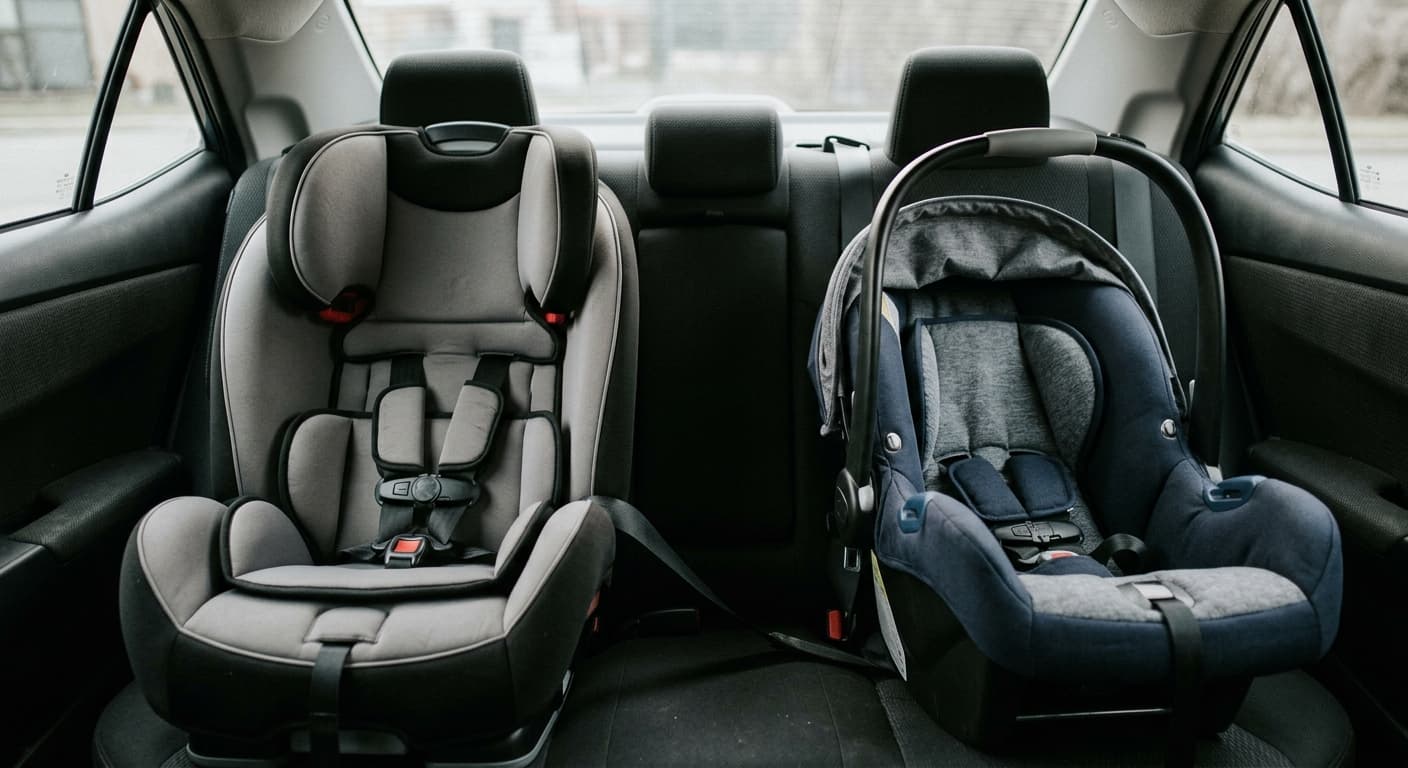
Every US state and the District of Columbia requires a young child to ride in a car seat, booster seat, or (once old enough) a seat belt, but the exact rear-facing cutoff, booster requirement, front-seat rule, and penalty differ by state. This page, current as of September 2026, gives the full 51-jurisdiction table, explains the four-stage progression most states build their law around, and separates what state law actually requires from what NHTSA and the American Academy of Pediatrics additionally recommend.
Jurisdiction scope: This article covers child car seat and booster seat law in all 50 US states and the District of Columbia, plus the federal product standards (49 CFR 571.213, 571.213a, and 571.213b) that govern what a car seat manufacturer may sell. It does not address Canadian provincial car seat law (see the Canada car seat laws page below) or the law of any country outside North America.
Car Seat Laws by State: Quick-Reference Table
The table below covers all 50 states and DC. "Not set by statute" is accurate for many cells: once a state's base restraint duty is met, a number of states leave the seat's orientation and type to the manufacturer's own instructions rather than legislating a separate age cutoff, and that's what the state's own statute says, not a gap in this page's coverage. Where a state joins two conditions with AND, both have to be true for the duty to apply and either one exceeded ends it; where a cell shows AND as the exit itself, the statute requires both thresholds to be crossed before the next stage begins. Click a state's name for its full page, sourcing, and exemptions.

Northeast states
The table below covers 9 states in the Northeast.
| State | Rear-facing until | Harness/forward-facing until | Booster until | Seat belt from | Front seat rule | First-offense penalty | Statute |
|---|---|---|---|---|---|---|---|
| Connecticut | age 2 AND 30 lb | age 5 AND 40 lb | age 8 AND 60 lb | Age 8 AND 60 lb | Rear-facing seat barred near an active airbag | Infraction (1st); up to $199 (2nd); Class A misdemeanor (3rd+) | Conn. Gen. Stat. § 14-100a |
| Maine | age 2, or manufacturer's limit (convertible seats) | 55 lb or manufacturer's limit (early move to booster) | age 8 or 80 lb or 4'9" (57 in) | Once the booster stage ends (age 8, 80 lb, or 4'9", whichever first) | Rear seat required "if possible" for children under 12 | $50 (1st); $125 (2nd); $250 (3rd+); no purchase waiver | 29-A M.R.S. §2081 |
| Massachusetts | No stage split (mandate to age 8 or 4'9") | No stage split (mandate to age 8 or 4'9") | No stage split (mandate to age 8 or 4'9") | Age 8, or 57 in if earlier (through 12) | Not addressed by statute | Up to $25 fine (taxi w/o restraint device excused from fine only, not the duty) | Mass. Gen. Laws c. 90, § 7AA |
| New Hampshire | age 2 | Combined mandate to age 7 or 4'9" | Combined mandate to age 7 or 4'9" | Age 7, or 4'9" (57 in) if earlier | Not addressed by statute | $50 (1st); $100 (2nd+) | RSA 265:107-a |
| New Jersey | age 2 or 30 lb | age 4 or 40 lb | age 8 or 4'9" (57 in) | Age 8 (any height), or 4'9" (57 in) if under 8 | All three restraint stages must be in a rear seat; front only if no rear seats exist (rear-facing further barred near an active airbag) | $50-$75 fine (flat, no 2nd-offense tier) | N.J.S.A. 39:3-76.2a |
| New York | age 2 | age 4 | Age 8 (affirmative defense if belted and over 4'9" or 100 lb) | Age 8 | Not addressed by statute (front and back seats carry the same age-based rules) | $25-$100 fine (child restraint violation); waived under-8 w/ proof of purchase (not on 2nd offense) | NY Vehicle and Traffic Law § 1229-c |
| Pennsylvania | Under 2, until manufacturer's limit (Act 43 of 2016) | Age 4 (restraint-system stage, from the rear-facing exit) | age 8 | Age 8 | Not addressed by statute | $75 fine (summary offense); dismissed w/ proof of purchase before hearing | 75 Pa.C.S. § 4581 |
| Rhode Island | age 2 AND 30 lb | Not set by statute | age 8 or 80 lb or 4'9" (57 in) | Age 8, or 57 in, or 80 lb (whichever first; belt worn in a rear seating position until 8) | Rear seat required (covered child); front only if no back seat or all rear seats occupied by other children | $100 fine (child restraint); voided w/ proof of purchase within 7 days; $40 (belt violation, ages 8-17) | R.I. Gen. Laws § 31-22-22 |
| Vermont | age 2 | age 5 or manufacturer's limit | age 8 | Age 8 | Rear seat required for under-13 "if practical" (real statutory duty, not mere guidance); rear-facing seat absolutely barred from front with an active airbag (no practicality exception) | $25 (1st); $50 (2nd); $100 (3rd+) | 23 V.S.A. § 1258 |
Midwest states
The table below covers 12 states in the Midwest.
| State | Rear-facing until | Harness/forward-facing until | Booster until | Seat belt from | Front seat rule | First-offense penalty | Statute |
|---|---|---|---|---|---|---|---|
| Illinois | age 2 or 40 lb or 3'4" (40 in) | Not set by statute | age 8 | Age 8 | Not addressed by statute | $75 fine (1st, avoidable w/ proof + course); $200 flat (2nd+) | 625 ILCS 25/4 |
| Indiana | Not set by statute | Not set by statute | age 8 | Age 8 | Not addressed by statute | Class D infraction, up to $25 (waived for a compliant first offender) | IC 9-19-11-2 |
| Iowa | age 1 or 20 lb, whichever first | Not set by statute | age 6 | Age 6 | Not addressed by statute (narrow motor-home carve-out only) | Simple misdemeanor (scheduled fine); 1st-offense relief w/ proof of purchase (subsection 1 only) | Iowa Code §321.446 |
| Kansas | age 4 (orientation not mandated) | Not set by statute | Age 8, or 80 lb AND 4'9" under (a)(2); in practice either, via (a)(3) | Age 8, or 80 lb, or 4'9" via (a)(3), whichever first | Not addressed by statute | $60 fine (waived for a restraint-system violation on proof of purchase; no license points) | K.S.A. 8-1344 |
| Michigan | age 2 or manufacturer's limit | age 5 or manufacturer's limit | age 8 or 4'9" (57 in) | Age 8, or 4'9" (57 in) if earlier (through 12) | Rear seat required if available (front only if all rear seats occupied by children); rear-facing barred from front unless airbag deactivated | Up to $10 fine (civil infraction) plus up to $100 costs plus $40 assessment (most cases) | MCL 257.710d |
| Minnesota | age 2 AND manufacturer's limit exceeded | age 4 AND forward-facing seat's limit exceeded | Age 9, or booster's limit exceeded (whichever first; a "more protective category" rule keeps a still-fitting child in the booster) | Age 9, or once the booster's limit is exceeded | Under 13 in rear seat when available (narrower under-6/60lb overlay when airbag active) | Up to $50 (petty misdemeanor); waivable w/ proof within 14 days | Minn. Stat. § 169.685 |
| Missouri | Not set by statute | Combined mandate through age 4 | Age 8, or 80 lb, or 4'9" (whichever first) | 80 lb or 4'9" (whichever first) | Not addressed by statute | $50 + costs (restraint/booster stages, dismissible w/ proof); $10, no costs (post-booster belt stage) | RSMo § 307.179 |
| Nebraska | age 2 or manufacturer's max | Combined mandate through age 8 | Combined mandate through age 8 | Age 8 | Rear seat required under 8 only if equipped for the restraint AND not already occupied by another under-8 child | $25 fine (single violation regardless of multiple children) | Neb. Rev. Stat. § 60-6,267 |
| North Dakota | Not set by statute | Not set by statute | age 8 or 4'9" (57 in) | Age 8, or 4'9" (57 in) if earlier | Not addressed by statute | $25 fee + 1 demerit point | N.D.C.C. § 39-21-41.2 |
| Ohio | Not set by statute (device required under 4 or under 40 lb, no orientation specified) | Not set by statute | age 8 or 4'9" (57 in) | Age 8 (no height trigger in (D)); a 4-7-year-old already 4'9" is covered only in the front seat, by ORC 4513.263 (uncovered in back) | Not addressed by 4511.81; ORC 4513.263 separately requires front-seat belt use | $25-$75 (1st, minor misdemeanor); 4th-degree misdemeanor (2nd+) | Ohio Rev. Code § 4511.81 |
| South Dakota | Not set by statute | Not set by statute | Not set by statute (restraint system required under 5; no separate booster stage) | Age 5 | No age-based ban; front-seat riders 5-17 must be belted | $25 judgment (petty offense, civil proceeding); court may reduce or eliminate | SDCL 32-37-1 |
| Wisconsin | age 1 AND 20 lb | age 4 AND 40 lb | age 8 or 80 lb or 4'9" (57 in) (exiting this stage still requires a belt under the catch-all) | Age 8, or 80 lb, or 4'9" (57 in) | Rear seat required only if vehicle has a back seat | $30-$75 (under 4); $10-$25 1st / $25-$200 2nd+ (age 4-to-under-8) | Wis. Stat. § 347.48(4)(as) |
Southern states
The table below covers 16 states in the South, plus the District of Columbia.
| State | Rear-facing until | Harness/forward-facing until | Booster until | Seat belt from | Front seat rule | First-offense penalty | Statute |
|---|---|---|---|---|---|---|---|
| Alabama | age 1 or 20 lb | age 5 or 40 lb | age 6 | Age 6 (through 14; general law at 15) | Not addressed by statute | $25 fine per offense (1 license point; 2 on repeat) | Ala. Code § 32-5-222 |
| Arkansas | Not set by statute | age 6 or 60 lb | Not set by statute | Age 6 or 60 lb | Not addressed by statute | $25-$100 fine (min $25 w/ proof of purchase) | Ark. Code Ann. § 27-34-104 |
| Delaware | age 2 or 30 lb | age 4 or 40 lb | Manufacturer's height/weight limit (mandatory booster stage) | After the booster's limit is reached (through age 15) | Under 12 and 5'5" or shorter barred from front seat with active airbag (exceptions apply) | No fine, 1st offense; $25 on repeat (no purchase waiver) | 21 Del. C. § 4803 |
| District of Columbia | Age 2, or 40 lb AND 40 in (both) | Combined mandate through age 3 | age 8 | Age 8 | Not addressed generally; only bars an unrestrained "excess child" (under the (c) exemption) from the front seat | $75 fine, or $25 safety class (waived w/ proof of purchase); escalates on repeat | D.C. Code § 50-1703 |
| Florida | Not set by statute (device required through age 3, no orientation specified) | Not set by statute (device-or-booster option, ages 4-5) | Age 6 (booster optional 4-5, not separately mandated) | Age 6 (narrow exceptions allow belt at 4-5) | Not addressed by statute | Moving violation, 3 points (waivable via safety program; fine waivable at court's discretion) | Fla. Stat. § 316.613 |
| Georgia | Not set by statute | Not set by statute | age 8 or 4'9" (57 in), if shown | Age 8, or 4'9" (57 in) if shown | Rear seat required unless unavailable or occupied by other children | Up to $50 (1st); up to $100 (2nd+) | O.C.G.A. § 40-8-76 |
| Kentucky | Not set by statute | 3'4" (40 in) | age 8 or 4'9" (57 in) | Age 8, or 4'9" (57 in) if earlier | Not addressed by statute | $50 (restraint) or $30 (booster, dismissible for 1st offense w/ proof); up to $25 (general belt) | KRS 189.125 |
| Louisiana | age 2 or manufacturer's limit | Manufacturer's forward-facing limit | age 9 or manufacturer's booster limit | Age 9, or earlier if booster outgrown | Under 13 in rear seat when available (plus narrower under-6/60lb overlay when passenger airbag active) | $100 (1st); $250-$500 (2nd); $500+ costs (3rd+) | La. R.S. 32:295 |
| Maryland | age 2 or manufacturer's limit | Not set by statute | age 8 or 4'9" (57 in) | Age 8, or 4'9" (57 in) if earlier | Not addressed by statute | $50 fine (written warning only for a 1st under-2 wrong-orientation citation, not no-seat-at-all) | Md. Code, Transportation §22-412.2 |
| Mississippi | Not set by statute | Combined mandate through age 4 | Age 7, or 65 lb AND 4'9" together (whichever first) | Age 7, or once both size thresholds are met (earlier) | Not addressed by statute | Up to $25 fine (no purchase waiver) | Miss. Code Ann. § 63-7-301 |
| North Carolina | Not set by statute | Not set by statute | age 8 or 80 lb | Age 8 or 80 lb (through 15) | Under 5 AND under 40 lb must ride in rear seat with an active passenger airbag (unless the restraint is designed for airbag use) | Up to $25 fine + 2 license points (no insurance points) | N.C. Gen. Stat. § 20-137.1 |
| Oklahoma | Age 2, or manufacturer's limit (whichever first) | age 4 | age 8 or 4'9" (57 in) | Age 8, or 4'9" (57 in) if earlier | Not addressed by statute | $50 fine plus court costs (waivable, 1st offense only, costs capped at $15) | 47 O.S. § 11-1112 |
| South Carolina | age 2 or manufacturer's limit | Manufacturer's height/weight limit (from age 2) | Fit test met (typically 8 or 57 in) | Age 8 or 57 in, if fit test passed | Under 8 may ride front only if no rear seat or all rear seats occupied by other under-8s | Up to $150 fine (mandatory waiver on proof of purchase) | S.C. Code § 56-5-6410 |
| Tennessee | age 1 AND 20 lb | age 4 | age 9 or 4'9" (57 in) | Age 9, or 4'9" if earlier (through 12); 13-15 under a separate belt provision | Rear seat OR per manufacturer instructions (disjunctive, not absolute); ages 9-12 rear seat only "recommended" | Class C misdemeanor (offenders' class option, 1st offense); $50 pay-in-lieu w/o court appearance for ages 9-15 | Tenn. Code Ann. § 55-9-602 |
| Texas | No stage split (mandate to age 8 or 4'9") | No stage split (mandate to age 8 or 4'9") | No stage split (mandate to age 8 or 4'9") | age 8 or 4'9" (once the restraint-device mandate ends) | Not addressed by statute | $25-$250 (child-seat violation); dismissible w/ 4 conditions incl. proof of purchase | Tex. Transp. Code § 545.412 |
| Virginia | Age 2, or manufacturer's minimum weight (whichever first) | No stage split (mandate to age 8) | No stage split (mandate to age 8) | Age 8 | All restraint stages under 8 must ride in rear (front allowed only if no back seat exists AND no active airbag) | $50 (1st, non-suspendable); up to $500 (2nd+) | Va. Code § 46.2-1095 |
| West Virginia | No stage split (mandate to age 8 or 4'9") | No stage split (mandate to age 8 or 4'9") | No stage split (mandate to age 8 or 4'9") | Age 8, or 4'9" (57 in) if earlier | Not addressed by statute | $10-$20 fine (misdemeanor) | W. Va. Code § 17C-15-46 |
Western states
The table below covers 13 states in the West.
| State | Rear-facing until | Harness/forward-facing until | Booster until | Seat belt from | Front seat rule | First-offense penalty | Statute |
|---|---|---|---|---|---|---|---|
| Alaska | age 1 AND 20 lb | age 4 | age 8 or 4'9" (57 in) or 65 lb | Age 4+, once 4'9" or 65 lb reached (ages 8-15: driver's choice of device or belt) | Not addressed by statute | Up to $50 fine (infraction) | AS 28.05.095 |
| Arizona | Not set by statute | age 5 | age 8 or 4'9" (57 in) | Age 8, or 4'9" (57 in) if earlier | Not addressed by statute | $50 civil penalty (no escalation; waived w/ proof of purchase) | A.R.S. § 28-907 |
| California | age 2 or 40 lb or 3'4" (40 in) | age 8 | age 8 or 4'9" (57 in) | Age 8, or 4'9" (57 in) if earlier | Under 8 in rear seat (exceptions: no rear seat, rear seats occupied by other under-8s, medical need); rear-facing further barred from front with active airbag | $100 (1st); $250 (2nd+); reducible/waivable if economically disadvantaged plus education program | Cal. Veh. Code §§ 27360, 27363 |
| Colorado | age 2 or 40 lb | age 4 | age 9 | Age 9 (restraint-or-belt option runs 9-17) | Rear seat required (when available) for every stage from birth through age 8 | ~$81 total ($65 fine + $16 surcharge); waivable w/ proof of purchase; no license points | C.R.S. § 42-4-236 |
| Hawaii | age 2 | age 4 | age 10 | Age 10, or age 7 if over 4'9" tall (both required) | Not addressed by statute | Up to $100 plus safety class (1st); $250-$500 (2nd); $500-$800 (3rd+); no purchase waiver | HRS §291-11.5 |
| Idaho | No stage split (mandate through age 6) | No stage split (mandate through age 6) | No stage split (mandate through age 6) | Age 7 | Not addressed by statute | Infraction (fine set by Idaho's infraction schedule, not fixed in this statute) | Idaho Code §49-672 |
| Montana | age 2 | age 4 | Age 9, or booster's limit outgrown (whichever first) | Age 9, or once the booster's limit is outgrown | Not addressed by statute | Up to $100 fine (waived once, w/ proof within 7 days) | MCA 61-9-420 |
| Nevada | age 2 | Combined mandate to age 6 or 4'9" | Combined mandate to age 6 or 4'9" | Age 6, or 4'9" (57 in) if earlier | Under 2 rear-facing in back unless airbag deactivated (narrow exceptions) | $100-$500 misdemeanor or 10-50 hrs community service (1st); waivable w/ training program | NRS 484B.157 |
| New Mexico | Under 1 (rear seat if available) | Age 5 (covers ages 1-4 regardless of weight, or any age under 40 lb) | Age 7 (covers ages 5-6 regardless of weight, or any age under 60 lb) | Age 7 (restraint device or belt w/ fit test through 12; general duty 13-17) | Under 1: rear seat if available; if none, front allowed only w/ airbag deactivated (or no deactivation switch) | $25 flat penalty assessment (NMSA 66-8-116 schedule) | NMSA 1978, § 66-7-369 |
| Oregon | age 2 | 40 lb | Entered at over 40 lb; ends at 4'9" (57 in) or age 8, whichever first | 4'9" (57 in) or age 8, whichever first | Not addressed by statute | Class D traffic violation (~$115 presumptive fine plus surcharge) | ORS 811.210 |
| Utah | No stage split (mandate to age 8 or 4'9") | No stage split (mandate to age 8 or 4'9") | No stage split (mandate to age 8 or 4'9") | Age 8, or 57 in (whichever first) | Not addressed by statute | Up to $45 (must be waived on proof of purchase, 1st offense) | Utah Code § 41-6a-1803 |
| Washington | age 2 or manufacturer's limit (may continue longer) | age 4 or manufacturer's limit (may continue longer) | 4'9" (57 in) | Once belts fit properly (4'9" or typically ages 8-12) | Rear seat "where practical" under 13 (real statutory duty) | Traffic infraction (amount set by Washington's general infraction schedule, not this statute); dismissible w/ proof within 7 days | Wash. Rev. Code § 46.61.687 |
| Wyoming | No stage split (mandate to age 9) | No stage split (mandate to age 9) | No stage split (mandate to age 9) | Age 9, or earlier once belts fit properly (fit test) | Must use a non-front seat, with exceptions; rear-facing seat barred near an active airbag | Up to $50 (1st, waived w/ proof); up to $100 (2nd+) | Wyo. Stat. § 31-5-1303 |
The Four Stages of Child Car Seat Progression
Most staged states build their car seat law around the same four-stage model: a rear-facing seat for infants and young toddlers, a forward-facing seat with an internal harness, a booster seat that positions the vehicle's own seat belt correctly, and finally the adult seat belt alone.
That model traces back to federal product standards, not a federal use requirement. 49 CFR 571.213, known as FMVSS 213 (Federal Motor Vehicle Safety Standard 213, "child restraint systems"), sets the crash-test and performance requirements a car seat must meet to be sold in the United States. It regulates the seat as a product. It creates no duty on a parent or driver to use that seat in any particular way at any particular age; that duty comes entirely from state law, and every state's numbers differ. Two companion standards become mandatory for newly manufactured seats on December 5, 2026: FMVSS 213a (49 CFR 571.213a), a side-impact test, and FMVSS 213b (49 CFR 571.213b), a revised version of the general standard (see "What's Changing in 2026-2027" below).
Not every state follows the four-stage model. Six states, Idaho, Massachusetts, Texas, Utah, West Virginia, and Wyoming, impose one undifferentiated restraint-device mandate instead: the statute sets a single age or height cutoff (commonly age 8 or 4 feet 9 inches) and leaves the seat's orientation and type entirely to the manufacturer's own instructions. A reader coming from a fully staged state, like Alabama or Alaska, should not assume every state legislates the same rear-facing, forward-facing, and booster progression; check the table above for your state.
Rear-Facing Car Seat Requirements
Where a state sets a rear-facing floor in statute, that number is commonly age 2 (or under 2), often paired with a weight or height threshold: 26 of the 51 jurisdictions set that floor at age 2. Eighteen more set no rear-facing-specific threshold by statute at all: 12 leave orientation to the seat manufacturer's own instructions from the start of the base restraint duty, and 6 (Idaho, Massachusetts, Texas, Utah, West Virginia, and Wyoming) run a single undifferentiated mandate with no separate stages of any kind. The remaining states set a rear-facing floor at a different age or a combined age-and-weight test; see the table above for your state's specific figure.
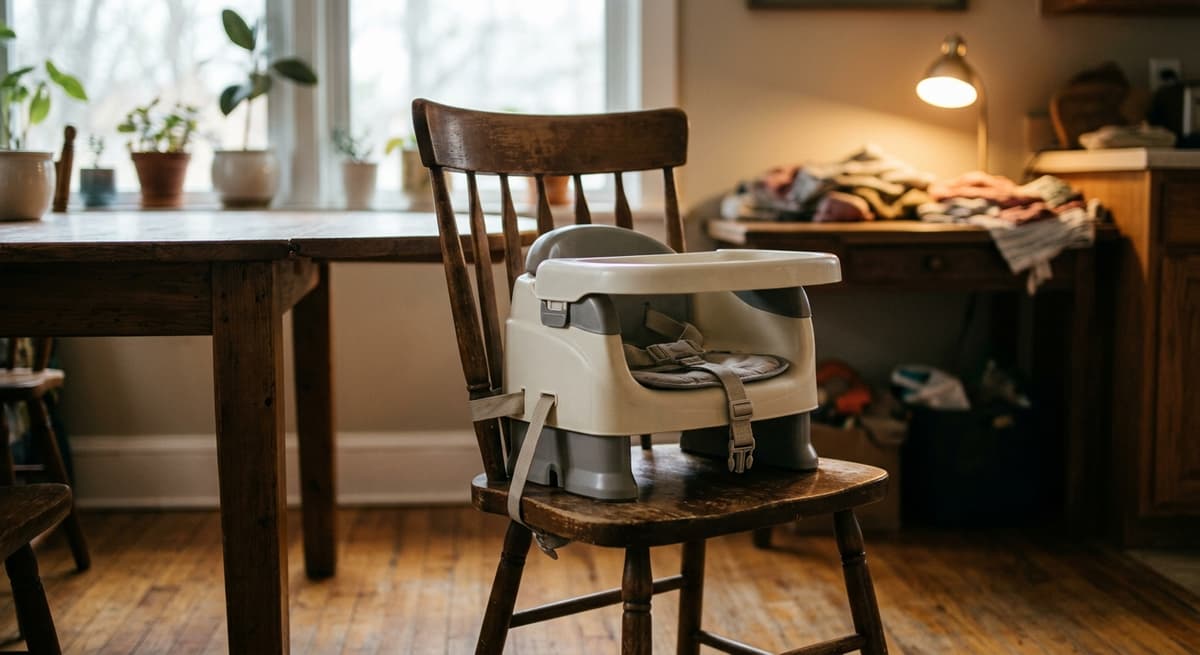
The statutory floor is a legal minimum, not a safety target. NHTSA's consumer-facing recommendation is that a child ride rear-facing as long as possible, up to the seat manufacturer's own height and weight limit, well past most states' statutory floor. The American Academy of Pediatrics' current published guidance states it plainly: "All infants and toddlers should continue to ride in a rear facing seat as long as possible until they reach the highest weight or height allowed by their car safety seat manufacturer." No minimum age like "at least 2 years" appears in that guidance. AAP dropped that specific floor from its policy in 2018; a page that still tells parents a child must turn forward-facing at exactly 2 years old is describing outdated guidance, not current law or current pediatric advice.
Forward-Facing Car Seat Requirements
The forward-facing harness stage sits between the rear-facing floor and the booster stage in states that legislate it as its own tier, typically running from roughly age 4 or 5 up to a weight or height limit in the 40 to 65-pound or 40 to 65-inch range. Several states fold this stage into the same combined mandate discussed above rather than setting it apart: DC, Mississippi, Missouri, Nebraska, Nevada, and New Hampshire each run a single continuous mandate through this age range rather than splitting out a distinct harness sub-stage, and the six undifferentiated states named above skip the split entirely. Check the table's "Harness/forward-facing until" column for your state's specific cutoff, or "Combined mandate" if it doesn't split this stage out.
Booster Seat Requirements and the Seat Belt Fit Test
The booster stage is the most consistent part of the four-stage model across states that legislate it separately: 32 of 51 jurisdictions run their booster (or booster-eligible) requirement to age 8 in some form, commonly paired with a height threshold around 4 feet 9 inches (57 inches), the point at which most vehicle seat belts start to fit a child's body correctly without a booster raising them. Only two states, Arkansas and South Dakota, set no statutory booster-type stage at all; both move straight from an early combined restraint-seat duty (Arkansas: under 6 and under 60 pounds; South Dakota: under 5) to a plain seat belt, with no booster tier in between.
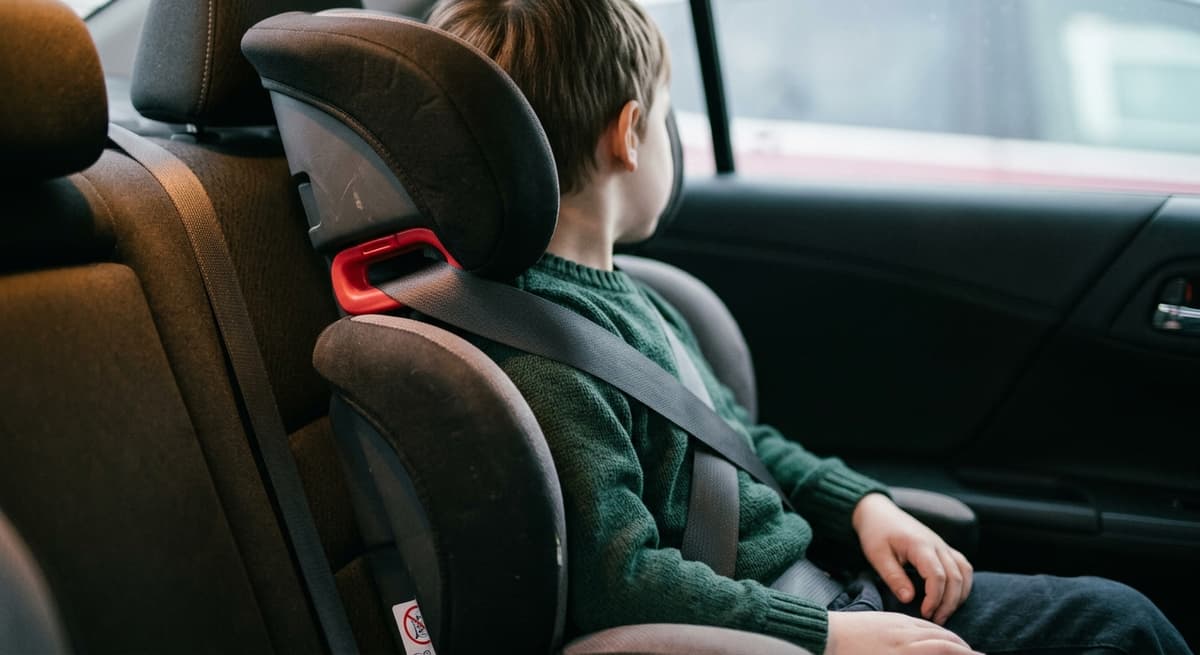
A booster seat's job is to raise a child high enough that the vehicle's own lap and shoulder belt fit properly: the lap belt low across the hips rather than the stomach, and the shoulder belt across the chest and shoulder rather than the neck or face. For most states, that fit description is safety-education material from highway-safety offices and pediatric groups layered on top of a flat age or height number in the statute, not the law itself. A real minority of states write the fit test directly into their statute as the actual legal standard: South Carolina's booster stage runs until a three-part fit test is met, New Mexico's seat-belt-eligible tier at age 7 carries its own statutory fit test, Minnesota's transition to a seat belt is defined by a four-part fit test, and Wyoming and Washington each let a child move to the vehicle's own belts once those belts fit correctly, as a matter of statute. Where your state's row in the table above shows a flat age or height instead, use that as the legal answer, and treat a fit-test checklist as a practical safety supplement rather than the law itself.
When Can a Child Sit in the Front Seat? (State Law vs. Recommendation)
Most states set no specific front-seat rule in statute: 27 of the 51 jurisdictions have no front-seat placement rule at all, confirmed absent in states including Alabama, Arizona, Florida, and Ohio. In those states, the front seat is not independently regulated; the restraint-stage and seat-belt rules in the table above still apply wherever the child sits.
24 of 51 jurisdictions do address front-seat or rear-seat placement in their own statute, and the scope varies widely. A real group of states run a broad rear-seat mandate that covers every restraint stage, not just an airbag scenario: Colorado requires a rear seat, when available, for every stage from birth through age 8; Louisiana and Minnesota each require every child under 13 to ride in the rear seat when one is available, layered with a narrower rule tied to an active airbag for younger, lighter children; Michigan and New Jersey require a rear seat for every restraint stage, with the front seat allowed only when no rear seat is available or already occupied; Virginia goes further still, requiring every restraint stage under 8 to ride in back with only a narrow no-back-seat exception; and Georgia, Maine, Rhode Island, South Carolina, Vermont, Washington, and Wisconsin each carry their own version of a rear-seat requirement, some absolute and some qualified by "if available" or "if practical." Tennessee's rule is disjunctive rather than absolute: a restraint goes in the rear seat if available, or is used according to the manufacturer's or vehicle's own instructions, and rear-seat placement is only "recommended," not required, for ages 9 through 12. New Mexico and Nevada each tie their rule to the youngest children specifically (under 1 and under 2). A narrower group of states, Connecticut, Delaware, and Wyoming among them, address only the airbag scenario: barring a rear-facing seat from the front seat of a vehicle with an active airbag, without a broader rear-seat mandate covering every stage. South Dakota sets no placement ban at all but does require any front-seat rider age 5 through 17 to be belted.
Beyond whatever a state's own statute requires, many pediatric and highway-safety organizations recommend keeping children in the back seat generally until early adolescence, since a front airbag poses more risk to a smaller body. That is a safety recommendation, not a nationwide legal requirement, and it does not override a state's own narrower or absent front-seat statute.
Car Seat Rules in Rideshares, Taxis, and School Buses
Most states carve some kind of taxi or for-hire exemption into their restraint mandate, but the scope varies widely. Louisiana excludes "commercial truck, van, or taxi" from its own definition of a covered vehicle, removing the entire child-restraint law from that ride, not just a single seat or occupant. Idaho's restraint duty binds only a "noncommercial motor vehicle operator," so a taxi or rideshare driver falls outside it by definition. Alabama exempts taxis and any vehicle seating 11 or more passengers outright. Florida exempts a chauffeur-driven taxi, limousine, sedan, van, bus, or motor coach hired for compensation from the restraint requirement itself, but shifts the underlying responsibility back to the child's own parent or guardian. Washington exempts for-hire vehicles, smaller vehicles operated by auto transportation companies, and airport and hotel shuttle services by name. Not every state follows this pattern: Illinois's rear-facing duty specifically carries no non-commercial qualifier, so a taxi is scoped in, and New Jersey and Arizona each confirm in their own statute's text that no separate taxi or for-hire exemption exists.
Rideshare coverage specifically, Uber, Lyft, and similar transportation network company (TNC) services, is genuinely unresolved in most states, because the "for-hire" or "commercial transportation" language in most statutes predates rideshare as an industry. Indiana and New Hampshire are the two states whose statute names rideshare or TNC vehicles specifically: Indiana exempts a TNC driver providing a prearranged ride, and New Hampshire's for-hire exemption lists "a taxi, livery, or rideshare vehicle" by name. Utah takes a different approach entirely: rather than exempting the ride, it shifts the restraint duty to whichever adult passenger is supervising the child. Absent language like Indiana's or New Hampshire's, do not assume a state's taxi exemption automatically covers a rideshare vehicle.
School buses are commonly exempt from the ordinary child-restraint mandate as a separate vehicle category, since school buses are regulated under their own federal and state safety standards rather than the passenger-vehicle car seat statute.
Leaving a Child Unattended in a Vehicle
A number of states carry a dedicated, vehicle-specific unattended-child statute, and they vary widely in what triggers it and how it's enforced. Hawaii's statute is triggered at exactly five minutes for a child under age 9, and "unattended" includes a child left with only an 11-year-old supervisor. Texas similarly triggers at longer than five minutes, for a child younger than 7 left without anyone 14 or older present, as a Class C misdemeanor. Florida splits the question in two: a child under 6 may not be left unattended for more than 15 minutes under one clause, but a second, independent clause removes that 15-minute grace period entirely, for any duration, if the vehicle's engine is running or the child's health appears to be in danger. Louisiana's statute reaches a child under 6 left more than 10 feet from an adult who can't continuously observe the child, and lets an officer remove a child left unattended for more than 10 minutes; penalties there range up to $500 and 6 months in jail for a first offense, rising to 1 to 2 years' imprisonment and a $1,000 to $2,000 fine for a second or later offense. Nevada's statute turns on risk conditions (a running engine, keys in the ignition, or a genuine safety risk) rather than a flat time limit, for a child 7 or younger. Michigan uses a contextual "unreasonable risk of harm" standard for a child under 6, with penalties that scale from a 93-day misdemeanor to a 15-year felony depending on the outcome. Washington makes it a misdemeanor to leave a vehicle running and unattended with a child under 16 inside. Utah's statute is comparatively narrow: it applies only to a child under 9 left unsupervised where conditions present a risk of hyperthermia, hypothermia, or dehydration specifically, not any safety risk. Wisconsin's unattended-child statute reaches only a licensed child-care vehicle, not a private car. Alabama's statute, sometimes called the Amiyah White Act, has a narrower scope worth noting specifically: it applies only to a licensed day care or child care facility, or a person paid to supervise the child, not to a parent driving their own child generally.
Where a state doesn't have a dedicated statute, that does not mean leaving a child unattended in a vehicle carries no legal exposure: a general child-neglect or endangerment statute can still reach the same conduct, sometimes at a felony level. "No dedicated statute" is never the same finding as "no law."
What's Changing in 2026-2027
Two federal product standards for car seats become mandatory for newly manufactured seats on December 5, 2026: FMVSS 213a (49 CFR 571.213a), a side-impact crash-protection standard, and FMVSS 213b (49 CFR 571.213b), a revised version of the general child-restraint standard. Both are product-manufacturing standards: they govern what a car seat maker may sell starting on that date. Neither makes a car seat already owned and in use illegal to keep using.
California's current Cal. Veh. Code § 27363 carries its own sunset clause and repeals itself on January 1, 2027; Stats. 2025, Ch. 434, Sec. 8 enacts the replacement text, effective that same date. This page, and California's own page, describe the version of § 27363 in effect through December 31, 2026; check the current statute directly for the rule effective after that date. Florida's 2026 attempt to expand its booster requirement through age 8, HB 233, died in a House subcommittee on March 13, 2026, and did not become law; Florida's booster requirement remains the through-age-5 requirement (belt from 6) described in the table above.
Car Seat Inspection and Replacement Guidelines
Most inspection and replacement guidance for car seats is safety guidance from NHTSA and seat manufacturers, not state law: replace a seat after a moderate or severe crash, check the seat's own expiration date printed by the manufacturer, and use a certified car seat inspection station or technician if you're unsure a seat is installed correctly. In most states, none of that is independently required by statute.
New Hampshire is the one state that has made a version of this a statutory duty rather than pure guidance. RSA 265:107-a, I-b, amended effective January 1, 2024, requires every child restraint system to be used according to its manufacturer's instructions, including the manufacturer's own height and weight limits, proper attachment to the vehicle, correct securement of the child, and the restraint's own expiration dates. A family using an expired seat, or one installed contrary to its own instructions, is out of compliance with New Hampshire law even if the seat itself is the right type for the child's age.
State-by-State Guides
Full details, sourcing, and exemptions for every state and DC:
Alabama · Alaska · Arizona · Arkansas · California · Colorado · Connecticut · Delaware · District of Columbia · Florida · Georgia · Hawaii · Idaho · Illinois · Indiana · Iowa · Kansas · Kentucky · Louisiana · Maine · Maryland · Massachusetts · Michigan · Minnesota · Mississippi · Missouri · Montana · Nebraska · Nevada · New Hampshire · New Jersey · New Mexico · New York · North Carolina · North Dakota · Ohio · Oklahoma · Oregon · Pennsylvania · Rhode Island · South Carolina · South Dakota · Tennessee · Texas · Utah · Vermont · Virginia · Washington · West Virginia · Wisconsin · Wyoming
Related reading: DUI laws, traffic camera tickets, window tint laws, car accident laws, and, for Canadian readers, car seat laws in Canada.
Disclaimer: This article provides general legal information about child car seat laws in the United States as of September 2026. It is not legal advice. Car seat statutes, exemptions, and penalties change; verify the current text of your state's law before relying on it, and consult a lawyer licensed in your state for advice about a specific situation. Safety recommendations from NHTSA and the American Academy of Pediatrics referenced on this page are guidance, not law, and may set a higher standard than your state's legal minimum.
Statutes cited reflect their in-force version as of 2026-09-17. Last updated: 2026-09-17.
Frequently Asked Questions
What is the current federal law on car seats?
There is no federal law requiring a parent to use a car seat in a particular way. The federal government regulates the seat as a product: FMVSS 213 (49 CFR 571.213) sets crash-test and performance standards a car seat must meet to be sold, and two companion standards, FMVSS 213a (side-impact) and FMVSS 213b (a revised general standard), become mandatory for newly manufactured seats on December 5, 2026. The age, weight, and height thresholds for actually using a car seat come entirely from your state's own law; see the table above.
Is it illegal to have a rear-facing car seat in the front seat?
In most states, this isn't independently addressed by statute. A real group of states does bar it specifically when the front passenger seat has an active airbag, including Connecticut, Delaware, and Wyoming, and several other states run a broader rear-seat mandate that covers every restraint stage, not just rear-facing seats. Check your state's row in the table above; where a state has no specific rule, the general safety recommendation is still to avoid placing a rear-facing seat in front of an active airbag.
Do all states require booster seats?
No. Two of the 51 jurisdictions, Arkansas and South Dakota, set no statutory booster-type stage at all, moving straight from an early combined restraint-seat duty to a plain seat belt. 32 of 51 jurisdictions run a booster requirement to roughly age 8 in some form. Check the table above for your state's specific cutoff.
What happens if I get pulled over without a car seat?
It depends entirely on the state. Delaware assesses no fine for a first offense (only $25 on repeat), while penalties otherwise run from a $10 civil infraction cap in Michigan to as much as $500 for a first offense in Nevada. Many states waive or reduce the fine if you show proof of acquiring a compliant seat after the stop, though several, including Delaware, Maine, Mississippi, and Hawaii, do not; see your state's row in the table above and its full page for the specifics.
Are car seat laws different for Uber and Lyft?
This is genuinely unresolved in most states, because the taxi or for-hire exemptions written into most car seat statutes predate rideshare as an industry. Indiana and New Hampshire are the two states that name rideshare or transportation network company vehicles specifically in their statute. Absent language like that, do not assume a taxi exemption automatically covers an Uber or Lyft ride.
When can a child legally stop using a booster seat?
The legal answer depends on your state; 32 of 51 jurisdictions set a booster requirement running to roughly age 8, commonly paired with a height around 4 feet 9 inches, while Arkansas and South Dakota set no statutory booster stage at all. Some states, including South Carolina, New Mexico, Minnesota, Wyoming, and Washington, write the exact seat belt fit test into the statute itself as the legal exit standard rather than leaving it as separate safety guidance.
Updates
Rebuilt with a state-by-state table regenerated from each state page after an independent review; counts, front-seat rules and penalties re-verified; FMVSS 213a/213b dates updated.
Independently fact-checked against the cited primary sources
Independently fact-checked against the cited primary sources; governing law re-checked for recent changes
Reviewed and approved by an editor
State-by-state comparison
Each state guide below is paired with the governing statute our editors adjudicated for it, held in our own legal record and verified against the official source.
Each statute shown is the same adjudicated anchor its state guide renders, independently verified against primary sources. A dash means not yet adjudicated in our record — never that no law exists.
The Law Behind This Article
This article rests on the statutory provisions below, held in our own legal record and retrieved from the official source. Tap a section to read the operative text.
Arkansas Code of 1987 Annotated
§ 27-34-104Requirements.In forcecited in 2 of our articles
(a) While operating a motor vehicle on a public road, street, or highway of this state, a driver who transports a child under fifteen (15) years of age in a passenger automobile, van, or pickup truck, other than one operated for hire, shall provide for the protection of the child by properly…
Official text (excerpt) · last checked 2026-09-09 · Read the full text in our law library · Verify at arkleg.state.ar.us
Cited in 7 court opinions in our collectionLatest citing opinion in our collection: 2021
Opinions citing this section in our collection:
- Opinion No. (Arkansas Attorney General Reports 2001)“…part of their services. Act 470 amended the provisions of A.C.A. § 27-34-104 , which is part of the Child Passenger…”
- Samantha Edwards, Individually and as Special Administratrix of the Estate of William Bobby Wray Edwards, and Arleigh Grayce Edwards, Deceased; And as Parent and Next Friend for Peyton Hale, a Minor v. Eric James Cornell Thomas and McElroy Truck Lines, Inc. (Supreme Court of Arkansas 2021, 625 S.W.3d 226)“…ion. 3 Ark. Code Ann. § 27-34-104. Any person who violates the CPPA is su…”
- Kroll v. Thomas (District Court, W.D. Arkansas 2020)“…d passenger safety seat properly secured to the vehicle.” Ark. Code Ann. § 27-34-104(b). Any child who is at least six year…”
Identified automatically from the court opinions citing this section — not a ranking of which case controls.
Also relied on in: Arkansas Car Seat Laws (2026): Ages, Weight & Fines
Arizona Revised Statutes, Title 28 (Transportation), Chapter 3 (TRAFFIC AND VEHICLE REGULATION), Article 15 (Miscellaneous Rules)
§ 28-907Child restraint system; civil penalty; exemptions; notice; child restraint fund; definitionsIn forcecited in 2 of our articles
A. Except as provided in subsection H of this section, a person shall not operate a motor vehicle on the highways in this state when transporting a child who is under five years of age unless that child is properly secured in a child restraint system. B. The operator of a motor vehicle that is designed for carrying ten or fewer passengers, that is manufactured for the model year 1972 and thereafter and that is required to be equipped with an integrated lap and shoulder belt or a lap belt pursuant to the federal motor vehicle safety standards prescribed in 49 Code of Federal Regulations section 571.208 shall require each passenger who is at least five years of age, who is under eight years of age and who is not more than four feet nine inches tall to be restrained in a child restraint system. C. Child restraint systems shall meet the requirements of 49 Code of Federal Regulations section 571.213 for the performance, design and installation of child restraint systems for use in motor vehicles as prescribed in this section. D.
Official text (excerpt) · last checked 2026-09-09 · Read the full text in our law library · Verify at azleg.gov
Cited in 4 court opinions in our collectionLatest citing opinion in our collection: 1999
Opinions citing this section in our collection:
- Law v. Superior Court of State of Ariz. (Arizona Supreme Court 1988, 157 Ariz. 147)“…any general legislation mandating seat belt use. But see A.R.S. § 28-907 requiring seat belt use for children fo…”
- Garcia v. General Motors Corp. (Court of Appeals of Arizona 1999, 195 Ariz. 510)“…me situations, such as for the very young, see A.R.S. section 28-907 (1998); Idaho Code section 49-672, or f…”
- Warfel v. Cheney (Court of Appeals of Arizona 1988, 157 Ariz. 424)“…systems for children under 4 years of age, see A.R.S. § 28-907, did not forbid a defendant from showin…”
Identified automatically from the court opinions citing this section — not a ranking of which case controls.
Also relied on in: Arizona Car Seat Laws (2026): Booster Age & Penalty Rules
California Vehicle Code
§ 27360In forcecited in 2 of our articles
(a) Except as provided in Section 27363, a parent, legal guardian, or driver who transports a child under eight years of age on a highway in a motor vehicle, as defined in paragraph (1) of subdivision (c) of Section 27315, shall properly secure that child in a rear seat in an appropriate child passenger restraint system meeting applicable federal motor vehicle safety standards. (b) Except as provided in Section 27363, a parent, legal guardian, or driver who transports a child under two years of age on a highway in a motor vehicle, as defined in paragraph (1) of subdivision (c) of Section 27315, shall properly secure the child in a rear-facing child passenger restraint system that meets applicable federal motor vehicle safety standards, unless the child weighs 40 or more pounds or is 40 or more inches tall. The child shall be secured in a manner that complies with the height and weight limits specified by the manufacturer of the child passenger restraint system. (c) This section does not apply to a driver if the parent or legal guardian of the child is a passenger in the motor vehicle. (d) This section shall become operative January 1, 2017.
Official text (excerpt) · last checked 2026-09-09 · Read the full text in our law library · Verify at leginfo.legislature.ca.gov
Cited in 10 court opinions in our collectionLatest citing opinion in our collection: 2025
Opinions citing this section in our collection:
- People v. Thomas (Appellate Division of the Superior Court of California 1984, 159 Cal. App. Supp. 3d 18)“…as appeals from the judgment of conviction for violation of Vehicle Code section 27360, subdivision (a) (failure to secure chi…”
- Los Angeles County Department of Children & Family Services v. William C. (California Supreme Court 2012, 54 Cal. 4th 610)“…el represents that William recently admitted a violation of Vehicle Code section 27360, subdivision (a) (transporting a young…”
- Chavez v. Glock, Inc. (California Court of Appeal 2012, 207 Cal. App. 4th 1283)“…now Pen. Code, § 25100) (unlawful storage of a firearm) and Vehicle Code section 27360 (failure to properly secure child in ca…”
Identified automatically from the court opinions citing this section — not a ranking of which case controls.
Also relied on in: California Car Seat Laws (2026): Ages, Airbags & Fines
§ 27363In forcecited in 2 of our articles
(a) The court may exempt from the requirements of this article any class of child by age, weight, or size if it is determined that the use of a child passenger restraint system would be impractical by reason of physical unfitness, medical condition, or size. The court may require satisfactory proof of the child’s physical unfitness, medical condition, or size and that an appropriate special needs child passenger restraint system is not available. (b) In case of a life-threatening emergency, or when a child is being transported in an authorized emergency vehicle, if there is no child passenger restraint system available, a child may be transported without the use of that system, but the child shall be secured by a seatbelt. (c) A child weighing more than 40 pounds may be transported in the backseat of a vehicle while wearing only a lap safety belt when the backseat of the vehicle is not equipped with a combination lap and shoulder safety belt.
Official text (excerpt) · last checked 2026-07-28 · Read the full text in our law library · Verify at leginfo.legislature.ca.gov
Cited in 1 court opinions in our collectionLatest citing opinion in our collection: 2022
Opinions citing this section in our collection:
- People v. Tonies CA3 (California Court of Appeal 2022)“…system. The court noted two relevant exceptions provided by Vehicle Code section 27363: (1) a child who weighs more than 40 po…”
Identified automatically from the court opinions citing this section — not a ranking of which case controls.
Connecticut General Statutes, Title 14 (Motor Vehicles. Use of the Highway By Vehicles. Gasoline), Chapter 246
§ 14-100aSeat safety belts. Child restraint systems. Wheelchair transportation devices.In forcecited in 2 of our articles
(a) No new passenger motor vehicle may be sold or registered in this state unless equipped with at least two sets of seat safety belts for the front and rear seats of the motor vehicle, which belts comply with the requirements of subsection (b) of this section. The anchorage unit at the attachment point shall be of such construction, design and strength as to support a loop load strength of not less than four thousand pounds for each belt. (b) No seat safety belt may be sold for use in connection with the operation of a motor vehicle on any highway of this state unless it is so constructed and installed as to have a loop strength through the complete attachment of not less than four thousand pounds, and the buckle or closing device shall be of such construction and design that after it has received the aforesaid loop belt load it can be released with one hand with a pull of less than forty-five pounds.
Official text (excerpt) · last checked 2026-09-09 · Read the full text in our law library · Verify at cga.ct.gov
Cited in 37 court opinions in our collectionLatest citing opinion in our collection: 2023
Opinions citing this section in our collection:
- State v. Dalzell (Connecticut Appellate Court 2006, 96 Conn. App. 515)“…ure to wear a seat belt in violation *517 of General Statutes § 14-100a (c) (1). The plea followed a denial of…”
- State v. Marsha P. (Connecticut Appellate Court 2011, 126 Conn. App. 497)“…g to instruct the jury that the motor vehicle infraction of General Statutes § 14-100a, concerning child safety in motor vehic…”
- In re Ivory W. (Supreme Court of Connecticut 2022, 342 Conn. 692)“…immunize children prior to school enroll- ment); General Statutes §§ 14-100a [and] 14-272a (requiring chil…”
Identified automatically from the court opinions citing this section — not a ranking of which case controls.
Also relied on in: Connecticut Car Seat Laws (2026): Closed Weight Bands
Code of the District of Columbia, Title 50: Motor and Non-Motor Vehicles and Traffic. - Chapter 17: Child Restraint.
§ 50-1703Requirements.In forcecited in 3 of our articles
(a) The operator of a motor vehicle may not transport any child of less than 3 years of age unless the child is properly restrained in a child restraint seat; provided, that, if the child weighs less than 40 pounds or measures less than 40 inches in length, and is under 2 years of age, the child shall be properly restrained in a rear-facing child restraint seat. (b) The operator of a motor vehicle shall not transport any child under 16 years of age unless the child is properly restrained in an approved child safety restraint system or restrained in a seat belt. Children under 8 years of age shall be properly seated in an installed infant, convertible (toddler) or booster child safety seat, according to the manufacturer’s instructions. A booster seat shall only be used with both a lap and shoulder belt. (c) A parent or legal guardian may transport his or her own child without restraint herein if that person is transporting a number of his or her own children of less than 16 years of age which exceeds the number of passenger positions equipped with safety belts in the motor vehicle. However, an unrestrained child may not be transported in the front seat of a motor vehicle.
Official text (excerpt) · last checked 2026-09-23 · Read the full text in our law library · Verify at github.com
Also relied on in: DC Dashcam Laws: Recording Rules, Windshield Mounting, and Legal Limits (2026), DC Car Seat Laws (2026): Ages, Fines & Points
Delaware Code, Title 21 (Motor Vehicles), Chapter 048 (OCCUPANT PROTECTION SYSTEM SAFETY ACT)
§ 4803Child restraint in motor vehicles.In forcecited in 2 of our articles
(a) (1) The driver shall be responsible, when transporting a child under the age of 16 in a motor vehicle operated on the roadways, streets, or highways of this State, for providing protection of the child by properly securing the child in all seating positions, according to manufacturer’s instructions, in a child safety seat or booster seat meeting federal motor vehicle safety standards, and that is appropriate for the child’s age, weight and height, or a properly secured seatbelt. The duty imposed by this subsection shall not apply to any operator or passenger of a “charter bus,” “limousine” or “taxicab” as defined in § 1801 of Title 2. (2) A child under the age of 2 years and less than 30 pounds shall be properly secured in a rear-facing child restraint equipped with a 5-point harness. (3) A child under the age of 4 and less than 40 pounds shall be properly secured in a child restraint equipped with a 5-point harness. This restraint shall be either rear-facing or forward facing until they reach the upper height or weight limits of the restraint.
Official text (excerpt) · last checked 2026-09-09 · Read the full text in our law library · Verify at delcode.delaware.gov
Cited in 2 court opinions in our collectionLatest citing opinion in our collection: 2005
Opinions citing this section in our collection:
- General Motors Corp. v. Wolhar (Supreme Court of Delaware 1996, 686 A.2d 170)“…stem” was restricted significantly by the General Assembly. 21 Del. C. § 4803(i). We are persuaded, however, t…”
- Cantinca v. Fontana (Supreme Court of Delaware 2005, 884 A.2d 468)“…be considered as evidence....”). 12 . 21 Del. C. § 4803(d) (2004) ("A violation of this section…”
Identified automatically from the court opinions citing this section — not a ranking of which case controls.
Also relied on in: Delaware Car Seat Laws (2026): Stages, Airbag Rule & Fines
Official Code of Georgia Annotated
§ 40-8-76Safety belts required as equipment; safety restraints for children.In forcecited in 2 of our articles
(a) No new private passenger automobile manufactured after January 1, 1964, shall be sold to the general public in this state unless such automobile shall be equipped with two sets of safety belts for the front seat thereof.…
Official text (excerpt) · last checked 2026-09-10 · Read the full text in our law library · Verify at gahighwaysafety.org
Cited in 9 court opinions in our collectionLatest citing opinion in our collection: 2026
Opinions citing this section in our collection:
- Bautista v. State (Court of Appeals of Georgia 2010, 305 Ga. App. 210)“…ecure a child passenger in an appropriate safety restraint, OCGA § 40-8-76 (b); failure to wear a seat safety belt…”
- Honda Motor Co., Ltd. v. Kimbrel (Court of Appeals of Georgia 1988, 189 Ga. App. 414)“…omobile, and even then not necessarily by the manufacturer. OCGA § 40-8-76 (a) (1). Added in 1983, subsection (d)…”
- C. W. Matthews Contracting Co. v. Gover (Supreme Court of Georgia 1993, 263 Ga. 108)“…as “negligence per se” as it did when enacting OCGA § 40-8-76 (d), regulating the use of automobile s…”
Identified automatically from the court opinions citing this section — not a ranking of which case controls.
Also relied on in: Georgia Car Seat Laws (2026): Ages, Fines & Exemptions
Iowa Code, Chapter 321: MOTOR VEHICLES AND LAW OF THE ROAD
§ 321.446Child restraint devices.In forcecited in 2 of our articles
1. a. A child under one year of age and weighing less than twenty pounds who is being transported in a motor vehicle subject to registration, except a school bus or motorcycle, shall be secured during transit in a rear-facing child restraint system that is used in accordance with the manufacturer’s instructions. b. A child under six years of age who does not meet the description in paragraph “a” and who is being transported in a motor vehicle subject to registration, except a school bus or motorcycle, shall be secured during transit by a child restraint system that is used in accordance with the manufacturer’s instructions. 2. A child at least six years of age but under eighteen years of age who is being transported in a motor vehicle subject to registration, except a school bus or motorcycle, shall be secured during transit by a child restraint system that is used in accordance with the manufacturer’s instructions or by a safety belt or safety harness of a type approved under section 321.445. 3. This section does not apply to the following: a. Peace officers acting on official duty. b.
Official text (excerpt) · last checked 2026-09-10 · Read the full text in our law library · Verify at legis.iowa.gov
Cited in 3 court opinions in our collectionLatest citing opinion in our collection: 2022
Opinions citing this section in our collection:
- State v. Anspach (Supreme Court of Iowa 2001, 627 N.W.2d 227)“…failure to have insurance, and speeding. See Iowa Code § 321.446 (providing the State counterpart to th…”
- State of Iowa v. Derrick Earl Johnson (Supreme Court of Iowa 2020)“…as a defense to this charge. 480 N.W.2d at 869; see also Iowa Code § 321.446(6) (2017) (evidence of a failure to us…”
- Courtney Saunders v. Kyle Thies (Court of Appeals for the Eighth Circuit 2022, 38 F.4th 701)“…d Saunders stated that he had not. 2 Under Iowa Code § 321.446, a child under six must be secured by “…”
Identified automatically from the court opinions citing this section — not a ranking of which case controls.
Also relied on in: Iowa Car Seat Laws (2026): Age, Weight & Penalty Rules
Idaho Code
§ 49-672Passenger safety for childrenIn forcecited in 2 of our articles
49-672. Passenger safety for children. (1) No noncommercial motor vehicle operator shall transport a child who is six (6) years of age or younger in a motor vehicle manufactured with seat belts after January 1, 1966, unless the child is properly secured in a child safety restraint that meets the…
Official text (excerpt) · last checked 2026-09-09 · Read the full text in our law library · Verify at legislature.idaho.gov
Cited in 1 court opinions in our collectionLatest citing opinion in our collection: 1992
Opinions citing this section in our collection:
- Curtis v. Canyon Highway District No. 4 (Idaho Supreme Court 1992, 122 Idaho 73)“…in direct conflict with another statute, I.C. § 49-584. Idaho Code § 49-672 was amended and recodified at I.C. § 4…”
Identified automatically from the court opinions citing this section — not a ranking of which case controls.
Also relied on in: Idaho Car Seat Laws (2026): Age, Rules & Exemptions
Kansas Statutes Annotated, Chapter 8: AUTOMOBILES AND OTHER VEHICLES
§ 8-1344Child passenger safety; restraining systems for children under the age of four; use of booster seats, when; use of seat belts by children, when; exceptions.In forcecited in 2 of our articles
(a) Every driver as defined in K.S.A. 8-1416, and amendments thereto, who transports a child under the age of 14 years in a passenger car as defined in K.S.A. 8-1343a, and amendments thereto, or an autocycle as defined in K.S.A. 8-1497, and amendments thereto, on a highway as defined in K.S.A. 8-1424, and amendments thereto, shall provide for the protection of such child by properly using: (1) For a child under the age of four years an appropriate child passenger safety restraining system that meets or exceeds the standards and specifications contained in federal motor vehicle safety standard no. 213; (2) for a child four years of age, but under the age of eight years and who weighs less than 80 pounds or is less than 4 feet 9 inches in height, an appropriate child passenger safety restraining system that meets or exceeds the standards and specifications contained in federal motor vehicle safety standard no. 213; or (3) for a child eight years of age but under the age of 14 years or who weighs more than 80 pounds or is more than 4 feet 9 inches in height, a safety belt manufactured in compliance with federal motor vehicle safety standard no. 208.
Official text (excerpt) · last checked 2026-09-10 · Read the full text in our law library · Verify at ksrevisor.gov
Also relied on in: Kansas Car Seat Laws (2026): Age, Weight & Penalty Rules
Kentucky Revised Statutes, Chapter 189: TRAFFIC REGULATIONS -- VEHICLE EQUIPMENT AND STORAGE
§ 189.125Requirements of use of seat belts, child restraint systems, and child booster seats -- ExceptionsIn forcecited in 2 of our articles
(1) Except as otherwise provided in this section, "motor vehicle" as used in this section means every vehicle designed to carry fifteen (15) or fewer passengers and used for the transportation of persons, but the term does not include: (a) Motorcycles; (b) Motor-driven cycles; or (c) Farm trucks registered for agricultural use only and having a gross weight of one (1) ton or more. (2) A person shall not sell any new motor vehicle in this state nor shall any person make application for registering a new motor vehicle in this state unless the front or forward seat or seats have adequate anchors or attachments secured to the floor and/or sides to the rear of the seat or seats to which seat belts may be secured. (3) (a) Any driver of a motor vehicle, when transporting a child of forty (40) inches in height or less in a motor vehicle operated on the roadways, streets, and highways of this state, shall have the child properly secured in a child restraint system of a type meeting federal motor vehicle safety standards.
Official text (excerpt) · last checked 2026-09-10 · Read the full text in our law library · Verify at apps.legislature.ky.gov
Cited in 22 court opinions in our collectionLatest citing opinion in our collection: 2025
Opinions citing this section in our collection:
- Wemyss v. Coleman (Kentucky Supreme Court 1987, 729 S.W.2d 174)“…(3). In the present case there is no conflicting statute. KRS 189.125 is our only statute related to seat bel…”
- Commonwealth v. Fox (Kentucky Supreme Court 2001, 48 S.W.3d 24)“…eals affirmed the suppression of the evidence, holding that KRS 189.125(7) prohibits law enforcement officers f…”
- Commonwealth v. Mitchell (Kentucky Supreme Court 2001, 41 S.W.3d 434)“…re the child seat to the automobile seat was a violation of KRS 189.125, but that because the violation of the…”
Identified automatically from the court opinions citing this section — not a ranking of which case controls.
Also relied on in: Kentucky Car Seat Laws (2026): Booster Rules & 3-Tier Fines
Louisiana Revised Statutes
§ 32:295Child passenger restraint systemIn forcecited in 2 of our articles
A. Except as provided in Subsections C, D, and E of this Section, every driver in this state who transports a child or children under the age of eighteen years in a motor vehicle that is in motion and is required by federal safety standards to be equipped with a safety belt system or lower anchors and tethers for children in a passenger seating position shall have the child properly restrained according to the vehicle and child safety seat manufacturer's instructions, as follows: (1) A child who is younger than the age of two years shall be restrained in a rear-facing child restraint system that complies with all applicable federal regulations until the child reaches the weight or height limit of the child restraint system as set by the manufacturer. (2) A child who is at least two years of age or older and has reached the rear-facing weight or height limits of the child restraint system as set by the manufacturer, shall be restrained in a forward-facing child restraint system with an internal harness until the child reaches the weight or height limit of the child restraint system set by the manufacturer.
Official text (excerpt) · last checked 2026-09-10 · Read the full text in our law library · Verify at legis.la.gov
Cited in 5 court opinions in our collectionLatest citing opinion in our collection: 2025
Opinions citing this section in our collection:
- Salaiman v. Louisiana Casino Cruises, Inc. (Louisiana Court of Appeal 2002, 835 So. 2d 823)“…E, [1] JJ. FOIL, J. At issue in this appeal is whether La. R.S. 32:295, which requires that children under the…”
- Opinion Number (Louisiana Attorney General Reports 1999)“…t of your opinion request relating to the following: Does La. R.S. 32:295 allow the assessment of court costs fo…”
- Louviere v. State (Louisiana Court of Appeal 1993, 625 So. 2d 1129)“…he statute. Defendant bases its argument on the language in La.R.S. 32:295.-1(E) which refers to the “... failure…”
Identified automatically from the court opinions citing this section — not a ranking of which case controls.
Also relied on in: Louisiana Car Seat Laws (2026): Stages, Taxi Rule & Fines
Maryland Code, Transportation Article
§ 22-412.2In forcecited in 2 of our articles
§22–412.2. (a) (1) In this section the following words have the meanings indicated. (2) (i) “Child safety seat” means a device, including a child booster seat, that the manufacturer: 1. Certifies is manufactured in accordance with applicable federal safety standards; and 2. Intends to be used to restrain, seat, or position a child who is transported in a motor vehicle. (ii) “Child safety seat” does not mean a seat belt or combination seat belt–shoulder harness used alone. (3) (i) “Seat belt” means a restraining device described under § 22–412 of this subtitle. (ii) “Seat belt” includes a combination seat belt–shoulder harness. (b) A child safety seat meets the requirements of this section only if it is installed and used in accordance with the directions of the manufacturer.
Official text (excerpt) · last checked 2026-09-14 · Read the full text in our law library · Verify at mgaleg.maryland.gov
Cited in 1 court opinions in our collectionLatest citing opinion in our collection: 1996
Opinions citing this section in our collection:
- Barnes v. Maryland National Capital Park & Planning Commission (District Court, D. Maryland 1996, 932 F. Supp. 691)“…Doe. That Motion is rendered MOOT by this Opinion. . Md.Code Ann.Transp. § 22-412.2(d)(1992). . The Complaint is not…”
Identified automatically from the court opinions citing this section — not a ranking of which case controls.
Also relied on in: Maryland Car Seat Laws (2026): Ages, Fines & Taxi Rule
Maine Revised Statutes, Title 29-A: MOTOR VEHICLES AND TRAFFIC, Chapter 19: OPERATION
§ 2081Use of safety seat belts and child restraint systemsIn forcecited in 2 of our articles
1. Definitions. As used in this section, unless the context otherwise indicates, the following terms have the following meanings. A. [PL 2019, c. 299, §2 (RP).] A-1. "Belt positioning seat" means a child restraint system that positions a child on a motor vehicle seat to improve the fit of a seat belt on the child. [PL 2019, c. 299, §2 (NEW).] A-2. "Child restraint system" means any device, except a Type I seat belt or Type II seat belt, designed for use in a motor vehicle to restrain, seat and position children who weigh 80 pounds or less and that meets the requirements of the Federal Motor Vehicle Safety Standard 213. [PL 2019, c. 299, §2 (NEW).] A-3. "Convertible child restraint system" means a child restraint system capable of positioning a child to face either in the direction of the front of the motor vehicle or the rear of the motor vehicle. [PL 2019, c. 299, §2 (NEW).] A-4.
Official text (excerpt) · last checked 2026-09-10 · Read the full text in our law library · Verify at legislature.maine.gov
Cited in 7 court opinions in our collectionLatest citing opinion in our collection: 2019
Opinions citing this section in our collection:
- State v. Bjorkaryd-Bradbury (Supreme Judicial Court of Maine 2002, 792 A.2d 1082)“…ion because the roadblock at which she was stopped violated 29-A M.R.S.A. § 2081(4)(E) (1996 tk Supp.2001),…”
- State v. Irving (Supreme Judicial Court of Maine 2003, 818 A.2d 204)“…testimony. [¶ 19] Irving also objected on the ground that 29-A M.R.S.A. § 2081(5) (Supp.2002) prohibits evidence of no…”
- State of Maine v. Dmitri L. Cannady (Supreme Judicial Court of Maine 2018, 190 A.3d 1019)“…making a traffic stop for the seatbelt violation, 29-A M.R.S. § 2081(3-A) (2017), the officer asked Ca…”
Identified automatically from the court opinions citing this section — not a ranking of which case controls.
Also relied on in: Maine Car Seat Laws (2026): Stages, Smoking Ban & Fines
Michigan Compiled Laws
§ 257.710dChild restraint system required; position; exceptions; violation as civil infraction; points; abstract; exemption by rules; alternate means of protectionIn forcecited in 3 of our articles
(1) Except as provided in this section, or as otherwise provided by law, a rule promulgated under the administrative procedures act of 1969, 1969 PA 306, MCL 24.201 to 24.328, or federal regulation, each driver transporting a child in a motor vehicle shall properly secure that child in a child restraint system that meets the standards prescribed in 49 CFR 571.213. (2) A driver transporting a child as required under subsection (1) shall position the child in the child restraint system in a rear seat, if the vehicle is equipped with a rear seat. If all available rear seats are occupied by children, then a child may be positioned in the child restraint system in the front seat. A child in a rear-facing child restraint system may be placed in the front seat only if the front passenger air bag is deactivated. In addition, a child must be seated and positioned in a child restraint system as follows: (a) A child must be restrained in a rear-facing child restraint system until the child meets either of the following conditions: (i) The child has reached the weight or height limit of the rear-facing child restraint system set by the manufacturer.
Official text (excerpt) · last checked 2026-09-14 · Read the full text in our law library · Verify at legislature.mi.gov
Cited in 4 court opinions in our collectionLatest citing opinion in our collection: 2016
Opinions citing this section in our collection:
- People v. Nix (Michigan Court of Appeals 2013, 301 Mich. App. 195)“…ither seatbelts or legally mandated child safety seats. See MCL 257.710d. Defendant contends that the prosecut…”
- Farm Bureau Mutual Insurance v. Stark (Michigan Supreme Court 1991, 437 Mich. 175)“…7.705(l)(a); MSA 9.2405(l)(a), MCL 257.679a; MSA 9.2379(1), MCL 257.710d(3); MSA 9.2410(4)(3), MCL 257.801e; MSA…”
- Fire Insurance Exchange v. Fox (Michigan Court of Appeals 1988, 167 Mich. App. 710)“…ification of title provision); MCL 257.679a; MSA 9.2379(1), MCL 257.710d(3); MSA 9.2410(4X3) (child restraint pr…”
Identified automatically from the court opinions citing this section — not a ranking of which case controls.
Also relied on in: Michigan Car Seat Laws (2026): Ages, Booster & Penalty
Minnesota Statutes, Chapter 169: TRAFFIC REGULATIONS
§ 169.685SEAT BELT; PASSENGER RESTRAINT SYSTEM FOR CHILDRENIn forcecited in 2 of our articles
Subdivision 1. Requirement; exemptions. After January 1, 1964, all new motor vehicles, not exempt from Minnesota license fees, other than a bus, school bus, motorcycle, motorized bicycle, farm tractor, road tractor, and truck, sold or offered for sale or registered in Minnesota shall be equipped to permit the installation of seat belts in the front seat thereof. Subd. 2. Required after registration. Within 30 days after the registration of such motor vehicle, it shall be equipped with seat belts installed for use in the left front and right front seats thereof. Subd. 3. Standards. The specifications and requirements for seat belts or seat belt assemblies shall conform with the minimum standards for seat belts or seat belt assemblies heretofore adopted by the Society of Automotive Engineers and in effect on January 1, 1963. Subd. 3a. Definitions. (a) For purposes of this section, the following terms have the meanings given. (b) "Booster seat" means a child passenger restraint system that meets applicable federal motor vehicle safety standards and is designed to provide belt-positioning that elevates a child to be properly seated with a safety belt.
Official text (excerpt) · last checked 2026-09-14 · Read the full text in our law library · Verify at revisor.mn.gov
Cited in 33 court opinions in our collectionLatest citing opinion in our collection: 2014
Opinions citing this section in our collection:
- Olson v. Ford Motor Co. (Supreme Court of Minnesota 1997, 558 N.W.2d 491)“…e court in this ease. I do so because the plain language of Minn.Stat. § 169.685, subd. 4 (1996), unambiguously preclude…”
- State v. Stone (Supreme Court of Minnesota 1997, 572 N.W.2d 725)“…and 8. Failure to have child in a child restraint seat (Minn.Stat. § 169.685, subd. 5 (1996)). The respondents sti…”
- Mutual Service Casualty Insurance Co. v. League of Minnesota Cities Insurance Trust (Supreme Court of Minnesota 2003, 659 N.W.2d 755)“…The manufacturer moved for summary judgment, arguing that Minn.Stat. § 169.685, subd. 4 (1996), known as the “seat bel…”
Identified automatically from the court opinions citing this section — not a ranking of which case controls.
Also relied on in: Minnesota Car Seat Laws (2026): Ages, Booster & Penalty
Revised Statutes of Missouri, Title XIX (MOTOR VEHICLES, WATERCRAFT AND AVIATION), Chapter 307
§ 307.179Definitions — transporting children under sixteen years of age, restraint systems — penalty — exceptions — program of public information.In forcecited in 2 of our articles
1. As used in this section, the following terms shall mean: (1) "Child booster seat", a seating system which meets the Federal Motor Vehicle Safety Standards set forth in 49 C.F.R. 571.213, as amended, that is designed to elevate a child to properly sit in a federally approved safety belt system; (2) "Child passenger restraint system", a seating system which meets the Federal Motor Vehicle Safety Standards set forth in 49 C.F.R. 571.213, as amended, and which is either permanently affixed to a motor vehicle or is affixed to such vehicle by a safety belt or a universal attachment system; (3) "Driver", a person who is in actual physical control of a motor vehicle.
Official text (excerpt) · last checked 2026-09-14 · Read the full text in our law library · Verify at revisor.mo.gov
Also relied on in: Missouri Car Seat Laws (2026): Ages, Booster & Penalty
Mississippi Code of 1972 Annotated
§ 63-7-301Requirement of device or belt positioning booster seat system; failure to provide and use device or belt positioning booster seat system not deemed negligence.In forcecited in 2 of our articles
(1)(a) Every person transporting a child under the age of four (4) years in a passenger motor vehicle, and operated on a public roadway, street or highway within this state, shall provide for the protection of the child by properly using a child passenger restraint device or system meeting…
Official text (excerpt) · last checked 2026-09-14 · Read the full text in our law library · Verify at billstatus.ls.state.ms.us
Also relied on in: Mississippi Car Seat Laws (2026): Ages, Booster & Penalty
Montana Code Annotated, Title 61
§ 61-9-420Child Safety Restraint Systems -- Standards -- ExemptionsIn forcecited in 2 of our articles
61-9-420. Child safety restraint systems -- standards -- exemptions. (1) A motor vehicle passenger who is under 2 years of age must be properly restrained in a rear-facing child safety restraint system that complies with federal motor vehicle safety standards. (2) A motor vehicle passenger who is between 2 years of age and up to 4 years of age must be properly restrained in a rear-facing or forward-facing child safety restraint system with an internal harness that complies with federal motor vehicle safety standards. (3) A motor vehicle passenger who is between 4 years of age and up to 8 years of age must be properly restrained in a forward-facing child safety restraint system with an internal harness or a child booster seat that is secured with a vehicle lap-shoulder seat belt, whichever is applicable, that complies with federal motor vehicle safety standards. (4) A motor vehicle passenger who is at least 9 years of age or has outgrown the height or weight limits of a child booster seat as set by the manufacturer, whichever comes first, must be secured with a motor vehicle adult safety belt.
Official text (excerpt) · last checked 2026-09-14 · Read the full text in our law library · Verify at mca.legmt.gov
Cited in 2 court opinions in our collectionLatest citing opinion in our collection: 2025
Opinions citing this section in our collection:
- State v. K. Mullendore (Montana Supreme Court 2025, 2025 MT 282)“…and weighed less than 60 pounds at the time of the crash. Section 61-9-420, MCA, provides that a “passenger who is unde…”
- State v. Grimes (Montana Supreme Court 1999, 295 Mont. 22)“…f the motion. Grimes contends that the child restraint law, § 61-9-420, MCA (1995), did not provide sufficient caus…”
Identified automatically from the court opinions citing this section — not a ranking of which case controls.
Also relied on in: Montana Car Seat Laws (2026): Ages, Booster & 2025 Update
Nebraska Revised Statutes, Chapter 60: MOTOR VEHICLES
§ 60-6,267Use of restraint system, occupant protection system, or three-point safety belt system; when; information and education programIn forcecited in 2 of our articles
(1) Any person in Nebraska who drives any motor vehicle which has or is required to have an occupant protection system or a three-point safety belt system shall ensure that all children up to eight years of age being transported by such vehicle (a) use a child passenger restraint system of a type which meets Federal Motor Vehicle Safety Standard 213 as developed by the National Highway Traffic Safety Administration, as such standard existed on January 1, 2009, and which is correctly installed in such vehicle and (b) occupy a seat or seats, other than a front seat, if such seat or seats are so equipped with such passenger restraint system and such seat or seats are not already occupied by a child or children under eight years of age. In addition, all children up to two years of age shall use a rear-facing child passenger restraint system until the child outgrows the child passenger restraint system manufacturer's maximum allowable height or weight.
Official text (excerpt) · last checked 2026-09-14 · Read the full text in our law library · Verify at nebraskalegislature.gov
Also relied on in: Nebraska Car Seat Laws (2026): Ages, Front Seat & Penalty
New Mexico Statutes Annotated 1978, Chapter 66
§ 66-7-369Child passenger restraint; enforcementIn forcecited in 3 of our articles
A. A person shall not operate a passenger car, van or pickup truck in this state, except for an authorized emergency vehicle, public transportation or a school bus, unless all passengers less than eighteen years of age are properly restrained. B. Each person less than eighteen years of age shall be properly secured in a child passenger restraint device or by a safety belt, unless all seating positions equipped with safety belts are occupied, as follows: (1) children less than one year of age shall be properly secured in a rear- facing child passenger restraint device that meets federal standards, in the rear seat of a vehicle that is equipped with a rear seat.
Official text (excerpt) · last checked 2026-09-14 · Read the full text in our law library · Verify at nmonesource.com
Cited in 3 court opinions in our collectionLatest citing opinion in our collection: 2011
Opinions citing this section in our collection:
- State v. Guilez (New Mexico Supreme Court 2000, 129 N.M. 240)“…riving, and violation of the child restraint statute, see NMSA 1978, § 66-7-369(A)(2) (1991) (requiring that children b…”
- State v. Begay (New Mexico Court of Appeals 2011)“…strict court erred 14 when it interpreted the exception to NMSA 1978, Section 66-7-369(B) (2005) to 15 apply only if all seat…”
- State v. Terrazas (New Mexico Court of Appeals 2009)“…t to public health, safety, 6 and welfare.” Id. ¶ 25; see NMSA 1978, § 66-7-369(A) (2001) (amended 2005) (“A 7 person…”
Identified automatically from the court opinions citing this section — not a ranking of which case controls.
Also relied on in: New Mexico Car Seat Laws (2026): 4 Age Tiers & $25 Fine
§ 66-8-116Penalty assessment misdemeanors; definition; schedule of assessments.In forcecited in 6 of our articles
A. As used in the Motor Vehicle Code and the Boat Act [Chapter 66, Article 12 NMSA 1978], "penalty assessment misdemeanor" means violation of any of the following listed sections of the NMSA 1978 for which, except as provided in Subsections D through F of this section, the listed penalty assessment is established: COMMON NAME OF OFFENSE SECTION VIOLATED PENALTY ASSESSMENT Vehicles subject to registration 66-3-1 $ 50.00 Improper display of registration plate 66-3-18 Failure to notify of change of name or address 66-3-23 25.00 Lost or damaged registration, plate or title 66-3-24 25.00 Horseless carriage registration 66-3-27 25.00 Transfer of registration and title 66-3-103 25.00 Expiration of dealer plates 66-3-403 25.00 Special registration plates 66-3-409, 66-3-412.1, 25.00 66-3-413, 66-3-415, Bicycle laws 66-3-417, 66-3-419,…
Official text (excerpt) · last checked 2026-07-30 · Read the full text in our law library · Verify at nmonesource.com
Cross-referenced in the statute itself: § 66-7-369
Cited in 12 court opinions in our collectionLatest citing opinion in our collection: 2024
Opinions citing this section in our collection:
- State v. Aragon (New Mexico Court of Appeals 2016, 2017 NMCA 5)“…66-8-128 (2013); NMSA 1978, § 66-8-131 (1990); see also NMSA 1978, § 66-8-116(A)(7) (2011, amended 2016) (setting the…”
- State v. Farish (New Mexico Supreme Court 2021, 499 P.3d 622)“…eanor[s].” See e.g., §§ 66-3-801 to -802, -804 to -806; see NMSA 1978, § 66-8-116 (2019) (listing penalty assessment misd…”
- State v. Guilez (New Mexico Supreme Court 2000, 129 N.M. 240)“…69(A)(2), assessing a penalty of twenty-five dollars, see NMSA 1978, § 66-8-116(A) (1995). Although the stated purpose…”
Identified automatically from the court opinions citing this section — not a ranking of which case controls.
Also relied on in: New Mexico Windshield Mounting Laws (2026 Guide), New Mexico Window Tint Laws (2026): Legal VLT Limits, New Mexico Open Container Law (2026): Statute and Penalty
Ohio Revised Code
§ 4511.81Child restraint system - child highway safety fundIn forcecited in 2 of our articles
(A) When any child who is in either or both of the following categories is being transported in a motor vehicle, other than a taxicab or public safety vehicle as defined in section 4511.01 of the Revised Code, that is required by the United States department of transportation to be equipped with…
Official text (excerpt) · last checked 2026-07-31 · Read the full text in our law library · Verify at codes.ohio.gov
Cited in 9 court opinions in our collectionLatest citing opinion in our collection: 2025
Opinions citing this section in our collection:
- State v. Donkers (Ohio Court of Appeals 2007, 170 Ohio App. 3d 509)“…or failux-e to use a child-restraint device in violation of R.C. 4511.81, a minor misdemeanor. The citation also…”
- State v. Haynes (Ohio Court of Appeals 2020, 2020 Ohio 6977)“…use child safety seats when transporting the children. See R.C. 4511.81 (“Certain children to be secured in chi…”
- State v. Petrovich (Ohio Court of Appeals 2019, 2019 Ohio 3547)“…ation, a misdemeanor of the fourth degree, in violation of R.C. 4511.81(C). {¶3} On October 29, 2018,…”
Identified automatically from the court opinions citing this section — not a ranking of which case controls.
Also relied on in: Ohio Car Seat Laws (2026): Ages, Day-Care Rule & Fines
§ 4513.263Occupant restraining devicesIn forcecited in 2 of our articles
(A) As used in this section and in section 4513.99 of the Revised Code: (1) "Automobile" means any commercial tractor, passenger car, commercial car, or truck that is required to be factory-equipped with an occupant restraining device for the operator or any passenger by regulations adopted by the…
Official text (excerpt) · last checked 2026-07-31 · Read the full text in our law library · Verify at codes.ohio.gov
Cited in 240 court opinions in our collectionLatest citing opinion in our collection: 2026
Opinions citing this section in our collection:
- State ex rel. Ohio Academy of Trial Lawyers v. Sheward (Ohio Supreme Court 1999, 86 Ohio St. 3d 451)“…2305.131), collateral benefits (R.C. 2317.45), seat belts (R.C. 4513.263), alcohol and drug consumption (R.C. 23…”
- Vogel v. Wells (Ohio Supreme Court 1991, 57 Ohio St. 3d 91)“…ral Assembly squarely confronted this issue when it enacted R.C. 4513.263.141 Ohio Laws, Part I, 49, 73, 81. Subs…”
- Gable v. Village of Gates Mills (Ohio Supreme Court 2004, 103 Ohio St. 3d 449)“…to make improper statements throughout the trial. {¶ 11} R.C. 4513.263 is Ohio’s mandatory seat belt law. It p…”
Identified automatically from the court opinions citing this section — not a ranking of which case controls.
South Dakota Codified Laws, Chapter 32-37: CHILD PASSENGER RESTRAINT SYSTEM
§ 32-37-1Use of system required--Violation as petty offense.In forcecited in 2 of our articles
Any operator of any passenger vehicle transporting a child under five years of age on the streets and highways of this state shall properly secure the child in a child passenger restraint system according to its manufacturer's instructions. The child passenger restraint system shall meet Department of Transportation Motor Vehicle Safety Standard 213 as in effect January 1, 1981. The requirements of this section are met if the child is under five years of age and is at least forty pounds in weight by securing the child in a seat belt. An operator who violates this section commits a petty offense.
Official text (excerpt) · last checked 2026-09-16 · Read the full text in our law library · Verify at sdlegislature.gov
Also relied on in: South Dakota Car Seat Laws (2026): Ages, Belts & Penalty
Tennessee Code Annotated
§ 55-9-602Child passenger restraint systems — Violations — Penalties.In forcecited in 2 of our articles
(a)(1) Any person transporting any child, under one (1) year of age, or any child, weighing twenty pounds (20 lbs.) or less, in a motor vehicle upon a road, street or highway of this state is responsible for the protection of the child and properly using a child passenger restraint system in a rear…
Official text (excerpt) · last checked 2021-05-21 · Read the full text in our law library
Cited in 5 court opinions in our collectionLatest citing opinion in our collection: 2026
Opinions citing this section in our collection:
- In Re Braxton M. (Court of Appeals of Tennessee 2026)“…d’s safety, even if he or she is not the driver. See Tenn. Code Ann. § 55-9-602(g)(5)(A) (“If the driver is neit…”
- In Re Azay C. (Court of Appeals of Tennessee 2024)“…y restrained in accordance with the child’s weight and age. Tenn. Code Ann. § 55-9-602. And a parent is responsible for a chil…”
- State v. Jones (Tennessee Supreme Court 2004, 151 S.W.3d 494)“…Jones as a passenger rather than a driver, see Tenn.Code Ann. § 55-9-602(a) (1998) (amended 2004), the child res…”
Identified automatically from the court opinions citing this section — not a ranking of which case controls.
Also relied on in: Tennessee Car Seat Laws (2026): 5 Stages, Ages & Penalty
Texas Transportation Code
§ 545.412CHILD PASSENGER SAFETY SEAT SYSTEMS; OFFENSEIn forcecited in 2 of our articles
(a) A person commits an offense if the person operates a passenger vehicle, transports a child who is younger than eight years of age, unless the child is taller than four feet, nine inches, and does not keep the child secured during the operation of the vehicle in a child passenger safety seat system according to the instructions of the manufacturer of the safety seat system. (b) An offense under this section is a misdemeanor punishable by a fine of not less than $25 and not more than $250. (b-1) Repealed by Acts 2011, 82nd Leg., 1st C.S., Ch. 4, Sec. 69.01(1), eff. September 28, 2011. (c) It is a defense to prosecution under this section that the person was operating the vehicle in an emergency or for a law enforcement purpose. (d) Repealed by Acts 2003, 78th Leg., ch. 204, Sec. 8.01.
Official text (excerpt) · last checked 2026-09-16 · Read the full text in our law library · Verify at statutes.capitol.texas.gov
Cited in 8 court opinions in our collectionLatest citing opinion in our collection: 2018
Opinions citing this section in our collection:
- Armando Loera, Individually and as Representative of the Estate of Josefina Loera, Joined by Morayma Loera v. Joe Fuentes and Nabors Well Services Ltd. (Texas Court of Appeals, 8th District (El Paso) 2013)“…In 2003, as part of House Bill 4, the Legislature repealed Texas Transportation Code Sections 545.412(d) and 545.413(g) without substituting…”
- Lerma v. State (Court of Criminal Appeals of Texas 2018, 543 S.W.3d 184)“…ined child constituted an additional traffic offense. See Tex. Transp. Code § 545.412(a) ("A person commits an offense if the…”
- Nabors Well Services, Ltd. v. Romero (Texas Supreme Court 2015, 58 Tex. Sup. Ct. J. 347)“…ch. 204, § 8.01, 2003 Tex. Gen. Laws 863 , 863 (repealing Tex. Transp. Code §§ 545.412(d), 545.413(g)). The Legislature did no…”
Identified automatically from the court opinions citing this section — not a ranking of which case controls.
Also relied on in: Texas Car Seat Laws (2026): Ages, Fines & Dismissal
Utah Code, Title 41: Motor Vehicles
§ 41-6a-1803Driver and passengers -- Seat belt or child restraint device required.In forcecited in 2 of our articles
(1) (a) Except as provided in Subsection (1)(c), the operator of a motor vehicle operated on a highway shall: (i) wear a properly adjusted and fastened safety belt; (ii) provide for the protection of each person younger than eight years old by using a child restraint device to restrain each person in the manner prescribed by the manufacturer of the device; and (iii) provide for the protection of each person that is at least eight years old and no less than 16 years old by securing, or causing to be secured, a properly adjusted and fastened safety belt on each person. (b) Notwithstanding the requirement under Subsection (1)(a)(ii), a child under eight years old who is 57 inches tall or taller: (i) is exempt from the requirement in Subsection (1)(a)(ii) to be in a child restraint device; and (ii) shall use a properly adjusted and fastened safety belt as required in Subsection (1)(a)(iii).
Official text (excerpt) · last checked 2026-09-16 · Read the full text in our law library · Verify at le.utah.gov
Also relied on in: Utah Car Seat Laws (2026): 57-Inch Rule & Penalty
Code of Virginia, Title 46.2: Motor Vehicles
§ 46.2-1095Child restraint devices required when transporting certain children; safety belts for passengers less than 18 years old requiredIn forcecited in 2 of our articles
A. Any person who drives on the highways of Virginia any motor vehicle manufactured after January 1, 1968, shall ensure that any child, up to age eight, whom he transports therein is provided with and properly secured in a child restraint device of a type which meets the standards adopted by the United States Department of Transportation. Such child restraint device shall not be forward-facing until at least (i) the child reaches two years of age or (ii) the child reaches the minimum weight limit for a forward-facing child restraint device as prescribed by the manufacturer of the device. Further, child restraint devices shall be placed in the back seat of a vehicle. In the event the vehicle does not have a back seat, the child restraint device may be placed in the front passenger seat only if the vehicle is either not equipped with a passenger side airbag or the passenger side airbag has been deactivated. B.
Official text (excerpt) · last checked 2026-09-16 · Read the full text in our law library · Verify at law.lis.virginia.gov
Cited in 1 court opinions in our collectionLatest citing opinion in our collection: 2010
Opinions citing this section in our collection:
- Evans v. Evans (Supreme Court of Virginia 2010, 280 Va. 76)“…Circuit Court erred in failing to recognize that Va. Code § 46.2-1095(C) refers only to “negligence”…”
Identified automatically from the court opinions citing this section — not a ranking of which case controls.
Also relied on in: Virginia Car Seat Laws (2026): Ages, Back Seat & Penalties
Vermont Statutes Annotated, Title 23: Motor Vehicles, Chapter 13: Operation of Vehicles, Subchapter: EQUIPMENT
§ 1258Child restraint systems; individuals under 18 years of ageIn forcecited in 2 of our articles
(a) No individual shall operate a motor vehicle, other than a type I school bus, in this State upon a public highway unless every occupant under 18 years of age is properly restrained in a federally approved child restraint system as defined in 49 C.F.R. § 571.213, as may be amended, or a federally approved safety belt, as follows: (1) a child under two years of age shall be properly secured in a federally approved rear-facing child restraint system with a harness, as those terms are defined in 49 C.F.R. § 571.213, as may be amended; (2) a child under five years of age who is not properly secured in a federally approved rear-facing child restraint system in accordance with subdivision (1) of this subsection shall be properly secured in a forward-facing federally approved child restraint system with a harness until the child reaches the weight or height limit of the child restraint system as set by the manufacturer; (3) a child under eight years of age who is not properly secured in a federally approved child restraint system in accordance with subdivision (1) or (2) of this subsection shall be properly secured in a booster seat, as defined in 49 C.F.R.
Official text (excerpt) · last checked 2026-09-16 · Read the full text in our law library · Verify at legislature.vermont.gov
Also relied on in: Vermont Car Seat Laws (2026): Ages, Booster & Penalty Rules
Revised Code of Washington
§ 46.61.687Child restraint system required—Conditions—Exceptions—Penalty for violation—Dismissal—Noncompliance not negligence—Immunity.In forcecited in 2 of our articles
(1) Whenever a child who is less than sixteen years of age is being transported in a motor vehicle that is in operation and that is required by RCW 46.37.510 to be equipped with a safety belt system in a passenger seating position, or is being transported in a neighborhood electric vehicle or medium-speed electric vehicle that is in operation, the driver of the vehicle shall keep the child properly restrained as follows: (a) A child under the age of two years must be properly secured in a child restraint system that is rear-facing until the child reaches the weight or height limit of the child restraint system as set by the manufacturer. A child may continue to be properly secured in a child restraint system that is rear-facing until the child reaches the weight or height limit of the child restraint system as set by the manufacturer, as recommended by the American academy of pediatrics.
Official text (excerpt) · last checked 2026-09-16 · Read the full text in our law library · Verify at app.leg.wa.gov
Cited in 1 court opinions in our collectionLatest citing opinion in our collection: 1997
Opinions citing this section in our collection:
- Patterson v. Horton (Court of Appeals of Washington 1997, 84 Wash. App. 531)“…ate safety restraints for children. See former RCW 46.61.687 4 (enacted by Laws of 1983…”
Identified automatically from the court opinions citing this section — not a ranking of which case controls.
Also relied on in: Washington Car Seat Laws (2026): Ages, Booster Height & Rules
Wisconsin Statutes, Chapter 347: Equipment Of Vehicles
§ 347.48Safety belts and child safety restraint systems.In forcecited in 2 of our articles
(1) Safety belts required. (a) No person may buy, sell, lease, trade or transfer a motor vehicle other than an automobile at retail from or to Wisconsin residents unless the vehicle is equipped with safety belts installed for use as required under 49 CFR 571, and no such vehicle may be operated in this state unless such belts remain installed. (b) No person may buy, sell, lease, trade or transfer an automobile that is required under 49 CFR 571 to be equipped with safety belts from or to a resident of this state unless the front designated seating positions of the automobile are equipped with safety belts installed for use as required under 49 CFR 571 and unless each rear outboard designated seating position of the automobile is equipped with a safety belt consisting of a combination of a pelvic and upper torso restraint that conforms to standards for a Type 2 seat belt assembly under 49 CFR 571.209, and no automobile may be operated in this state unless such belts remain installed. Nothing in this section applies to antique reproductions. (2) Type and manner of installing. All such safety belts must be of a type and must be installed in a manner approved by the department.
Official text (excerpt) · last checked 2026-09-16 · Read the full text in our law library · Verify at docs.legis.wisconsin.gov
Cited in 8 court opinions in our collectionLatest citing opinion in our collection: 2022
Opinions citing this section in our collection:
- Gaertner v. Holcka (Wisconsin Supreme Court 1998, 219 Wis. 2d 436)“…conclusions of both Justice Geske and Justice Bradley that Wis. Stat. § 347.48 (2m)(g) does not bar a common law cause…”
- Stehlik v. Rhoads (Wisconsin Supreme Court 2002, 253 Wis. 2d 477)“…ct the determination of causal negligence in the action. Wis. Stat. § 347.48 (2m)(g). ¶ 39. In Gaertner v. Holcka…”
- Ferdon Ex Rel. Petrucelli v. Wisconsin Patients Compensation Fund (Wisconsin Supreme Court 2005, 284 Wis. 2d 573)“…is consistent with right to trial by jury). [245] See Wis. Stat. § 347.48 (2m)(g). [246] Other statutes limit…”
Identified automatically from the court opinions citing this section — not a ranking of which case controls.
Also relied on in: Wisconsin Car Seat Laws (2026): Ages, Booster & Penalty
West Virginia Code
§ 17C-15-46Child passenger safety devices required; child safety seats and booster seats.In forcecited in 3 of our articles
Every driver who transports a child under the age of eight years in a passenger automobile, van or pickup truck other than one operated for hire shall, while the motor vehicle is in motion and operated on a street or highway of this state, provide for the protection of the child by properly placing, maintaining and securing the child in a child passenger safety device system meeting applicable federal motor vehicle safety standards: Provided, That if a child is under the age of eight years and at least four feet nine inches tall, a safety belt shall be sufficient to meet the requirements of this section. Any person who violates any provision of this section is guilty of a misdemeanor and, upon conviction thereof, shall be fined not less than $10 nor more than $20. A violation of this section does not by virtue of the violation constitute evidence of negligence or contributory negligence or comparative negligence in any civil action or proceeding for damages.
Official text (excerpt) · last checked 2026-09-16 · Read the full text in our law library · Verify at code.wvlegislature.gov
Also relied on in: West Virginia Car Seat Laws (2026): Age, Fine & Rules
Code of Federal Regulations Title 49
§ 571.213Child restraint systems; Applicable unless a vehicle or child restraint system is certified to § 571.213b.In forcecited in 51 of our articles
S1. Scope. This standard specifies requirements for child restraint systems used in motor vehicles and aircraft. S2. Purpose. The purpose of this standard is to reduce the number of children killed or injured in motor vehicle crashes and in aircraft. S3. Application. This standard applies to passenger cars, multipurpose passenger vehicles, trucks and buses, and to child restraint systems for use in motor vehicles and aircraft, manufactured before December 5, 2026. FMVSS No. 213b applies to child restraint systems manufactured on or after December 5, 2026. S4. Definitions. Add-on child restraint system means any portable child restraint system. Backless child restraint system means a child restraint, other than a belt-positioning seat, that consists of a seating platform that does not extend up to provide a cushion for the child's back or head and has a structural element designed to restrain forward motion of the child's torso in a forward impact.
Official text (excerpt) · last checked 2026-07-28 · Read the full text in our law library · Verify at ecfr.gov
Cited in 16 court opinions in our collectionLatest citing opinion in our collection: 2022
Opinions citing this section in our collection:
- Welsh Ex Rel. Welsh v. Century Products, Inc. (District Court, D. Maryland 1990, 745 F. Supp. 313)“…afety Act”) and Federal Motor Vehicle Safety Standard 213, 49 C.F.R. § 571.213 (1989) (“FMVSS 213”). In particular, C…”
- Hendrix Ex Rel. Gp v. Evenflo Co., Inc. (Court of Appeals for the Eleventh Circuit 2010, 609 F.3d 1183)“…meets the requirements imposed by federal regulations. See 49 C.F.R. § 571.213. When used properly, the base is positio…”
- Hendrix v. Evenflo Co. (District Court, N.D. Florida 2009, 255 F.R.D. 568)“…ance requirements and a testing procedure for CRS modules. 49 C.F.R. § 571.213 . Van Arsdell’s mechanical engineering…”
Identified automatically from the court opinions citing this section — not a ranking of which case controls.
Also relied on in: Alabama Car Seat Laws (2026): Ages, Stages & Penalties, Alaska Car Seat Laws (2026): 5 Stages & Penalties, Colorado Car Seat Laws (2026): Ages, Rear Seat & the Rear-Seat Change
§ 571.213a§ 571.213a Standard No. 213a; Child restraint systems—side impact protection.In forcecited in 2 of our articles
S1. Scope. This standard specifies side impact protection requirements for child restraint systems recommended for children in a weight range that includes weights up to 18 kilograms (40 pounds) or by children in a height range that includes heights up to 1100 millimeters (43 inches). S2. Purpose. The purpose of this standard is to reduce the number of children killed or injured in motor vehicle side impacts. Each child restraint system subject to this standard shall also meet all applicable requirements in FMVSS No. 213 (§ 571.213). S3. Application. This standard applies to add-on child restraint systems that are either recommended for use by children in a weight range that includes weights up to 18 kilograms (40 pounds) regardless of height, or by children in a height range that includes heights up to 1100 millimeters regardless of weight, except for car beds and harnesses. S4. Definitions. Add-on child restraint system means any portable child restraint system.
Official text (excerpt) · last checked 2026-07-28 · Read the full text in our law library · Verify at ecfr.gov
Also relied on in: South Carolina Car Seat Laws (2026): 4 Stages & Fit Test
§ 571.213b§ 571.213b Standard No. 213b; Child restraint systems; Mandatory applicability beginning December 5, 2026.In force
S1. Scope. This standard specifies requirements for child restraint systems used in motor vehicles and aircraft. S2. Purpose. The purpose of this standard is to reduce the number of children killed or injured in motor vehicle crashes and in aircraft. S3. Application. This standard applies to passenger cars, multipurpose passenger vehicles, trucks and buses, and to child restraint systems for use in motor vehicles and aircraft, manufactured on or after December 5, 2026. S4. Definitions — Add-on child restraint system means any portable child restraint system. Backless child restraint system means a child restraint system, other than a belt-positioning seat, that consists of a seating platform that does not extend up to provide a cushion for the child's back or head and has a structural element designed to restrain forward motion of the child's torso in a forward impact. Belt-positioning seat means a child restraint system that positions a child on a vehicle seat to improve the fit of a vehicle Type 2 belt system on the child and that lacks any component, such as a belt system or a structural element, designed to restrain forward movement of the child's torso in a forward impact.
Official text (excerpt) · last checked 2026-07-28 · Read the full text in our law library · Verify at ecfr.gov
Explore the law
The laws cited above reference these related sections in their own text:
- New Mexico Statutes Annotated 1978, Chapter 66 § 66-3-707 — Lamps and other equipment on bicycles view in our statute record · read at the official source
- New Mexico Statutes Annotated 1978, Chapter 66 § 66-7-356 — Mandatory use of protective helmets view in our statute record · read at the official source
- New Mexico Statutes Annotated 1978, Chapter 66 § 66-7-374 — Texting while driving view in our statute record · read at the official source
Related law for further reading — not part of this article’s citations.
Search our full record of US law — 2.1 million sections, every state + federal →
Sources and References
- Alabama car seat statute: Ala. Code § 32-5-222(alison.legislature.state.al.us).gov
- Alaska car seat statute: AS 28.05.095(www.akleg.gov).gov
- Arizona car seat statute: A.R.S. § 28-907(www.azleg.gov).gov
- Arkansas car seat statute: Ark. Code Ann. § 27-34-104 (current codified text, not the 2013 session-law PDF)(law.justia.com)
- California car seat statute: Cal. Veh. Code § 27360(leginfo.legislature.ca.gov).gov
- Colorado car seat statute: C.R.S. § 42-4-236(olls.info)
- Colorado HB24-1055, effective January 1, 2025, which added the rear-seat-if-available requirement across the under-2, 2-through-3, and 4-through-8 age tiers reflected in this table's front-seat rule cell(leg.colorado.gov).gov
- Connecticut car seat statute: Conn. Gen. Stat. § 14-100a(www.cga.ct.gov).gov
- Delaware car seat statute: 21 Del. C. § 4803(delcode.delaware.gov).gov
- District of Columbia car seat statute: D.C. Code § 50-1703(code.dccouncil.gov).gov
- Florida car seat statute: Fla. Stat. § 316.613(www.leg.state.fl.us).gov
- Florida HB 233 (2026), which would have extended the booster requirement through age 8: official bill page showing it died in the House Government Operations Subcommittee on 3/13/2026 and never became law(www.flsenate.gov).gov
- Georgia car seat statute: O.C.G.A. § 40-8-76 (codified statute text, not the agency seat-belt-laws summary page)(law.justia.com)
- Hawaii car seat statute: HRS §291-11.5(www.capitol.hawaii.gov).gov
- Idaho car seat statute: Idaho Code §49-672(legislature.idaho.gov).gov
- Illinois car seat statute: 625 ILCS 25/4(www.ilga.gov).gov
- Indiana car seat statute: IC 9-19-11-2(iga.in.gov).gov
- Iowa car seat statute: Iowa Code §321.446(www.legis.iowa.gov).gov
- Kansas car seat statute: K.S.A. 8-1344(www.ksrevisor.gov).gov
- Kentucky car seat statute: KRS 189.125(apps.legislature.ky.gov).gov
- Louisiana car seat statute: La. R.S. 32:295(www.legis.la.gov).gov
- Maine car seat statute: 29-A M.R.S. §2081(legislature.maine.gov).gov
- Maryland car seat statute: Md. Code, Transportation §22-412.2(mgaleg.maryland.gov).gov
- Massachusetts car seat statute: Mass. Gen. Laws c. 90, § 7AA(malegislature.gov).gov
- Michigan car seat statute: MCL 257.710d(www.legislature.mi.gov).gov
- Michigan 2024 PA 21 (House Bill 4511), effective April 2, 2025, which rewrote MCL 257.710d to extend restraint coverage from under-4 to under-8 and create the age-2 rear-facing / age-5 forward-facing / age-8 or 4'9" booster staging reflected in this table(www.legislature.mi.gov).gov
- Minnesota car seat statute: Minn. Stat. § 169.685(www.revisor.mn.gov).gov
- Mississippi car seat statute: Miss. Code Ann. § 63-7-301 (codified statute text, not the introduced 2024 HB 1008)(law.justia.com)
- Missouri car seat statute: RSMo § 307.179(revisor.mo.gov).gov
- Montana car seat statute: MCA 61-9-420(mca.legmt.gov).gov
- Nebraska car seat statute: Neb. Rev. Stat. § 60-6,267(nebraskalegislature.gov).gov
- Nevada car seat statute: NRS 484B.157(www.leg.state.nv.us).gov
- New Hampshire car seat statute: RSA 265:107-a(gc.nh.gov).gov
- New Hampshire's 2023 amendment adding the manufacturer-instructions/expiration-date duty in RSA 265:107-a, I-b: the current RSA page's own source note reads 'Laws of 2023, 163:1, eff. Jan. 1, 2024'(gc.nh.gov).gov
- New Jersey car seat statute: N.J.S.A. 39:3-76.2a (the official lis.njleg gateway URL returns HTTP 500)(law.justia.com)
- New Mexico car seat statute: NMSA 1978, § 66-7-369(www.nmonesource.com)
- New York car seat statute: NY Vehicle and Traffic Law § 1229-c(legislation.nysenate.gov).gov
- North Carolina car seat statute: N.C. Gen. Stat. § 20-137.1(www.ncleg.gov).gov
- North Dakota car seat statute: N.D.C.C. § 39-21-41.2(ndlegis.gov).gov
- Ohio car seat statute: Ohio Rev. Code § 4511.81(codes.ohio.gov).gov
- Oklahoma car seat statute: 47 O.S. § 11-1112(www.oklegislature.gov).gov
- Oregon car seat statute: ORS 811.210(www.oregonlegislature.gov).gov
- Pennsylvania car seat statute: 75 Pa.C.S. § 4581(www.palegis.us).gov
- Rhode Island car seat statute: R.I. Gen. Laws § 31-22-22(webserver.rilegislature.gov).gov
- South Carolina car seat statute: S.C. Code § 56-5-6410(www.scstatehouse.gov).gov
- South Dakota car seat statute: SDCL 32-37-1(sdlegislature.gov).gov
- Tennessee car seat statute: Tenn. Code Ann. § 55-9-602(law.justia.com)
- Texas car seat statute: Tex. Transp. Code § 545.412(statutes.capitol.texas.gov).gov
- Utah car seat statute: Utah Code § 41-6a-1803(le.utah.gov).gov
- Vermont car seat statute: 23 V.S.A. § 1258(legislature.vermont.gov).gov
- Virginia car seat statute: Va. Code § 46.2-1095(law.lis.virginia.gov).gov
- Washington car seat statute: Wash. Rev. Code § 46.61.687(app.leg.wa.gov).gov
- West Virginia car seat statute: W. Va. Code § 17C-15-46(code.wvlegislature.gov).gov
- Wisconsin car seat statute: Wis. Stat. § 347.48(4)(as)(docs.legis.wisconsin.gov).gov
- Wyoming car seat statute: Wyo. Stat. § 31-5-1303(wyoleg.gov).gov
- 49 CFR 571.213 (FMVSS 213), the base federal car seat product safety standard, eCFR(www.ecfr.gov).gov
- 49 CFR 571.213a (FMVSS 213a), the federal side-impact standard for car seats, mandatory December 5, 2026, eCFR(www.ecfr.gov).gov
- 49 CFR 571.213b (FMVSS 213b), the revised general child-restraint standard, mandatory December 5, 2026, eCFR(www.ecfr.gov).gov
- NHTSA car seat and booster seat guidance (consumer-facing, not a binding use mandate)(www.nhtsa.gov).gov
- American Academy of Pediatrics, healthychildren.org car-seat guidance (current rear-facing recommendation, no fixed minimum age)(www.healthychildren.org)
- Cal. Veh. Code § 27363, current text through December 31, 2026, including its own sunset clause and the Stats. 2025, Ch. 434, Sec. 8 replacement text effective January 1, 2027(leginfo.legislature.ca.gov).gov
- California AB 435 (2025), chaptered as Stats. 2025, Ch. 434: Sec. 7 amends and sunsets the current Cal. Veh. Code § 27363 on January 1, 2027; Sec. 8 adds the replacement § 27363 text, operative that same date(leginfo.legislature.ca.gov).gov