Tennessee Dog Bite Laws: Liability and Victim Rights

Tennessee Dog Bite Liability: How the Law Works
Tennessee does not follow a simple one-bite rule. Instead, the state uses a mixed liability system created by the Dianna Acklen Act of 2007 (Tenn. Code Ann. 44-8-413). The type of liability that applies depends on where the bite occurs.
If a dog injures someone in a public place or on someone else's private property, the owner faces strict liability. The victim does not need to prove the owner knew the dog was dangerous. The victim does not need to prove negligence. The owner is liable simply because the dog caused harm while running at large or not under reasonable control.
If the bite happens on the dog owner's own residential, farm, or noncommercial property, a different standard applies. In that situation, the victim must prove the owner "knew or should have known of the dog's dangerous propensities." This is the traditional one-bite rule, and Tennessee refers to it as the residential exclusion.
This two-track system means the location of the attack is one of the most important facts in any Tennessee dog bite case.

The Dianna Acklen Act: Strict Liability Under TCA 44-8-413
The Dianna Acklen Act places two duties on every dog owner in Tennessee:

- Keep the dog under reasonable control at all times.
- Prevent the dog from running at large.
An owner who breaches either duty is strictly liable for injuries the dog causes to any person in a public place or lawfully on someone else's private property.
Key Definitions in the Statute
Owner means a person who regularly harbors, keeps, or exercises control over the dog at the time of the incident. A person who is temporarily harboring or keeping the dog is not considered the owner under this statute.
Running at large means a dog goes uncontrolled by the owner onto another person's property without consent, or onto a highway, public road, street, or any other place open to the public.
Exceptions to Strict Liability
The statute provides several exceptions where strict liability does not apply:
- The dog was performing police or military work in an official capacity at the time of the injury.
- The dog was protecting the owner or another person from an attack.
- The dog was securely confined in a kennel, crate, or similar enclosure when the injury occurred.
- The injured person provoked the dog before the bite.
- The injured person was trespassing on private, nonresidential property.

The Residential Exclusion: One-Bite Rule on Owner's Property
When a dog bite happens on residential, farm, or other noncommercial property belonging to the dog's owner (or where the owner is present by permission of the property owner, or as a tenant), the victim faces a higher burden of proof.
Under this residential exclusion, the victim must prove that the owner knew or should have known about the dog's dangerous propensities. Evidence that can establish this includes:
- The dog has bitten someone before
- The dog has growled, lunged, or snapped at people in the past
- The owner received warnings from neighbors or animal control about the dog's behavior
- The dog's breed or training history suggests aggressive tendencies
- The owner kept the dog specifically for guarding or protection purposes
This requirement exists in addition to any other elements the claimant must prove under Tennessee premises liability or comparative fault law.
Dog Owner Responsibilities Under Tennessee Law
Tennessee law imposes several responsibilities on dog owners beyond the requirements of TCA 44-8-413.
Leash and Confinement Laws
Under Tenn. Code Ann. 44-8-408, it is an offense for a dog to run at large. Many Tennessee municipalities, including Nashville, Memphis, Knoxville, and Chattanooga, enforce local leash ordinances that require dogs to be on a leash in all public areas.

Rabies Vaccination Requirements
Under Tenn. Code Ann. 68-8-103, it is unlawful for any person to own, keep, or harbor a dog six months of age or older that has not been vaccinated against rabies. Vaccinations must be administered by or under the supervision of a licensed veterinarian. Owners must maintain proof of vaccination.
Licensing and Registration
Most Tennessee counties and municipalities require dogs to be licensed and registered. Registration typically requires proof of current rabies vaccination. Check with your local county clerk or animal control office for specific requirements.
Warning Signs for Dangerous Dogs
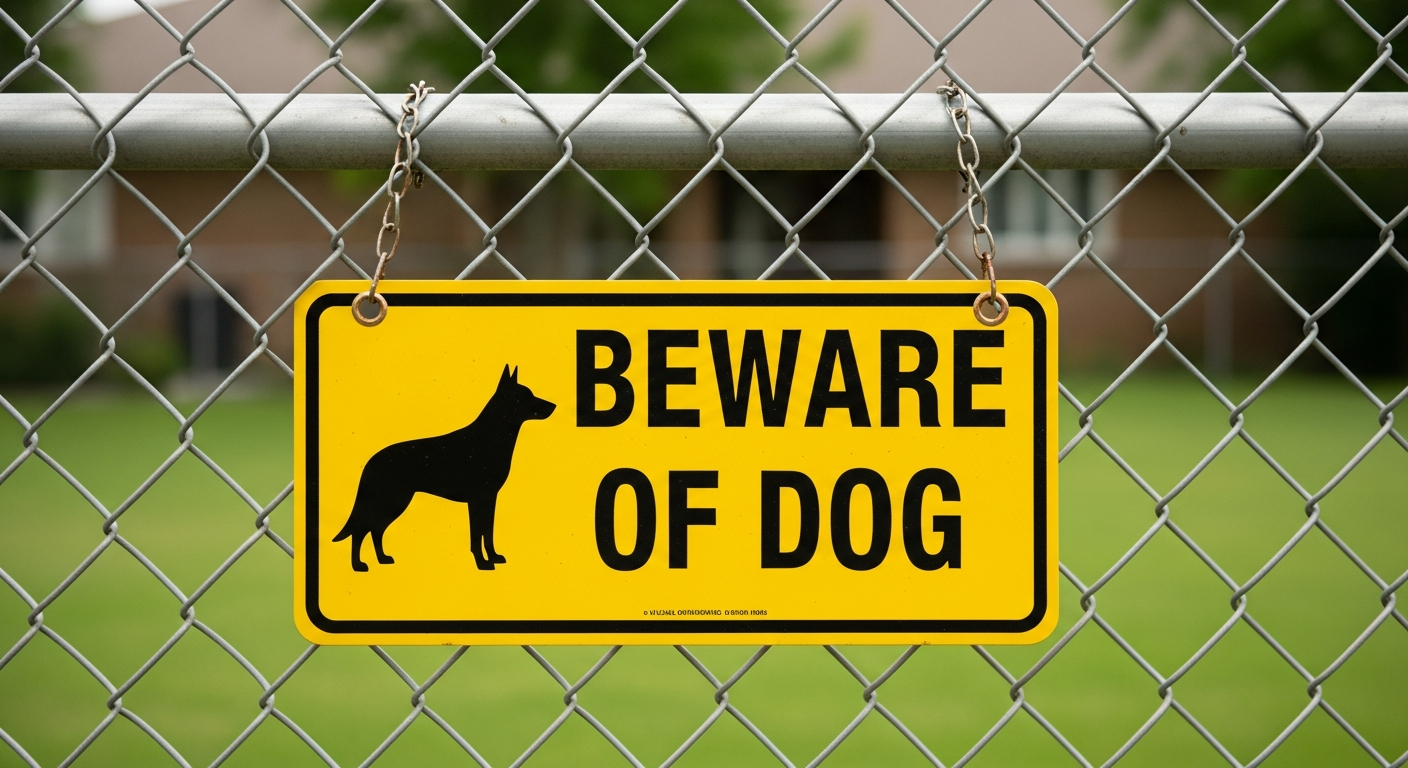
Owners of dogs that have been designated as dangerous or vicious may be required by local ordinances to post clearly visible warning signs on their property. Failure to post these signs can be used as evidence of negligence.
Victim Rights and Compensation
Dog bite victims in Tennessee may recover both economic and noneconomic damages, subject to certain caps and limitations.

Economic Damages (No Cap)
There is no cap on economic damages in Tennessee. Recoverable economic damages include:
- Medical expenses for emergency treatment, surgery, hospitalization, and rehabilitation
- Future medical costs for ongoing treatment, reconstructive surgery, or therapy
- Lost wages from missed work during recovery
- Loss of earning capacity if injuries limit future employment
- Property damage such as destroyed clothing or personal items
Noneconomic Damages (Capped)
Under Tenn. Code Ann. 29-39-102, noneconomic damages are capped at $750,000 for most personal injury cases. For catastrophic injuries, the cap increases to $1,000,000. Catastrophic injuries include:
- Spinal cord injuries resulting in paraplegia or quadriplegia
- Amputation of two or more extremities
- Third-degree burns over 40% or more of the body or face
- Wrongful death of a parent leaving a surviving minor child
Noneconomic damages cover pain and suffering, emotional distress, scarring and disfigurement, and loss of enjoyment of life. The jury does not learn about the cap during trial; the court applies it afterward.
Statute of Limitations: One Year to File
Tennessee has one of the shortest statutes of limitations in the country for personal injury claims. Under Tenn. Code Ann. 28-3-104, you have one (1) year from the date of the dog bite to file a lawsuit.
This deadline applies to all personal injury tort actions in Tennessee. Important considerations include:
- The clock starts running on the date of the bite, not the date you discover the full extent of your injuries.
- Minors may have extended deadlines. The statute of limitations may be tolled (paused) until the minor reaches the age of majority (18).
- Claims against government entities have even shorter notice requirements, sometimes as little as 12 months.
- If the defendant faces criminal charges related to the bite, the deadline may extend to two years.
- Missing the deadline almost always bars your claim permanently. Courts rarely grant exceptions.
Because of this tight deadline, anyone bitten by a dog in Tennessee should consult an attorney promptly.
Modified Comparative Fault: The 50% Bar Rule
Tennessee follows a modified comparative fault system under Tenn. Code Ann. 29-11-103. This rule affects dog bite cases in two ways:
- If the victim is partially at fault (for example, by provoking the dog or ignoring warning signs), the victim's compensation is reduced by their percentage of fault.
- If the victim is 50% or more at fault, the victim is completely barred from recovering any damages.
For example, if a jury awards $100,000 in damages but finds the victim was 30% at fault for teasing the dog, the victim would receive $70,000. If the victim was found 50% or more at fault, the victim would receive nothing.
Criminal Penalties for Dog Owners
Tennessee imposes criminal penalties on dog owners whose animals cause harm while running at large. Under Tenn. Code Ann. 44-8-408, the severity of the charge depends on the outcome.
| Outcome | Classification | Potential Penalty |
|---|---|---|
| Dog runs at large (no harm) | Class C misdemeanor | Fine only |
| Dog damages another's property | Class B misdemeanor | Fine only |
| Dog causes bodily injury | Class A misdemeanor | Fine only |
| Dog causes serious bodily injury | Class E felony | 1 to 6 years imprisonment |
| Dog causes death | Class D felony | 2 to 12 years imprisonment |
In addition to these penalties, a court must order full restitution for all damages arising from the offense when a dog running at large causes bodily injury, serious bodily injury, death, or property damage.
Court-Ordered Destruction of Dangerous Dogs
Under Tenn. Code Ann. 44-17-120, any dog that attacks a human and causes death or serious bodily injury may be destroyed by order of a general sessions court judge. The district attorney general files the petition, and the owner has five days after receiving notice to appear and show cause why the dog should not be destroyed.
Dangerous and Vicious Dog Designations
Tennessee law distinguishes between potentially vicious dogs and vicious dogs.
A dog may be classified as potentially vicious if it has:
- Bitten a person or domestic animal without provocation and off the owner's property, causing bodily injury
- Chased or menaced a person or domestic animal in an aggressive manner on two or more separate occasions
A dog may be classified as vicious if it has:
- Attacked a person without provocation and off the owner's property, causing death or serious bodily injury
Owners of designated dangerous or vicious dogs typically face additional requirements, which may include:
- Maintaining liability insurance of at least $100,000
- Keeping the dog in a secure enclosure at all times
- Using a muzzle and leash whenever the dog is in public
- Posting warning signs on the property
- Having the dog microchipped for identification
Proposed Dangerous Dog Registry (SB1794/HB1902)
As of March 2026, the Tennessee General Assembly is considering SB1794, a bill that would create a statewide public dangerous dog registry. The bill would require owners of designated dangerous dogs to register the dog with local animal control for three years, keep the dog restrained on a leash or in a secure enclosure at all times, and carry at least $100,000 in liability insurance. The companion bill, HB1902, is pending in the Agriculture and Natural Resources Subcommittee. This legislation has not yet been enacted into law.
Landlord Liability for Dog Bites in Tennessee
Tennessee landlords can face liability for a tenant's dog bite under certain circumstances. To hold a landlord liable, the victim must generally prove:
- The landlord knew or had reason to know the tenant's dog was dangerous
- The landlord had the ability to remove the dog or require the tenant to remove it (for example, through lease terms)
- The landlord failed to take reasonable action to address the known danger
A landlord who rents to a tenant despite knowing the tenant keeps a dangerous dog, or who ignores complaints about an aggressive dog in a shared area, may face partial liability for injuries. Landlords can reduce their risk by including pet policies in lease agreements, requiring tenants to carry renter's insurance with liability coverage, and acting promptly on reports of aggressive animals.
Breed-Specific Legislation in Tennessee
Some Tennessee municipalities have enacted breed-specific legislation (BSL) that restricts or bans certain breeds. Breeds commonly affected include pit bulls, pit bull mixes, and Rottweilers.
However, many Tennessee communities have moved away from breed-specific bans in favor of behavior-based dangerous dog laws. The state does not have a statewide BSL. Specific restrictions vary by city and county, so check your local ordinances for rules that apply in your area.
How to File a Dog Bite Claim in Tennessee
If you have been bitten by a dog in Tennessee, take these steps to protect your legal rights:
- Get medical treatment immediately. Keep all records, receipts, and documentation of your injuries and treatment.
- Report the bite to local animal control and law enforcement. Ask for a copy of the incident report.
- Document everything. Photograph your injuries, the location of the attack, and the dog if you can do so safely.
- Collect the owner's information. Get the owner's name, address, phone number, and homeowner's or renter's insurance details.
- Identify witnesses. Get contact information from anyone who saw the attack.
- Preserve physical evidence. Keep torn clothing, bloodstained items, and anything else related to the attack.
- Contact a personal injury attorney promptly. Tennessee's one-year statute of limitations is among the shortest in the country.

More Tennessee Laws
Sources and References
- Tenn. Code Ann. 44-8-413 - Civil liability for injury caused by dogs (Dianna Acklen Act)(law.justia.com)
- Tenn. Code Ann. 44-8-408 - Dogs not allowed at large; penalties(law.justia.com)
- Tenn. Code Ann. 28-3-104 - Personal tort actions; statute of limitations(law.justia.com)
- Tenn. Code Ann. 29-39-102 - Civil damage awards; noneconomic damages cap(law.justia.com)
- Tenn. Code Ann. 44-17-120 - Destruction of dog causing death or serious injury(law.justia.com)
- Tenn. Code Ann. 68-8-103 - Rabies vaccination requirements(law.justia.com)
- Tenn. Code Ann. 29-11-103 - Modified comparative fault(law.justia.com)
- Tennessee SB1794 - Proposed Dangerous Dog Registry (2025-2026 session)(legiscan.com)
- MTAS - Conditions for the Return of a Biting Dog to Owner(mtas.tennessee.edu).gov