
Florida
Florida Dog Bite Laws: Liability and Victim Rights
Independently fact-checked against primary sources (last audited August 23, 2026). · Reviewed by the RecordingLaw editorial team. · Law checked current as of August 23, 2026. · 12 primary sources cited on this page. How we verify our legal content
Florida imposes strict liability on dog owners under Fla. Stat. § 767.04: if a dog bites someone in a public place or on property where the person is lawfully present, the owner is liable for damages regardless of whether the dog had ever bitten before. Florida is not a one-bite state.
Estimate your claim: Use our free Florida Dog Bite Settlement Calculator to see a rough settlement range based on the medical bills, the bite location, the victim's age, and Florida's liability rule.
Florida Dog Bite Liability: Strict Liability Standard
Florida follows a strict liability standard for dog bite injuries. Under Fla. Stat. § 767.04, the owner of any dog that bites a person while that person is in a public place or lawfully on private property is liable for damages. This applies even if the owner had no prior knowledge that the dog was dangerous.
This means Florida is not a "one free bite" state. Dog owners cannot escape liability by arguing they did not know the dog was capable of biting.
To establish a claim under this statute, a bite victim needs to prove three things:
- The defendant owned the dog
- The dog bit the victim
- The victim was in a public place or lawfully on private property at the time of the bite
The victim does not need to prove the owner was negligent, that the dog had bitten before, or that the dog had previously shown aggressive behavior.
Non-Bite Injuries
Florida law also addresses injuries caused by dogs that do not involve bites. Under Fla. Stat. § 767.01, dog owners are liable "for any damage done by the owner's dog to a person or to any animal included in the definitions of 'domestic animal' and 'livestock.'" This section covers injuries to people and to domestic animals or livestock; it does not create liability for property damage. Florida courts have interpreted this provision to impose strict liability on owners for non-bite injuries as well, such as when a dog knocks someone down or causes a person to fall.
The "Bad Dog" Sign Defense
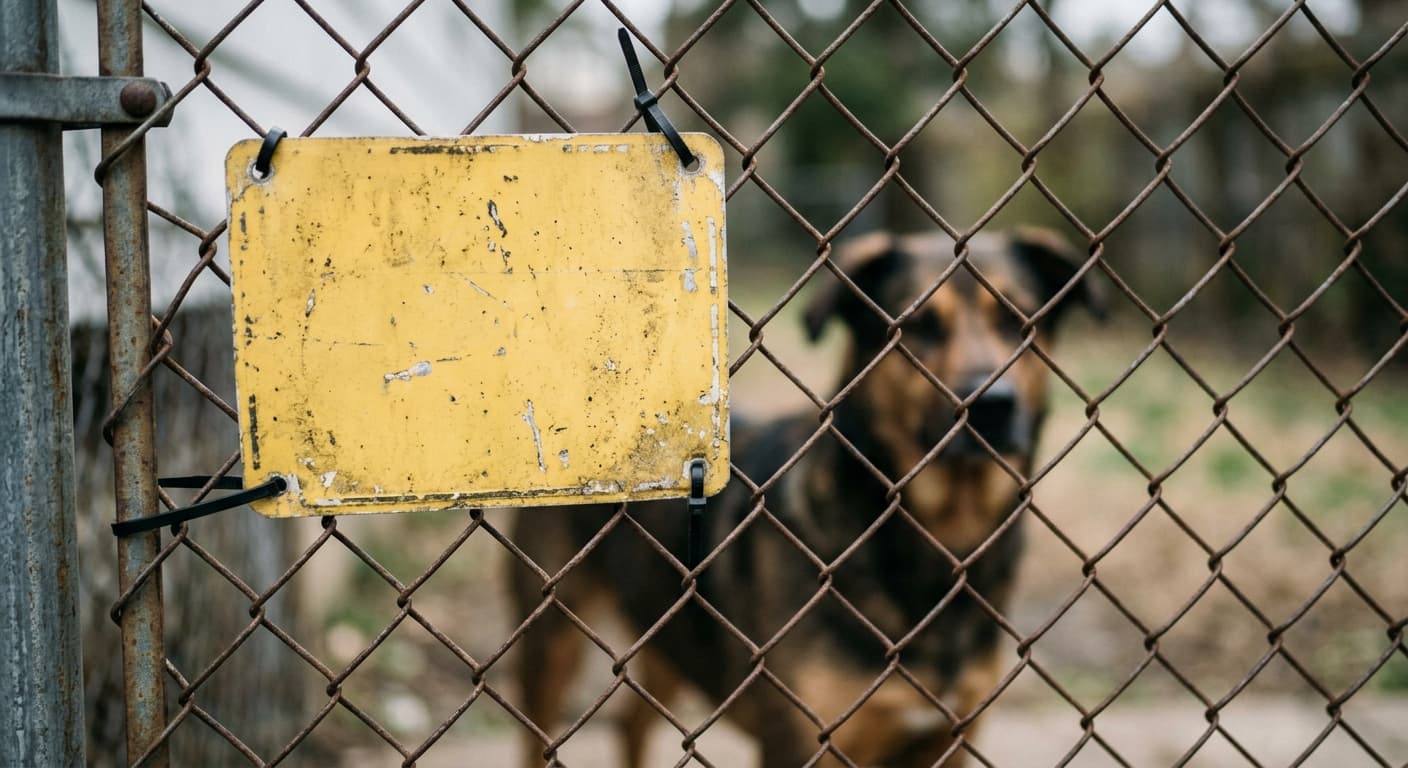
Florida law provides a unique defense for dog owners. Under Fla. Stat. § 767.04, an owner is not liable for a dog bite if, at the time of the injury, the owner had displayed "in a prominent place on his or her premises a sign easily readable including the words 'Bad Dog.'"

However, this defense has two important exceptions:
- It does not apply if the victim is under 6 years old
- It does not apply if the owner's own negligence was a proximate cause of the bite
The sign must be clearly visible and readable. Courts have examined the size, placement, and visibility of "Bad Dog" signs when evaluating this defense.
Comparative Negligence in Dog Bite Cases
Fla. Stat. § 767.04 also includes a comparative negligence provision. If the victim's own negligence contributed to the bite, the court reduces the owner's liability by the percentage of fault attributed to the victim.
The 51% Bar Rule (HB 837)
In March 2023, Florida enacted HB 837, a sweeping tort reform law that changed Florida from a pure comparative negligence state to a modified comparative negligence state. Under this new framework:
| Victim's Fault | Recovery |
|---|---|
| 0% to 50% | Full damages minus the victim's percentage of fault |
| 51% or more | Completely barred from recovery |
This 51% bar applies to dog bite cases. If a court determines the victim was more than 50% responsible for the incident (for example, through severe provocation), the victim recovers nothing.
The only exception is medical negligence claims, which still operate under pure comparative negligence.
Defenses Available to Dog Owners
Even under strict liability, Florida dog owners have several potential defenses:
Provocation
If the victim provoked the dog through teasing, tormenting, hitting, or other aggressive behavior, the owner may not be liable. The provocation must be significant enough to cause a normally calm dog to bite.
Trespassing
Because Fla. Stat. § 767.04 only applies when a victim is in a public place or "lawfully" on private property, trespassers generally cannot use this strict liability statute. However, this defense may not apply to young children who may not understand property boundaries.
Assumption of Risk
If the victim knowingly accepted the risk of being bitten, this may limit or bar recovery. Professionals who work with animals (veterinarians, groomers, kennel workers) may face this defense.
Veterinary or Professional Exception
People whose jobs involve handling dogs may have limited ability to recover under strict liability, since the risk of a bite is inherent to their work.
Statute of Limitations: 2 Years
Under Fla. Stat. § 95.11(5)(a), the statute of limitations for personal injury claims in Florida is 2 years from the date of the bite. This deadline was reduced from 4 years to 2 years by HB 837, effective March 24, 2023.
Important considerations for the filing deadline:
- The clock starts on the date the bite occurs
- Minors may have extended deadlines (the statute of limitations is tolled during minority under Fla. Stat. § 95.051)
- Claims against government entities often have shorter notice periods
- Missing the deadline will normally end the claim, because the owner can raise the limitations period as a complete defense
One caveat worth raising with a lawyer: § 95.11(3)(e) still sets a four-year period for "an action founded on a statutory liability," and a § 767.04 claim is a statutory strict-liability action in which the victim does not have to prove negligence. Whether that four-year period survives for dog bite claims after HB 837 has not been settled by a Florida appellate court, and the common practice is to treat two years as the deadline. Plan around two years, but do not assume an older claim is worthless without asking an attorney first.
With two years to file, have a Florida dog bite lawyer confirm your deadline in a free consultation and start the claim (attorney advertising).
Victim Rights and Compensation
Dog bite victims in Florida may recover several categories of damages:
Economic Damages
- Medical expenses (emergency care, surgery, rehabilitation, reconstructive procedures)
- Future medical costs for ongoing treatment
- Lost wages and loss of earning capacity
- Property damage
Non-Economic Damages
- Pain and suffering
- Emotional distress and psychological trauma
- Scarring and disfigurement
- Loss of enjoyment of life
Florida does not impose a statutory cap on damages in dog bite cases. Victims can typically recover both economic and non-economic damages through a strict liability claim.
Dog Owner Responsibilities Under Florida Law
Dog owners in Florida have several legal obligations:
- Rabies Vaccination: Fla. Stat. § 828.30 requires all dogs four months of age or older to be vaccinated against rabies
- Leash Laws: Many Florida counties and municipalities require dogs to be leashed in public areas (these vary by local ordinance)
- Confinement: Dogs must be securely confined on the owner's property
- Licensing: Most local jurisdictions require dogs to be licensed and registered
- Warning Signs: Owners of classified dangerous dogs must post warning signs and meet additional requirements
Violating these responsibilities can strengthen a victim's case and may result in additional penalties.
Dangerous Dog Designations
Florida law establishes a formal process for classifying dogs as "dangerous" under Fla. Stat. §§ 767.11-767.13.
What Makes a Dog "Dangerous"
Under Fla. Stat. § 767.11, a dog may be classified as dangerous if it has:
- Aggressively bitten, attacked, or endangered a person on public or private property
- Inflicted severe injury on a human being
- More than once severely injured or killed a domestic animal while off the owner's property
- When unprovoked, chased or approached a person on the streets, sidewalks, or any public grounds in a menacing fashion or apparent attitude of attack, where those actions are attested to in a sworn statement by one or more persons and investigated by the appropriate authority
That last category matters: a dog can be classified as dangerous under it without ever having bitten anyone. A neighbor who is repeatedly charged at by a loose dog can start the classification process on a sworn statement alone.
"Severe injury" under the statute means physical injury resulting in broken bones, multiple bites, or disfiguring lacerations requiring sutures or reconstructive surgery.
Requirements for Dangerous Dog Owners
Owners of dogs classified as dangerous must comply with strict requirements under Fla. Stat. § 767.12:
- Obtain liability insurance of at least $100,000
- Implant a microchip in the dog
- Keep the dog in a secure enclosure meeting specific standards
- Use a muzzle and leash when the dog is outside the enclosure
- Post warning signs on the property
- Register the dog as dangerous with animal control
The Pam Rock Act (2025)
In May 2025, Governor DeSantis signed the Pam Rock Act (CS/HB 593, Ch. 2025-61), which took effect July 1, 2025. The Senate companion, SB 572, was laid on the table once the House bill passed, so CS/HB 593 is the enacted vehicle. Named after Pam Rock, a Putnam County mail carrier who was killed by five dogs while delivering mail in August 2022, this law made significant changes:
| Change | Before Pam Rock Act | After Pam Rock Act |
|---|---|---|
| Penalty when a classified dangerous dog causes severe injury or death | Third-degree felony | Second-degree felony |
| Mandatory confiscation during investigation | Only for dogs that caused severe injury | Expanded to include dogs scoring 5+ on the Dunbar Bite Scale |
| Microchip removal | Not specifically addressed | Third-degree felony to intentionally remove a microchip from a dangerous dog |
| Maximum fine for dangerous dog violations | Lower amounts | Increased to $1,000 |
A second-degree felony in Florida carries penalties of up to 15 years in prison and a $10,000 fine.
Criminal Penalties for Dog Owners
In serious cases, dog owners may face criminal charges beyond civil liability:
Misdemeanor Charges
Under Fla. Stat. § 767.13, if a dog previously classified as dangerous attacks or bites a person or domestic animal without provocation, the owner faces a first-degree misdemeanor, punishable by up to 1 year in jail and a $1,000 fine.
Felony Charges
If a classified dangerous dog causes severe injury or death to a person, the owner faces a second-degree felony under the Pam Rock Act (previously a third-degree felony). This carries up to 15 years in prison.
Dogs That Were Never Classified as Dangerous
Most dogs that bite have never been through a classification proceeding, so § 767.13 does not reach them. The section that does is Fla. Stat. § 767.136. If a dog that has not been declared dangerous attacks and causes severe injury or death to a person, and the owner knew of the dog's dangerous propensities yet showed reckless disregard for them, the owner commits a first-degree misdemeanor.
Separately, Fla. Stat. § 767.135 requires that an unclassified dog that attacks and kills a person be immediately confiscated by animal control, impounded, and held for 10 business days after the owner receives written notice, then destroyed. That provision is not a criminal penalty; it is a mandatory disposition of the animal.
Criminal liability may also apply when the owner intentionally used the dog as a weapon.
Breed-Specific Legislation in Florida
Florida law generally prohibits breed-specific legislation (BSL) at the local level. Under Fla. Stat. § 767.14, no local government may adopt any breed-specific ordinance or regulation.
The End of the Miami-Dade Pit Bull Ban
When Florida passed the BSL preemption law in 1990, it included a grandfather clause allowing existing local breed bans to remain in effect. This preserved Miami-Dade County's 1989 pit bull ban, which had prohibited ownership of pit bull-type dogs.
In 2023, the Florida Legislature passed SB 942, which removed the grandfather clause effective October 1, 2023. This change:
- Ended Miami-Dade County's 34-year pit bull ban
- Ended the City of Sunrise's similar breed ban
- Expanded the prohibition to also cover regulations based on a dog's size or weight
- Applied the same rules to public housing policies
As of 2026, no Florida jurisdiction may regulate dogs based on breed, size, or weight. All dog regulations in Florida must be behavior-based.
Landlord Liability for Dog Bites
While Fla. Stat. § 767.04 applies to dog owners, Florida courts have also recognized landlord liability in certain situations. A landlord may be held responsible for a tenant's dog bite when:
- The landlord had actual knowledge that the tenant's dog was dangerous
- The landlord maintained control over the property and could enforce lease provisions
- The landlord failed to take reasonable steps to protect others from the dog
The key court case establishing this principle is White v. Whitworth, where a Florida court found a landlord liable because the landlord had actual knowledge of the dog's dangerous nature and failed to act.
Landlords can reduce their risk by:
- Including pet policies in lease agreements
- Requiring tenants with dogs to carry renter's insurance with liability coverage
- Acting promptly when they learn a tenant's dog may be dangerous
- Documenting all complaints about aggressive animals on the property
How to File a Dog Bite Claim in Florida
If a dog bites you in Florida, these steps can protect your legal rights:
- Seek medical attention immediately. Get treatment and keep all medical records and bills.
- Report the incident. File a report with local animal control and police. This creates an official record.
- Document the scene. Take photos of injuries, the location, the dog (if safe to do so), and any torn clothing.
- Gather information. Get the owner's name, contact details, and homeowner's or renter's insurance information.
- Identify witnesses. Collect contact information from anyone who saw the attack.
- Preserve evidence. Keep torn clothing, bloody bandages, and other physical evidence.
- Contact an attorney within the 2-year deadline. Because HB 837 shortened the statute of limitations, acting quickly is essential.
More Florida Laws
Frequently Asked Questions
Is Florida a strict liability state for dog bites?
Yes. Under Fla. Stat. § 767.04, dog owners are strictly liable for bite injuries regardless of whether they knew the dog was dangerous. The victim only needs to prove the defendant owned the dog, the dog bit them, and they were lawfully present at the location.
How long do I have to file a dog bite lawsuit in Florida?
You have 2 years from the date of the bite under Fla. Stat. § 95.11(5)(a). This deadline was reduced from 4 years to 2 years by HB 837, effective March 24, 2023, and missing it will normally end the claim because the owner can raise the limitations period as a complete defense. One unsettled point is worth asking a lawyer about: § 95.11(3)(e) still allows four years for an action founded on a statutory liability, and a § 767.04 claim is a statutory strict-liability action, but no Florida appellate court has resolved which period governs. Plan around two years.
Can a 'Bad Dog' sign protect a dog owner from liability in Florida?
Potentially, yes. Under Fla. Stat. § 767.04, an owner who displays a prominent, readable sign with the words 'Bad Dog' on their premises may avoid strict liability. However, this defense does not apply if the victim is under 6 years old or if the owner's negligence contributed to the bite.
What happens if I was partially at fault for the dog bite?
Florida applies modified comparative negligence. If you were 50% or less at fault, your compensation is reduced by your percentage of fault. If you were 51% or more at fault (for example, by severely provoking the dog), you are completely barred from recovering any damages under HB 837.
What is the Pam Rock Act and how does it affect dangerous dog owners?
The Pam Rock Act (CS/HB 593, Ch. 2025-61), signed into law in May 2025 and effective July 1, 2025, increased penalties for owners of dogs classified as dangerous. If a classified dangerous dog causes severe injury or death, the owner now faces a second-degree felony (up to 15 years in prison) instead of a third-degree felony. The law also makes removing a microchip from a dangerous dog a third-degree felony.
Updates
Added the third dangerous-dog prong under Fla. Stat. 767.11(3)(c), which allows a classification without a bite, cited Fla. Stat. 767.136 and 767.135 for dogs never declared dangerous, corrected the Pam Rock Act to its enacted vehicle CS/HB 593 (Ch. 2025-61) rather than the tabled SB 572, corrected the rabies rule to four months of age or older, and noted the unresolved four-year statutory-liability argument alongside the two-year filing deadline.
Independently fact-checked against the cited primary sources; governing law re-checked for recent changes
Corrected a fabricated quotation of Fla. Stat. 767.01 (the statute covers damage to people and domestic animals/livestock, not property) and re-pinned the 2-year dog bite statute of limitations from 95.11(3)(a) (paternity) to the correct 95.11(5)(a) (negligence) in three places.
Governing law re-checked for recent changes
Reviewed and approved by an editor
The Law Behind This Article
This article rests on the statutory provisions below, held in our own legal record and retrieved from the official source. Tap a section to read the operative text.
Florida Statutes
§ 767.04Dog owner’s liability for damages to persons bitten.In forcecited in 2 of our articles
The owner of any dog that bites any person while such person is on or in a public place, or lawfully on or in a private place, including the property of the owner of the dog, is liable for damages suffered by persons bitten, regardless of the former viciousness of the dog or the owners’ knowledge of such viciousness. However, any negligence on the part of the person bitten that is a proximate cause of the biting incident reduces the liability of the owner of the dog by the percentage that the bitten person’s negligence contributed to the biting incident. A person is lawfully upon private property of such owner within the meaning of this act when the person is on such property in the performance of any duty imposed upon him or her by the laws of this state or by the laws or postal regulations of the United States, or when the person is on such property upon invitation, expressed or implied, of the owner.
Official text (excerpt) · last checked 2026-08-28 · Read the full text in our law library · Verify at leg.state.fl.us
Cited in 40 court opinions in our collectionLatest citing opinion in our collection: 2022
In the courts (editorial summary, independently checked):Belcher Yacht, Inc. v. Stickney (1984) held section 767.04 reaches only the dog owner, not a non-owner keeper, and Carroll v. Moxley (1970) held the Bad Dog sign defense turns on whether the sign was prominent and easily readable. Huie v. Wipperfurth (1994) noted the 1993 amendment made the remedy cumulative with common law.
Opinions citing this section in our collection:
- Carroll v. Moxley (Supreme Court of Florida 1970, 241 So. 2d 681)✓A woman was bitten by a dog in her mother's store, which had a warning sign; the court held section 767.04 supersedes the common law only in the situations it covers, and that whether a Bad Dog sign is prominent and readable is a fact question, so summary judgment was error.
- Belcher Yacht, Inc. v. Stickney (Supreme Court of Florida 1984, 450 So. 2d 1111)✓A boat owner was bitten by a marina's guard dog behind a posted Beware of Dog sign; the court held section 767.04 is the exclusive remedy against the dog's owner, barring the common law claim, but that the statute reaches only owners, so the guard could still be sued.
- Donner v. Arkwright-Boston Manufacturers Mutual Insurance (Supreme Court of Florida 1978, 358 So. 2d 21)✓A guest petted a nervous Doberman and was bitten on the lip, and the jury got an assumption-of-risk charge; the Supreme Court held a dog owner sued under section 767.04 has only the defenses the statute itself sets out, then provocation or a posted Bad Dog sign.
Identified automatically from the court opinions citing this section — not a ranking of which case controls.
Also relied on in: Dog Bite Laws by State: Liability and Victim Rights
§ 767.01Dog owner’s liability for damages to persons, domestic animals, or livestock.In force
(1) A dog owner is liable for any damage done by the owner’s dog to a person or to any animal included in the definitions of “domestic animal” and “livestock” as provided by s. 585.01. (2) If a dog owner has knowledge of the dog’s dangerous propensities, the owner must securely confine the dog in a proper enclosure as defined in s. 767.11.
Official text (excerpt) · last checked 2026-07-28 · Read the full text in our law library · Verify at leg.state.fl.us
Cited in 22 court opinions in our collectionLatest citing opinion in our collection: 2008
Opinions citing this section in our collection:
- Brandeis v. Felcher (District Court of Appeal of Florida 1968, 211 So. 2d 606)“…question to be determined on this appeal is whether, under Fla. Stat. § 767.01 , F.S.A., liability might be imposed up…”
- Mapoles v. Mapoles (District Court of Appeal of Florida 1977, 350 So. 2d 1137)“…Mapoles was entered by the trial court upon the theory that Section 767.01, Florida Statutes, imposed strict liability upon the dog…”
- Smith v. Allison (District Court of Appeal of Florida 1976, 332 So. 2d 631)“…intiff relies for affirmance on several cases interpreting Fla. Stat. § 767.01 , the "Damage [Done] by Dogs" statute,…”
Identified automatically from the court opinions citing this section — not a ranking of which case controls.
§ 767.11Definitions.In force
As used in this part, unless the context clearly requires otherwise:(1) “Animal control authority” means an entity acting alone or in concert with other local governmental units and authorized by them to enforce the animal control laws of the city, county, or state. In those areas not served by an animal control authority, the sheriff shall carry out the duties of the animal control authority under this part. (2) “Animal control officer” means any individual employed, contracted with, or appointed by the animal control authority for the purpose of aiding in the enforcement of this part or any other law or ordinance relating to the licensure of animals, control of animals, or seizure and impoundment of animals and includes any state or local law enforcement officer or other employee whose duties in whole or in part include assignments that involve the seizure and impoundment of an animal.
Official text (excerpt) · last checked 2026-07-28 · Read the full text in our law library · Verify at leg.state.fl.us
Cited in 1 court opinions in our collectionLatest citing opinion in our collection: 2008
Opinions citing this section in our collection:
- Trammell v. Thomason (District Court, M.D. Florida 2008, 559 F. Supp. 2d 1281)“…rous *1290 dogs” as that term in defined in Fla. Stat. § 767.11 (1) and not to address police work dogs…”
Identified automatically from the court opinions citing this section — not a ranking of which case controls.
§ 767.12Classification of dogs as dangerous; owner requirements; penalty.In force
(1) An animal control authority shall investigate reported incidents involving any dog that may be dangerous and, if possible, shall interview the owner and require a sworn affidavit from any person, including any animal control officer or enforcement officer, desiring to have a dog classified as dangerous.(a) An animal that is the subject of a dangerous dog investigation and that has killed a human being or has bitten a human being and left a bite mark that scores 5 or higher on the Dunbar bite scale must be immediately confiscated by an animal control authority; placed in quarantine, if necessary, for the proper length of time; impounded; and held. The animal must be held pending the outcome of the investigation and any hearings or appeals related to the dangerous dog classification or any penalty imposed under this section. If the dog is to be destroyed, the dog may not be destroyed while an appeal is pending. The owner is responsible for payment of all boarding costs and other fees as may be required to humanely and safely keep the animal pending any hearing or appeal.
Official text (excerpt) · last checked 2026-07-28 · Read the full text in our law library · Verify at leg.state.fl.us
Cited in 3 court opinions in our collectionLatest citing opinion in our collection: 2007
Opinions citing this section in our collection:
- County of Pasco v. Riehl (Supreme Court of Florida 1994, 19 Fla. L. Weekly Supp. 183)“…Justice, concurring. I concur, but hasten to note that section 767.12, Florida Statutes (1991), was amended in 1993 and the pre…”
- Marion County v. Grunnah (District Court of Appeal of Florida 2007, 962 So. 2d 931)“…determination that her dogs are "dangerous," as defined by section 767.12, Florida Statutes (2006). The threshold question we must…”
Identified automatically from the court opinions citing this section — not a ranking of which case controls.
§ 767.13Attack or bite by dangerous dog; penalties; confiscation; destruction.In force
(1) If a dog that has previously been declared dangerous attacks or bites a person or a domestic animal without provocation, the owner commits a misdemeanor of the first degree, punishable as provided in s. 775.082 or s. 775.083. The dangerous dog must be immediately confiscated by an animal control authority; placed in quarantine, if necessary, for the proper length of time; impounded; and held for 10 business days after the owner is given written notification under s. 767.12, and thereafter destroyed in an expeditious and humane manner. The owner may request a hearing under s. 767.12 during the 10 business days after such notification. The owner is responsible for payment of all boarding costs and other fees as may be required to humanely and safely keep the animal during any appeal procedure. (2) If a dog that has previously been declared dangerous attacks and causes severe injury to or death of any human, the owner commits a felony of the second degree, punishable as provided in s. 775.082, s. 775.083, or s. 775.084.
Official text (excerpt) · last checked 2026-07-28 · Read the full text in our law library · Verify at leg.state.fl.us
Cited in 2 court opinions in our collectionLatest citing opinion in our collection: 2010
Opinions citing this section in our collection:
- State v. Nowlin (District Court of Appeal of Florida 2010, 50 So. 3d 79)“…viously bitten a small child, she could not be liable under section 767.13, Florida Statutes, for the acts of her dangerous dog sinc…”
- City of Ocala v. Green (District Court of Appeal of Florida 2008, 988 So. 2d 114)“…convicted criminally for violating Florida's dog bite law, section 767.13, Florida Statutes (2007). The city now seeks review of th…”
Identified automatically from the court opinions citing this section — not a ranking of which case controls.
§ 767.14Additional local restrictions authorized.In force
This act does not limit any local government or public housing authority from adopting an ordinance or a policy, respectively, to address the safety and welfare concerns caused by attacks on persons or domestic animals; placing further restrictions or additional requirements on owners of dogs that have bitten or attacked persons or domestic animals; or developing procedures and criteria for the implementation of this act, provided that no such regulation is specific to breed, weight, or size and that the provisions of this act are not lessened by such additional regulations or requirements.
Official text (excerpt) · last checked 2026-07-28 · Read the full text in our law library · Verify at leg.state.fl.us
Cited in 1 court opinions in our collectionLatest citing opinion in our collection: 2011
Opinions citing this section in our collection:
- Hoesch v. Broward County (District Court of Appeal of Florida 2011, 53 So. 3d 1177)“…ttempts to avoid this suggestion of conflict by pointing to section 767.14, Florida Statutes (2010). Bro-ward argues that no conflic…”
Identified automatically from the court opinions citing this section — not a ranking of which case controls.
§ 95.11Limitations other than for the recovery of real property.In forcecited in 16 of our articles
Actions other than for recovery of real property shall be commenced as follows:(1) WITHIN TWENTY YEARS.—An action on a judgment or decree of a court of record in this state. (2) WITHIN FIVE YEARS.—(a) An action on a judgment or decree of any court, not of record, of this state or any court of the United States, any other state or territory in the United States, or a foreign country. (b) A legal or equitable action on a contract, obligation, or liability founded on a written instrument, except for an action to enforce a claim against a payment bond, which shall be governed by the applicable provisions of paragraph (6)(e), s. 255.05(10), s. 337.18(1), or s. 713.23(1)(e), and except for an action for a deficiency judgment governed by paragraph (6)(g). (c) An action to foreclose a mortgage. (d) An action alleging a willful violation of s. 448.110. (e) Notwithstanding paragraph (b), an action for breach of a property insurance contract, with the period running from the date of loss. (3) WITHIN FOUR YEARS.—(a) An action relating to the determination of paternity, with the time running from the date the child reaches the age of majority.
Official text (excerpt) · last checked 2026-09-08 · Read the full text in our law library · Verify at leg.state.fl.us
Cited in 698 court opinions in our collectionLatest citing opinion in our collection: 2026
In the courts (editorial summary, independently checked):Merkle v. Robinson (1999) held that the significant relationship test governs conflict of law questions about section 95.11, so a claim time-barred in Florida may proceed under another state's period. Foley v. Morris (1976) applied a shortened 95.11 period to a pre-existing claim where the plaintiff still had the full new period.
Opinions citing this section in our collection:
- Merkle v. Robinson (Supreme Court of Florida 1999, 737 So. 2d 540)✓A West Virginia patient sued a doctor's estate in Florida, where he had retired; her claim was untimely under Florida law but not West Virginia's. The court held the significant relationship test governs conflicts involving section 95.11, so West Virginia's period applied.
- Foley v. Morris (District Court of Appeal of Florida 1976, 325 So. 2d 37)✓A surgeon left a rubber drain in a patient in 1971; suit came in 1974, after Florida replaced the four-year period with the two-year medical malpractice period in section 95.11(6). The court applied the new period from its effective date and affirmed dismissal.
- State ex rel. Gerstein v. Hialeah Race Course, Inc. (Supreme Court of Florida 1971, 245 So. 2d 53)✓A state attorney sued racetrack operators over political contributions. Holding the campaign statute's four-year period unconstitutional as applied, the court ruled the general one-year limit in section 95.11(7)(a) governed, so the late complaint was properly dismissed.
Identified automatically from the court opinions citing this section — not a ranking of which case controls.
Also relied on in: Florida Hit and Run Laws: Penalties and What to Do, Florida Car Accident Laws: No-Fault, PIP, and Your Claim, Florida Defamation Laws: Libel, Slander & Suing (2026)
§ 95.051When limitations tolled.In forcecited in 2 of our articles
(1) The running of the time under any statute of limitations except ss. 95.281, 95.35, and 95.36 is tolled by:(a) Absence from the state of the person to be sued. (b) Use by the person to be sued of a false name that is unknown to the person entitled to sue so that process cannot be served on the person to be sued. (c) Concealment in the state of the person to be sued so that process cannot be served on him or her. (d) The adjudicated incapacity, before the cause of action accrued, of the person entitled to sue. In any event, the action must be begun within 7 years after the act, event, or occurrence giving rise to the cause of action. (e) Voluntary payments by the alleged father of the child in paternity actions during the time of the payments. (f) The payment of any part of the principal or interest of any obligation or liability founded on a written instrument. (g) The pendency of any arbitral proceeding pertaining to a dispute that is the subject of the action. (h) The period of an intervening bankruptcy tolls the expiration period of a tax certificate under s. 197.482 and any proceeding or process under chapter 197.
Official text (excerpt) · last checked 2026-07-28 · Read the full text in our law library · Verify at leg.state.fl.us
Cited in 75 court opinions in our collectionLatest citing opinion in our collection: 2026
Opinions citing this section in our collection:
- Major League Baseball v. Morsani (Supreme Court of Florida 2001, 26 Fla. L. Weekly Supp. 465)“…the district court certified the following question: Does section 95.051, Florida Statutes (1993), prohibit the application of the…”
- Landers v. Milton (Supreme Court of Florida 1979, 370 So. 2d 368)“…of proving the inapplicability of the tolling provisions of section 95.051, Florida Statutes (1977). They argue that once it appears…”
- Totura & Co., Inc. v. Williams (Supreme Court of Florida 2000, 754 So. 2d 671)“…nter does not suggest that any of the tolling provisions in section 95.051, Florida Statutes (1991), pertain to this case and we fin…”
Identified automatically from the court opinions citing this section — not a ranking of which case controls.
Also relied on in: Florida Statute of Limitations: Filing Deadlines by Case Type
§ 828.30Rabies vaccination of dogs, cats, and ferrets.In force
(1)(a) All dogs, cats, and ferrets 4 months of age or older must be vaccinated by a licensed veterinarian or a person authorized under paragraph (b) against rabies with a vaccine that is licensed by the United States Department of Agriculture for use in those species. (b) Acting under the indirect supervision of a veterinarian, an employee, an agent, or a contractor of a county or municipal animal control authority or sheriff may vaccinate against rabies dogs, cats, and ferrets that are in the custody of an animal control authority or a sheriff and which will be transferred, rescued, fostered, adopted, or reclaimed by the owner. The supervising veterinarian assumes responsibility for any person vaccinating animals at his or her direction or under his or her direct or indirect supervision. As used in this paragraph, the term “indirect supervision” means that the supervising veterinarian is required to be available for consultation through telecommunications but is not required to be physically present during such consultation. (c) The owner of every dog, cat, and ferret shall have the animal revaccinated 12 months after the initial vaccination.
Official text (excerpt) · last checked 2026-07-28 · Read the full text in our law library · Verify at leg.state.fl.us
Cited in 1 court opinions in our collectionLatest citing opinion in our collection: 2015
Opinions citing this section in our collection:
- Alboniga v. School Board of Broward County Florida (District Court, S.D. Florida 2015, 87 F. Supp. 3d 1319)“…d to the regulation of animals permitted in schools, see Fla. Stat. § 828.30 , Fla. Admin. Code 6A-2.0040. ■ By Au…”
Identified automatically from the court opinions citing this section — not a ranking of which case controls.
§ 767.135Attack or bite by unclassified dog that causes death; confiscation; destruction.In force
If a dog that has not been declared dangerous attacks and causes the death of a human, the dog must be immediately confiscated by an animal control authority; placed in quarantine, if necessary, for the proper length of time; impounded; and held for 10 business days after the owner is given written notification under s. 767.12, and thereafter destroyed in an expeditious and humane manner. The owner may request a hearing under s. 767.12 during the 10 business days after such notification. If the owner files a written appeal under s. 767.12 or this section, the dog must be held and may not be destroyed while the appeal is pending. The owner is responsible for payment of all boarding costs and other fees as may be required to humanely and safely keep the animal during any appeal procedure.
Official text (excerpt) · last checked 2026-07-28 · Read the full text in our law library · Verify at leg.state.fl.us
§ 767.136Attack or bite by unclassified dog that causes severe injury or death; penalties.In force
(1) If a dog that has not been declared dangerous attacks and causes severe injury to, or the death of, a human, and the owner of the dog had knowledge of the dog’s dangerous propensities, yet demonstrated a reckless disregard for such propensities under the circumstances, the owner of the dog commits a misdemeanor of the first degree, punishable as provided in s. 775.082 or s. 775.083. (2) If the dog attacks or bites a person who is engaged in or attempting to engage in a criminal activity at the time of the attack, the owner of the dog is not guilty of any crime under this section.
Official text (excerpt) · last checked 2026-07-28 · Read the full text in our law library · Verify at leg.state.fl.us
Search our full record of US law — 2.1 million sections, every state + federal →
Sources and References
- Fla. Stat. § 767.04 - Dog owner liability for damages to persons bitten(leg.state.fl.us).gov
- Fla. Stat. § 767.01 - Damage by dogs; owner liability(leg.state.fl.us).gov
- Fla. Stat. § 767.11 - Definitions (Dangerous Dogs)(leg.state.fl.us).gov
- Fla. Stat. § 767.12 - Classification of dogs as dangerous(leg.state.fl.us).gov
- Fla. Stat. § 767.13 - Attack or bite by dangerous dog; penalties(leg.state.fl.us).gov
- Fla. Stat. § 767.14 - Local regulation of dogs preempted(leg.state.fl.us).gov
- Fla. Stat. § 95.11 - Statute of limitations for personal injury(leg.state.fl.us).gov
- HB 837 (2023) - Florida Tort Reform Act(flsenate.gov).gov
- SB 572 / Pam Rock Act (2025) - Dangerous Dogs(flsenate.gov).gov
- SB 942 (2023) - Breed-specific legislation repeal(flsenate.gov).gov
- Fla. Stat. § 828.30 - Rabies vaccination requirement(leg.state.fl.us).gov
- Fla. Stat. Chapter 767 - Damage by Dogs; Dangerous Dogs (full chapter)(leg.state.fl.us).gov
- Fla. Stat. § 767.136 - Attack or bite by unclassified dog that causes severe injury or death; penalties(leg.state.fl.us)
- Fla. Stat. § 767.135 - Attack or bite by unclassified dog that causes death; confiscation; destruction(leg.state.fl.us)
- CS/HB 593 (2025), Ch. 2025-61 - Pam Rock Act (Dangerous Dogs), approved by the Governor May 2025(flsenate.gov)
Paid attorney referral. RecordingLaw may receive compensation when you use an attorney-help link. RecordingLaw is not a law firm. Submitting a request does not guarantee that an attorney will accept your case and does not create an attorney-client relationship.